Home » Archive by category 'Uncategorized' (Page 11)

Movie review: ‘Quartet’ provides senior singers (and actors) a curtain call

January 24th, 2013 Posted in Uncategorized Tags: , ,

By

Catholic News Service

Dustin Hoffman steps behind the camera for his directorial debut with “Quartet,” a comedy-drama about musical artists who face the ultimate curtain call: a date with the Grim Reaper.

Based on the play by Ronald Harwood (who also wrote the screenplay), “Quartet” casts senior citizens in the same warm and fuzzy glow as last year’s “The Best Exotic Marigold Hotel.” Amid the gags and catfights, however, lie serious reflections on the challenges of aging and a reminder to embrace the talents of our still-vital elderly.

Billy Connolly, Maggie Smith, Tom Courtenay and Pauline Collins star in a scene from the movie “Quartet.” The Catholic News Service classification is A-III — adults.

Beecham House in the picturesque English countryside is a home for retired singers and musicians. As such, it’s a haven for eccentrics and outsize egos, ringing true Bette Davis’ famous observation, “Old age is not for sissies.”

Impresario Cedric Livingston (Michael Gambon) corrals the residents to put on a fundraiser every year on composer Giuseppe Verdi’s birthday. His dream is to reunite four legendary opera singers who once performed the “Quartet” from Verdi’s “Rigoletto.”

“It would be as if Maria Callas made her comeback,” he predicts.

The ensemble is made up of newly arrived, acid-tongued diva Jean Horton (Maggie Smith), her gentle ex-husband Reginald Paget (Tom Courtenay), dotty Cecily Robson (Pauline Collins), who’s in the early stages of dementia, and randy rogue Wilfred Bond (Billy Connolly). Wilf, as he’s known, is forever flirting with the young staff.

All of the singers are keen for the reunion, except Jean, who fears stepping into the spotlight again. “My gift deserted me,” she tells Reginald.

“It deserted us all,” he says. “It’s called life.”

Jean has an ulterior motive: to reconcile with Reginald, whom she abandoned for an affair with a rival tenor. She regrets the indiscretion, but Reginald is still bitter.

“I wanted a dignified senility,” he muses. “Fat chance now that she’s here.”

Still, the show must go on, and nothing tempts an aging performer more than the smell of greasepaint and the glare of the footlights.

The salty language in “Quartet’ and the script’s rather juvenile obsession with sex (it’s ripe with British euphemisms like “rumpy-pumpy”) distract somewhat from the fun of watching the veteran actors perform as well as from the pleasures afforded by the glorious soundtrack.

The film contains sexual innuendo and some profane and rough language. The Catholic News Service classification is A-III — adults. The Motion Picture Association of America rating is PG-13 — parents strongly cautioned. Some material may be inappropriate for children under 13.


Comments Off

Novena by email and text part of ‘Nine Days of Prayer, Penance and Pilgrimage’

By

WASHINGTON — The U.S. Catholic bishops have launched “Nine Days of Prayer, Penance and Pilgrimage” to take place Jan. 19-27 as part of events marking the 40th anniversary of the Roe v. Wade decision legalizing abortion virtually on demand in the U.S.

Jan. 22 is the actual anniversary of the U.S. Supreme Court’s 1973 decision, but because this year it is the day after public ceremonies for the presidential inauguration, the annual March for Life in Washington will take place Jan. 25.

Materials about the “Nine Days” program posted on the website of the U.S. Conference of Catholic Bishops suggests prayers, activities and other ways U.S. Catholics can mark the Roe anniversary, whether they planned to come to Washington or to attend local or regional pro-life rallies, events and liturgies.

A signature event of the program is a novena, which participants can receive via a daily email by signing up at www.usccb.org/9days or by texting “9days” to 99000 to receive a daily text message.

Described as youth-friendly, the daily message will include: an intercession; simple prayers; a brief reflection on the saint of the day or a lesson from the daily readings; suggestions for concrete acts of prayer, penance and charity; and “a powerful myth/reality comment related to abortion.”

According to the USCCB, the “Nine Days” program is part of a pastoral strategy the U.S. bishops approved during their fall general assembly in Baltimore to address life, marriage and religious liberty concerns.

Components include monthly eucharistic holy hours in cathedrals and parishes, daily family rosary, special Prayers of the Faithful at all Masses, and fasting and abstinence on Fridays.

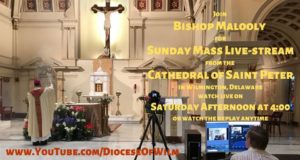
The first such monthly Eucharistic holy hour in the Diocese of Wilmington will be Sunday, Jan. 27, 4 p.m., at Immaculate Heart of Mary Church in Wilmington. Bishop Malooly will preside.

A second “Fortnight for Freedom” event is planned for 2013 to raise concern about infringements to religious freedom.


Comments Off

Pro-life activist sees ‘despair’ in abortion mindset

January 17th, 2013 Posted in Uncategorized Tags: ,

By

Catholic News Service

ARLINGTON, Va. — Pro-life activist Lila Rose was a just child when she first became aware of the tragedy of abortion.

Growing up in San Jose, Calif., the third of eight children, “we were taught from a young age to love and respect human life,” she told more than 150 pro-life advocates gathered at St. Charles Borromeo Church in Arlington for a mini-retreat.

Pro-life activist Lila Rose, 24, is pictured in a 2009 photo in Los Angeles. She got an early start in the pro-life movement and at age 15 founded Live Action, a pro-life nonprofit specializing in investigative journalism. (CNS photo/Lucy Nicholson, Reuters)

Rose, a 24-year-old Catholic convert, officially became involved with the right-to-life movement at 15 when she founded Live Action, a pro-life nonprofit specializing in investigative journalism.

But at age 9, Rose, a prolific reader, stumbled upon a book on abortion.

She went to her mom and asked, “Is this real?”

Hearing the affirmative answer, Rose, stunned and uncomprehending, began reading everything she could find on the topic.

“I began to see and realize that even though I was safe, there were other children (who) were not safe,” she said in her talk Jan. 12. “As I learned more of these things, my heart began to seek out an answer to the question: ‘What can I do? … Isn’t there something to be done?’”

Rose prayed to the Lord for him to use her in whatever way he knew was best.

“It’s very dangerous to ever ask God to use you … because he will,” she said. “Give him an inch and he’ll take a mile. He’s a gentleman, so he’ll wait for you to pray and for you to offer yourself. But then he wants all of you.”

When Rose was a student at the University of California-Los Angeles, she began visiting Planned Parenthood clinics, posing as an underage, pregnant teen. In her first foray as an investigative journalist, Rose went into a California abortion clinic posing as a 15-year-old pregnant girl who had gotten impregnated by a 23-year-old male — what Rose called “a clear case of statutory rape in California.”

Instead of reporting it to the authorities, she said, the Planned Parenthood employee told Rose to lie about her age on the paperwork.

Later that day, Rose went to a second clinic in downtown Los Angeles where the manager told her that she knew what Rose was going through, that she had gotten pregnant at 17 and had the baby, a son who was then 16 years old. But, the manager said, if she could do it again, she would have had an abortion.

Whether the woman’s story was true, Rose said she didn’t know, but it gave “a peek into the culture of death and the hopelessness and the despair in that mindset.”

After graduating from college, Rose made the trip east to Arlington, where she continues to work for Live Action. Part of her ministry is giving talks, such as the one at St. Charles.

To combat the culture of death, Rose told the pro-lifers gathered in the church’s sanctuary to remember how much God loves each person and for them to remember always to trust in that love.

She encouraged receiving the sacraments frequently, especially the holy Eucharist, and praying in front of abortion clinics. And she recommended speaking the truth about abortion gently, lovingly and plainly.

“Every vocation is a call to build a culture of life, because at the heart of that call is loving Jesus and being part of his saving of souls — ours souls and the souls around us,” Rose said. “It’s so exciting and marvelous that we are invited every single day, if we just say ‘yes’ to be part of God’s salvific plan for the whole world.”

Crowe is senior staff writer at the Arlington Catholic Herald, newspaper of the Diocese of Arlington, Va.


Comments Off

Vatican official: Armstrong’s misdeeds reflect ‘rotten’ cycling world

By

Catholic News Service

VATICAN CITY — U.S. cyclist Lance Armstrong’s admission to doping is just the tip of the iceberg, since high-stakes commercial interests pressure almost every professional cyclist into the illegal practice, said a Vatican official.

“It’s a world that is rotten, all of cycling, even soccer,” said Msgr. Melchor Sanchez de Toca Alameda, head of the Pontifical Council for Culture’s “Culture and Sport” section.

U.S. cyclist Lance Armstrong’s admission to doping is just the tip of the iceberg, since high-stakes commercial interests pressure almost every professional cyclist into the illegal practice, said a Vatican official. Armstrong is pictured in a 2010 file photo in South Africa. (CNS photo/Mike Hutchings, Reuters)

Pro-sports “have become a commodity that are subordinate to the free market and, therefore, to profit,” he told Catholic News Service Jan. 16.

Instead of sports being an activity that builds important values, respects human dignity and helps shape the whole human person, “it has reduced people to merchandise,” he said.

The monsignor’s comments came the same week Armstrong appeared on U.S. television to admit that he had used performance-enhancing drugs throughout his career.

Armstrong, who won the famed “Tour de France” for a record-breaking seven consecutive times, was stripped of his titles in 2012 after he was accused of using and distributing performance-enhancing drugs. He was also banned from professional cycling for life.

Though he had denied doping, Armstrong never officially appealed the United States Anti-Doping Agency’s sanctions.

Msgr. Sanchez said that some pro-athletes who have confessed to doping also revealed the enormous pressure they felt to give ever-improved performances; some said they felt it was physically impossible to fulfill such high expectations without the illicit boosts.

The practice is especially rampant in cycling, he said, adding, “it’s very sad.”

Pope Benedict XVI recently condemned doping in sports and called on athletes, coaches and team owners to strive for victory through ethical and legal practices.

“Pressure to achieve important results must never drive (people) to take shortcuts as happens in the case of doping,” the pope said during an audience with Italian Olympic and Paralympic athletes in December 2012.

What’s at stake in the world of sports is not just a respect for the rules, but upholding the dignity of and serving the whole person, he said.

Team spirit must be channeled not only to prevent athletes from taking “these dead ends” of illegal performance-enhancement drugs or practices, the pope said, but also to “support those who recognized they’ve made a mistake, so that they can feel accepted and helped” afterward.


Comments Off

Who forgot the Dutch? Pope completes ‘ad limina’ visits with world’s bishops — almost

January 10th, 2013 Posted in Uncategorized

By

Catholic News Service

VATICAN CITY — The Vatican announced that after more than seven years in office, Pope Benedict XVI had hosted the formal visits of bishops from every country in the world and would begin the cycle all over again by meeting the heads of Italy’s 227 dioceses in 2013.

The only problem is the Vatican overlooked the bishops of the Netherlands who made their last visits “ad limina apostolorum” (“to the threshold of the apostles”) with Blessed John Paul II in 2004.

Cardinal Adrianus Simonis of Utrecht, Netherlands, blesses tulips, which were shipped to the Vatican several years ago. (CNS)

Archbishop Lorenzo Baldisseri, secretary of the Congregation for Bishops, which coordinates the visits, said his office was informed by the Prefecture of the Papal Household, which schedules audiences with the pope, that when the last group of French bishops met Pope Benedict in November “the cycle was complete.”

“But now it seems that with the Netherlands, something happened,” the archbishop said Jan. 8.

A spokesman for the Dutch bishops said Jan. 8 that the heads of the seven dioceses of the Netherlands expect to make their visits either late this year or early in 2014.

Also missing from the list of Pope Benedict “ad limina” visits are the bishops of communist-controlled mainland China, but that is because government restrictions prevent them from making the visits. However, the bishops of Hong Kong and Macau had their meetings with Pope Benedict in 2008.

The Code of Canon Law calls for the heads of every diocese in the world to make their “ad limina” visits every five years, but there are now almost 2,900 dioceses in the world and the 85-year-old pope also has other obligations as well.

Archbishop Baldisseri told CNS, “the firm principle is that the pope must meet the bishops of the whole world regularly.” The five-year rhythm set by canon law provides concrete guidance but is not always possible to follow because of the number of bishops in the world, the pope’s schedule and the schedules of the bishops.

The order in which bishops’ conferences make the visits is not strictly set, which means that although the French bishops were making their first “ad limina” visits with Pope Benedict late in 2012, the bishops of Papua New Guinea already had made two: one in June 2005 and the second in June 2012.

Archbishop Baldisseri told L’Osservatore Romano, the Vatican newspaper, that the importance of visiting and consulting with the pope, the successor of St. Peter, goes back to St. Paul’s description in the Letter to the Galatians of returning to Jerusalem for consultations with St. Peter.

However, the archbishop said, it wasn’t until 743 that Pope Zachary made it a universal rule. The rule was reconfirmed by Pope Sixtus V in 1585.

“The bishops are invited periodically to come to Rome to see Peter, make a pilgrimage to the tombs of the apostles Peter and Paul — founders of the church of Rome — and to express and reinforce the unity and collegiality of the church,” he said.

The visits are not just “a simple juridical-administrative exercise,” he said, but “an experience of pastoral communion, participating in the concerns and hopes” of the church on the local and universal levels.

The relationship between the bishops and the pope, he said, “cannot simply be sporadic or spontaneous, but must be regular and ordered because we are dealing with the life of the church in its universal and particular dimensions.”

The Italian bishops made their first and only “ad limina” visits with Pope Benedict from November 2006 to April 2007, which means their second visits are coming six or seven years later. Bishops from Mexico, Austria, Poland and other countries that had “ad limina” visits in 2005, the first year of Pope Benedict’s pontificate, will have to wait until 2014 or beyond.

The special Year of Faith calendars of Pope Benedict and of local bishops, together with the size of the Italian bishops’ conference, “will not permit the visits of other episcopal conferences” this year, Archbishop Baldisseri said.


Comments Off

Cinema in the Year of Faith: What makes a movie Catholic?

January 10th, 2013 Posted in Uncategorized

By

Catholic News Service

In “Porta Fidei” (“The Door of Faith”), an apostolic letter announcing the current Year of Faith, Pope Benedict XVI urges us to study the history of Catholicism, which he describes as “marked by the unfathomable mystery of the interweaving of holiness and sin.”

This striking observation also can apply to the medium of film. All too often in movies, however, sin dominates and holiness is difficult to recognize.

Catholic News Service praised the portrayal of Catholicism in the Academy Award nominated movie “Les Miserables.” (CNS)

In the spirit of the new evangelization, the Year of Faith, which runs through Nov. 24, is an appropriate time to ask what constitutes a faithful and, more specifically, a Catholic movie. If the definitions are too narrow, few films will make the grade; if too broad, the designations themselves will become meaningless.

Movies seeking to embody the tenets of a particular religious tradition, explain one of its sacred texts, or profile a key prophet are the easiest to classify in this way. Admiring portraits of clerics, converts, laypeople or other believing protagonists are also strong candidates, as are films that use storytelling techniques, such as allegory, to impart an article of faith.

Turning to Catholic films, there are many reasons a picture might be deemed Catholic. But the dynamic between those who create a work, the work itself, and the audience beholding it is a useful shortcut. A movie may qualify as Catholic if the filmmaker has a Catholic sensibility, if the subject matter — plot, personae or setting — involves Catholicism, and/or if a viewer offers a plausible Catholic interpretation.

Adducing meaning in a film by reference to the filmmaker’s intentions and outlook is problematic because cinema is such a collaborative medium. Still, provided they are manifested on screen, a filmmaker’s aims and sensibility are a rich source of interpretive material.

The pantheon of Catholic directors (lapsed and devout) includes Robert Bresson, Luis Bunuel, Frank Capra, Francis Ford Coppola, Federico Fellini, Alfred Hitchcock, Pier Paolo Pasolini, Martin Scorsese and Andrei Tarkovsky.

Of course not every one of their films is Catholic, and not every film with a Catholic theme, plot, setting or protagonist qualifies either. A minimum amount of respect for the Catholic subject matter must be evinced, even if strong doubts are expressed and considerable ambiguity permitted.

The range of examples stretches from Carl Theodor Dreyer’s silent masterwork “The Passion of Joan of Arc” (1928) and popular entertainments from Hollywood’s Golden Age — Bible epics and certain Bing Crosby vehicles, for instance — to more recent fare. The latter includes the biopic “Romero” (1989), “The Chronicles of Narnia” series (2005-2010), the documentary “Into Great Silence” (2007) and the fact-based French film “Of Gods and Men’ (2011).

Today, the musical “Les Miserables, ” a film Catholic News Service said presents a “positive portrayal of the Catholic faith, was nominated for a best picture Academy Award.

When assessing subject matter, movies blatantly hostile to religion, patently heretical or obviously anti-Catholic are readily disqualified. Those that merely pay lip service to religious faith or peddle watered-down beliefs are nearly as easy to dismiss.

While better than many alternatives, what passes for religiosity in most mainstream movies is too shallow and generic to leave a deep impression. Humanism, non-specific ethical concerns and advocacy of a vaguely spiritual, less materialistic approach to life are not enough.

Several recently released films illustrate this point. As a boy, the title character in “Life of Pi” embarks on a personal quest to find God, picking and choosing from a number of different faiths, including Catholicism. Yet, as his atheist father remarks, “Believing in everything is like believing in nothing.”

Many elements in the time-traveling fantasia “Cloud Atlas” can be considered pro-faith. But its overarching theme concerning individuals linked throughout history is insufficiently detailed and cogent.

In “The Sessions”– a drama in which a Catholic priest encourages a paraplegic member of his flock to have relations with a so-called sex surrogate — a young woman, asked if she’s religious, replies, “I don’t think about God much but I do believe there’s a mysterious logic or poetry to life.” This line succinctly expresses the type of soft, unthinking religiosity typically encountered at the multiplex.

Two other current releases underscore another important point. Steven Spielberg’s “Lincoln” and Quentin Tarantino’s “Django Unchained” address the immorality of slavery in very different ways. Both want to entertain and enlighten audiences about historical realities. Yet, along with its revenge narrative, the extremely graphic violence, plethora of obscene language, and exploitative tenor of Tarantino’s latest undercuts any salubrious message.

Although completely separating form and content is impossible, when attempting to fathom an artwork we tend to focus on the “how” more than the “what.” Style and tone convey as much, and sometimes more, than action and dialogue.

At this juncture the viewer’s act of interpretation becomes decisive. A movie can be deemed authentically Catholic through description and evaluation presented from a Catholic perspective.

Offering a convincing Catholic interpretation that accurately reflects form and content, and possibly the sensibility and intentions of a movie’s creators, requires a certain manner of discernment. The interpreter must train a Catholic imagination on the film and be committed to reading it through that prism.

That said, each movie must be considered on its own merits without bias or preconceptions. Valid judgments can only be made after engaging with a film on its own terms. This must be followed by reflection and analysis in which sound critical method, clear values and personal experiences are brought to bear.

A movie is authentically Catholic when its Catholic traits are fully integrated into its form and content. Such integrity is similar to that perceived in a person whose beliefs and behavior always appear to be in concert, someone we can justly say “lives their faith.”

This critical process is analogous to the task Pope Benedict calls us to undertake regarding the history of the church during the Year of Faith. The question is not whether holiness and sin are intertwined in our faith, in ourselves and in what we create. We are challenged to discern how they are woven together — and to begin unspooling the mystery of why.


John P. McCarthy is a guest reviewer for Catholic News Service.


Comments Off

‘Zero Dark Thirty’ an unsettling depiction of killing bin Laden

January 10th, 2013 Posted in Uncategorized

By

Catholic News Service

“Zero Dark Thirty,” an Oscar-nominee for best picture, offers moviegoers a challenging account, based on real events, of the decade-long hunt for terrorist leader Osama bin Laden.

This gritty glimpse into the underworld of acknowledged detention centers and concealed prisons, known as “black sites,” raises ethical quandaries and presents content that will prove unsettling even for many adults.

U.S. Navy SEALs are portrayed in a scene from the movie “Zero Dark Thirty.” The Catholic News Service classification is L — limited adult audience, films whose problematic content many adults would find troubling.

The action centers on a relentlessly determined CIA officer named Maya (Jessica Chastain). Urged on by her superiors, one of whom demands that she “bring me people to kill,” Maya painstakingly gathers intelligence hints concerning bin Laden’s whereabouts and those of his confederates.

Eventually she weaves these slender strands of evidence together sufficiently to track America’s public enemy number one to his fortified compound in Abbottabad, Pakistan. There, as enacted in the film’s climax, Navy SEALs killed him in May 2011.

Some of Maya’s leads are obtained by her colleague Dan (Jason Clarke), who employs both physical and psychological torture to break down the prisoners he interrogates. His techniques include water-boarding, a process that simulates the effects of drowning, close confinement and various forms of humiliation.

While director Kathryn Bigelow and screenwriter Mark Boal have crafted a compelling drama, their movie’s moral stance is ambiguous. The harsh reality of so-called “enhanced interrogation,” as practiced by Dan, is graphically portrayed. Yet the results of subjecting prisoners to it are shown to be effective.

Viewers will need a strong grounding in their faith to discern the proper balance between the imperative of upholding human dignity and the equally grave obligation to save innocent human lives. They will also need to guard against the temptation to revel in the death of an evildoer.

As God asks the prophet Ezekiel, “Do I find pleasure in the death of the wicked — oracle of the Lord God? Do I not rejoice when they turn from their evil way and live?” (Ez. 18:23)

In keeping with the tough-guy tone of the spying and soldiering worlds in which “Zero Dark Thirty” is set, moreover, the dialogue involves a steady assault with F-bombs and other vulgarities.

The film contains considerable violence, including scenes of torture and degradation, brief rear nudity, at least one use of profanity as well as frequent rough and crude language. The Catholic News Service classification is L — limited adult audience, films whose problematic content many adults would find troubling. The Motion Picture Association of America rating is R — restricted.


Comments Off

Commentary — Pope Benedict’s peace message confronts greed, inequality and violence

By

In his Jan. 1, 2013 World Day of Peace Message titled “Blessed are the Peacemakers,” Pope Benedict XVI immediately lays out for us the foundation upon which the church’s ministry for world peace must be built.

Using a challenging proclamation from the Second Vatican Council, the pope teaches that Christians must be committed “to sharing humanity’s joys and hopes, grief and anguish.”

Pope Benedict’s peace message confronts greed, inequality and violence.

The Holy Father is reminding us that God’s peace is much more than the absence of war – it is the universal experience of justice and love.

We not permitted to sit on the comfortable sidelines of life, safely viewing from afar humanity’s problems. Rather, we must put ourselves into the muck and mire of this world.

The pope writes, “Peace is an order enlivened and integrated by love, in such a way that we feel the needs of others as our own, share our goods with others and work throughout the world for greater communion in spiritual values.”

Pope Benedict’s message wastes no time in confronting the personal and structural evils of greed, inequality and violence.

From the very first page he writes, “It is alarming to see hotbeds of tension and conflict caused by growing instances of inequality between rich and poor, by the prevalence of a selfish and individualistic mindset which also finds expression in an unregulated financial capitalism.”

In his PBS documentary “Park Avenue: Money, Power and the American Dream,” Alex Gibney states that while income disparity has always existed in the U.S., it has accelerated sharply over the last 40 years. As of 2010, the 400 richest Americans controlled more wealth than the bottom 50 percent of the U.S. population.

Just think about it, 400 people control more wealth than 150 million Americans combined.

Pope Benedict laments that the predominant economic model of recent decades calls for seeking maximum profit and consumption, based on an individualistic and self-centered mentality, while considering human beings as mere tools in economic competitiveness.

Unbridled capitalism cannot be trusted to work for the common good of humanity. It must legislatively be forced to do so. But instead, the political and economic system has been rigged to outrageously favor the wealthy over the middle-class and poor.

And for those struggling to survive in extreme poverty throughout the world, 1.4 billion human beings, the inequality between them and the rich is tragically unjust.

In the face of “unregulated financial capitalism” the pope is calling us to build “a new economic model” for the sake of the common good – providing full, dignified employment, food security for every person, and peaceful coexistence with all creation.

The Holy Father maintains that the path to “peace is above all that of respect for human life in all its many aspects … True peacemakers, then, are those who love, defend and promote human life in all its dimensions … Anyone who loves peace cannot tolerate attacks and crimes against life.”

It’s morally wrong and intellectually dishonest to claim one’s self a peacemaker while permitting abortion – brutal warfare against the unborn.

Following the example of Jesus, peacemakers cannot accept any form of violence. Instead, in the words of Pope Benedict, we must be committed to the truth that “Evil is in fact overcome by good.”

“Blessed are the peacemakers, for they will be called children of God” (Matt. 5:9).


   Tony Magliano, a syndicated social justice and peace columnist, is a parishioner on the Diocese of Wilmington.


Comments Off

Visiting bishops note strain of war, refugees, tensions on Mideast countries

By

Catholic News Service

JERUSALEM — Bishops who traveled to the Holy Land to assess the local church’s needs noted the “profound anxiety” that the “dark and dramatic events” of the past year have caused in the region.

The civil war in Syria has resulted in an increasingly large number of refugees pouring into other countries, putting an enormous strain on national and government resources, they said. The situation within Israel and Palestine has also become increasingly polarized, they added.

Bishop Gerald F. Kicanas of Tucson, Ariz., shares a light moment with Bethlehem University students during a Jan. 9 visit to the West Bank campus. Bishop Kicanas said young Christian Palestinians from the Gaza Strip and West Bank demonstrated “a great deal of hope and vision,” despite the reality they face. (CNS photo/Debbie Hill)

“We shall work hard to persuade our respective governments to recognize the root causes of suffering in this land and to step up their efforts for a just peace,” they said in the Jan. 10 statement.

Each year bishops from the U.S., Canada and Europe travel to the Mideast for the Holy Land Coordination, designed to show support for the churches there. This year’s focus was on the “suffering and vulnerable people in the Holy Land.”

A Jerusalem news conference in which the bishops’ statement was to have been presented to journalists was canceled due to a rare winter snow storm, which left the bishops stuck in Bethlehem, West Bank, to enjoy the unusual sight of the city covered in snow.

In their statement, the bishops encouraged people to take steps toward practical support for the most vulnerable in the Holy Land, including African refugees who are victims of trafficking, migrant workers and Christian prisoners.

They also urged support for the formation of young people in the Palestinian territories and for every effort promoting peace.

“We encourage Christians to come on pilgrimage to the Holy Land, where they will experience the same warm hospitality we received,” they said.

The bishops said their faith was enriched by “the strength and fortitude” of the people whom they met during their visit, including parishioners in a “vibrant celebration of Mass” in Zarqa, Jordan; those who care for the vulnerable such as the refugees from Syria who are “fleeing terror and violence;” and those “struggling in the face of oppression and insecurity across the countries that make up the Holy Land.”

The bishops also said their visit inspired them to promote a “just peace.”

“We call upon Christian communities in our home countries and people of good will everywhere to support the work undertaken in this region to build a better future,” they said, highlighting the work of Catholic Relief Services in Gaza and the Caritas refugee program in Jordan, whose programs delegation members visited during their Jan. 5-10 stay.

They said they also felt called to recognize and tell others how faith in God “brings light into the lives of people in the Holy Land,” which is expressed practically in the church’s commitment to education at Bethlehem University and the American University of Madaba, Jordan.

Bishops signing the statement included Bishop Gerald F. Kicanas of Tucson, Ariz.; Archbishop Richard Smith of Edmonton, Alberta, president of the Canadian Conference of Catholic Bishops; Bishop Declan Lang of Bristol, chairman of the English and Welsh bishops’ Department of International Affairs; Auxiliary Bishop William Kenney of Birmingham, England; Bishop Michel Dubost of Evry, France; Bishop Stephan Ackermann of Trier, Germany; Bishop Peter Burcher of Reykjavik, Iceland, representing the Nordic bishops’ conference; and Archbishop Joan Vives Silicia of Urgell, Spain.


Comments Off

Bishop Malooly announces monthly holy hours in diocese for life, marriage and religious liberty

By

Dialog Editor

Bishop Malooly has announced the diocese will conduct monthly Eucharistic Holy Hours beginning Jan. 27 through November as part of the U.S. bishops’ Call to Prayer movement during the Year of Faith.

The bishops initiated Call to Prayer at their November meeting in Baltimore to help build a culture in the United States that’s favorable to life, marriage and increased protections for religious liberty.

Call to Prayer is part of a national movement for life, marriage and religious liberty, which are foundational to Catholic social teaching and the good of society, said Archbishop Salvatore Cordileone, chairman of the U.S. bishops’ Subcommittee for Promotion and Defense of Marriage.

Bishop Malooly said the holy hours in the Diocese of Wilmington will be conducted in a different church each month. The first, which will be led by the bishop, is scheduled for Jan. 27, 4 p.m. at Immaculate Heart of Mary Church in Wilmington.

Additional dates and locations will be announced in coming weeks.

The Call to Prayer has been “prompted by the rapid social movements and policy changes currently underway, such as the mandate by the U.S. Department of Health and Human Services that coerces employers, including heads of religious agencies, to pay for sterilizations, abortion-inducing drugs and contraceptives, as well as increased efforts to redefine marriage,” the U.S. bishops said in a December news release.

Three bishops who are U.S. Conference of Catholic Bishops’ leaders in pro-life, pro-marriage and religious liberty efforts announced the Call to Prayer movement last month:

• Cardinal Sean O’Malley of Boston, chairman of the Committee on Pro-Life Activities;

• Archbishop Salvatore J. Cordileone of San Francisco, chairman of the Subcommittee for the Promotion and Defense of Marriage; and

• Archbishop William E. Lori of Baltimore, chairman of the Ad Hoc Committee for Religious Liberty.

For the good of society

The aim of Call to Prayer is to encourage Catholics to prayer and sacrifice; “it’s meant to be simple,” said Archbishop Cordileone. It’s part of a movement for “life, marriage, and religious liberty, which engages the New Evangelization and can be incorporated into the Year of Faith. Life, marriage, and religious liberty are not only foundational to Catholic social teaching but also fundamental to the good of society.”

Pope Benedict has called the Year of Faith, which began last Oct. 11 on the 50th anniversary of the opening of the Second Vatican Council and ends next November, “a year to acquire a more conscious and vigorous adherence to the Gospel, especially at a time of profound change such as humanity is currently experiencing.”

The Call to Prayer in the United States during the Year of Faith addresses the recent changes in American attitudes on life issues, traditional marriage and religious liberty that have arisen as a result of such issues as the HHS mandate for contraception and initiatives on same-sex marriage.

Five components

The Call to Prayer has five components, according to the U.S. bishops’ plan. They include:

• Establishing monthly holy hours for life, marriage and religious liberty.

• Encouraging Catholics to pray a daily rosary for the preservation of life, marriage and religious liberty in the nation.

The rosary, long a favorite devotion of pro-life activists, is an appropriate prayer for life, family and religious liberty because it invokes Mary, the mother of evangelization, to lead all to Christ. It’s also a prayer that strengthens family life and its Hail Marys recall Mary’s acceptance of God’s will in becoming the mother of God.

• Including specific intentions in Sunday and daily Prayers of the Faithful for respect for all human life from conception to natural death, the strengthening of marriage and family life, and the preservation of religious liberty at all levels of government, both at home and abroad.

• Encouraging abstinence from meat and fasting on Fridays for the intention of the protection of life, marriage, and religious liberty, thereby recognizing the importance of spiritual and bodily sacrifice in the life of the church.

Cardinal Timothy M. Dolan of New York, president of the U.S. bishops’ conference, said during the bishops’ November meeting that the task of evangelizing American culture should begin with bishops first recognizing their sins and experiencing “the grace of repentance.” The cardinal also called all Catholics to re-embrace Friday as a day of penance and consider abstaining from meat as a prayerful sacrifice.

• Observing a second Fortnight for Freedom at the end of June and beginning of July. The fortnight would emphasize faith and marriage in a particular way in the face of the potential Supreme Court rulings during this time. The Fortnight would also emphasize the need for conscience protection in light of the Aug.1 deadline for religious organizations to comply with the HHS mandate, as well as religious freedom concerns in other areas, such as immigration, adoption, and humanitarian services.

Stamina and courage

“With the challenges this country is facing, it is hoped that this call to prayer and penance will help build awareness among the faithful as well as spiritual stamina and courage for effective witness. We also hope that it will encourage solidarity with all people who are standing for the precious gifts of life, marriage, and religious liberty,” Archbishop Cordileone said.

Comments Off
Marquee Powered By Know How Media.