
Home » Posts tagged 'religious liberty'

Marchers at the beach hear of threats to religious liberty

By

For The Dialog


LEWES — About 40 people from St. Jude Parish strolled through downtown Lewes May 18 in the fifth Walk for Life at the Beach, practicing their right to freedom of religion that a pre-walk speaker warned is under attack.

A banner and a statue of Mary preceded marchers on the 2-mile walk through the Lewes business district and a nearby residential area before returning to Lewes Beach, where it had begun, “to let people know where we stand,” said Mandy Olewiler. She is a member of the pro-life committee at St. Jude, which organized the walk; she, her husband and their four children participated. Read more »

Comments Off

At first Year of Faith holy hour, Bishop Malooly focuses on life issues

By

Dialog Editor

Some Catholics are confusing the importance of life issues within the church’s social values agenda, Bishop Malooly said during a Jan. 27  Eucharistic holy hour at Immaculate Heart of Mary Church in Wilmington.

“In the hierarchy of social values, none is higher or of greater importance than the right to life,” the bishop said. “Nowhere in our teaching does the church sanction the killing of an unborn baby in order to further social justice. Many in our society sadly seem to think that is the case.”

The holy hour, attended by nearly 200 people, was the first in a monthly series that will be held throughout the diocese as part of the U.S. bishops’ Call to Prayer movement during the Year of Faith.

The holy hours, with exposition of the Blessed Sacrament, Scripture readings, a homily, contemplation and Benediction, will focus on prayers to build a culture favorable to life, marriage and religious liberty.

Bishop Malooly told the congregation at IHM that in addition to the holy hours, he is encouraging Catholics during the Year of Faith to pray the rosary daily, and to abstain from meat and also fast on Fridays throughout the year. The diocese will also celebrate a second Fortnight for Freedom, two weeks leading to the Fourth of July that will focus on the American right of religious liberty.

The Call to Prayer events and practices are a reminder, the bishop said, that “dependence on the Lord through prayer and our presence before the Blessed Sacrament is extremely important.”

Speaking two days after the national March for Life in Washington, D.C., the bishop said, “God gives life and can take it back home when he is ready. It is not our right to interfere with that.” However, “the moral compass in our country continues to move away from respect for all life.”

The bishop said that when he blessed young pilgrims prior to the March for Life during a Mass at St. John the Beloved Parish, he told them he had turned 69 on Jan. 18. “But when I thought of that reality, I realized that actually it was 69 ¾ because my life began when I was conceived by my mom and dad, not when I was delivered. Science has long proven that life begins at conception. It is no longer disputed in serious circles.”

In praying before the Blessed Sacrament to do better in promoting respect for life, the bishop reminded the congregation that the church “teaches us to do this with compassion, to explain to others that there are alternatives.”

The bishop praised the work of Catholic Charities’ Bayard House “that helps young women who are pregnant to prepare themselves for the birth of their child and the support and upbringing of that child. They have a real choice,” he said.

“What the church is about is never simply a matter of imposition of our church laws. Protecting life is God’s universal law.”

The bishop urged the congregation to “pray for the precious unborn,” pray for young women and families facing the “menace of abortion” and to pray for those who have had abortions.

“So often, they, too, are victims, in their own way, of a society that sanctions this crime and offers no clear alternatives.”

Prayers for a change of heart on life issues can include challenges to neighbors, family members and co-workers “who do not understand the sanctity of life,” the bishop said. “This can be a gentle form of charity.”

Noting he will join 40 Days for Life demonstrators praying at Planned Parenthood in Wilmington on Ash Wednesday, Feb. 13, the bishop said, “Our prayer and our presence there can have a tremendous impact.”

The bishop also thanked the Knights of Columbus for their support providing ultrasound machines for pregnancy centers as one of the greatest gifts for pro-life efforts, “a wake-up call for many women who take advantage of those sonograms. There can be no question what they see is life.”

Bishop Malooly quoted Cardinal Daniel DiNardo of Galveston-Houston on three qualities of pro-life witness — joy, charity and dependence on Christ.

“We kneel here today before our Blessed Sacrament and acknowledge our dependence on Christ,” the bishop said. “Let him provide the joy and charity that will help us continue to change hearts and minds, to lead men and women to life and to ultimately change this horrible culture of death that we have experienced for the past 40 years once again into a culture of life.”

Thomas J. Smoot, a St. Helena’s parishioner, said he attended the holy hour to “pray with my church for this godless country.” He called prayers for life, marriage and religious freedom “much needed in a nation where prayer is greatly discouraged.


Comments Off

2012: Religious liberty, front and center, likely to remain a big issue

By

Catholic News Service

Defending religious liberty was a top priority this year for the U.S. Catholic bishops, who repeatedly spoke out against threats to its existence.

Much as they did the year before, the bishops in 2012 spoke out consistently against the U.S. Department of Health and Human Services’ mandate requiring most religious employers to provide free coverage of artificial contraception, sterilization and abortion-causing drugs in their insurance plans, even if they are morally opposed to such coverage.

Bishop William E. Lori of Bridgeport, Conn., chairman of the bishops’ Ad Hoc Committee for Religious Liberty, the Rev. Matthew Harrison, Ben Mitchell, Rabbi Meir Soloveichik and Craig Mitchell are sworn in before testifying at a hearing on Capitol Hill in Washington Feb. 16. The hearing of the House Oversight and Government Reform Committee was on religious liberty, prompted by debate over a federal mandate on contraceptive coverage.(CNS photo/Bob Roller)

The mandate, put in place in August 2011, has a narrow exemption for employers who object to providing these services on religious grounds, namely if they serve or hire people primarily of their own faith. It does not include a conscience clause for employers who object to providing such coverage.

The HHS issue took center stage early this year when the Obama administration announced Feb. 10 that it would leave the definition of an exempt religious entity but would shift the costs of contraceptives from the policyholders to the insurers. But the Catholic bishops and other religious leaders rejected the change, saying it failed to ensure that Catholic individuals and institutions would not have to pay for services that they consider immoral, because many dioceses and other Catholic entities are self-insured.

At a congressional hearing, now-Archbishop William E. Lori, who head the Baltimore Archdiocese and is chairman of the bishops’ Ad Hoc Committee for Religious Liberty, said the ongoing debate over the mandate demonstrated a need for enacting conscience protection into federal law.

The bishops have repeatedly said the mandate is a restriction on religious liberty because the requirement violates church teaching.

They echoed this concern throughout the year and urged lay Catholics to similarly speak out against infringements to religious freedom. Catholics around the country responded by participating in Masses, devotions, holy hours, educational presentations and rallies during the June 21 to July 4 campaign of the U.S. Conference of Catholic Bishops called a “Fortnight for Freedom.”

In April, the U.S. bishops’ Ad Hoc Committee on Religious Freedom issued a 12-page statement on threats to religious liberty which highlighted the HHS mandate but also included other examples such as: immigration laws that “forbid what the government deems ‘harboring’ of undocumented immigrants;” and government actions in Boston, San Francisco, the District of Columbia and the state of Illinois that have “driven local Catholic Charities out of the business of providing adoption or foster care services” because the agencies would not place children with same-sex or unmarried heterosexual couples.

Prior to the fortnight events, Archbishop Lori said the USCCB planned to closely monitor the lawsuits filed May 21 by 43 Catholic dioceses, schools, hospitals, social service agencies and other institutions challenging the HHS mandate.

“Even if we win the HHS lawsuits, the larger cultural issue of preserving religious liberty and the place of religion in our culture is something we’re going to have to engage in for many years to come,” he added.

He echoed this sentiment Nov. 12 in a report during the fall general assembly of the USCCB.

“Whatever setbacks or challenges in the efforts to defend religious liberty we may be experiencing, we’re going to stay the course,” he said.

At their annual meeting in Baltimore, the bishops approved a pastoral strategy specifically aimed at addressing critical life, marriage and religious liberty concerns. The campaign, set to begin after Christmas, includes monthly eucharistic holy hours in cathedrals and parishes, daily family rosary, special Prayers of the Faithful at all Masses, fasting and abstinence on Fridays, and the second observance of a Fortnight for Freedom.

Throughout the year, theologians and Catholic leaders discussed the importance of religious freedom and the issue also was addressed by Vatican officials.

In a Nov. 4 speech at the University of Notre Dame, the apostolic nuncio to the United States said threats to religious liberty in the United States may not be as obvious as the religious persecution in other countries, but he stressed that the “not so obvious” threat often “appears inconsequential or seems benign but in fact is not.”

Archbishop Carlo Maria Vigano specifically mentioned the contraceptive mandate as a threat to religious liberty but added that it was just one example of attacks on “authentic and legitimate exercise of religious freedom” in the United States.

The archbishop said religious liberty has been threatened when Catholic Charities agencies are “being removed from vital social services that advance the common good because the upright people administering these programs would not adopt policies or engage in procedures that violate fundamental moral principles of the Catholic faith.”

Cardinal Angelo Scola of Milan, Italy, a prominent theologian, said in a Dec. 6 prayer service at the Vatican that most modern democracies have ended up hurting religious freedom in their effort to be “neutral” toward their citizens’ diverse beliefs.

He said the “classic problem of the moral assessment of laws has increasingly turned into a problem of religious liberty,” which he said was explicitly evident in the USCCB’s battle against the HHS contraception mandate.

In governments’ attempt to protect everyone’s religious freedom by being “neutral” or “indifferent” to religion, a well-intentioned secularity “has ended up becoming a model that is ill-disposed toward the religious dimension,” he said.

Thomas Farr, director of the Religious Freedom Project of Georgetown University’s Berkley Center for Religion, Peace and World Affairs, told Catholic News Service in a Dec. 13 email that the heightened focus on religious liberty by the U.S. bishops and the Vatican is “having an impact, especially on American Catholics,” whom he described as becoming more aware of “an emergent danger to religious communities in the United States.”

He noted that with the federal contraceptive mandate the government is “taking a position that is highly unusual in American history” by using its authority to “require religious individuals and communities to abandon their most sacred beliefs.”

“Unless the administration’s position changes,” he said, “Catholic hospitals, colleges, charities and private businesses will either have to support — through their health care plans — the provision of contraceptive, abortifacient and sterilization services, secularize, or get out of business. That coercive policy would not only suppress the rights of individuals and communities in a way that is highly un-American, but would undermine another pillar of our democracy — civil society.”


Comments Off

Work to defend religious liberty will not end, archbishop says — updated

By

Catholic News Service

BALTIMORE — The work of defending religious liberty will continue more robustly and without end in the face of growing challenges, said the chairman of the U.S. bishops’ Ad Hoc Committee for Religious Liberty.

Archbishop William E. Lori of Baltimore, told his fellow bishops during the fall general assembly of the U.S. Conference of Catholic Bishops that “whatever setbacks or challenges in the efforts to defend religious liberty we may be experiencing, we’re going to stay the course.”

He made the comments in a report on the ad hoc committee’s recent activities Nov. 12.

Read more »

Comments Off

Threats to religious liberty in US are of ‘grave concern,’ nuncio says

By

Catholic News Service

In a Nov. 4 speech at the University of Notre Dame, the apostolic nuncio to the United States warned that the “menace to religious liberty is concrete on many fronts” today particularly “within your own homeland.”

Archbishop Carlo Maria Vigano, speaking in South Bend, Ind., at a university-sponsored conference on religious freedom, said threats to religious liberty in the United States may not be as obvious as the religious persecution in other countries, but he stressed that the “not so obvious” threat often “appears inconsequential or seems benign but in fact is not.”

The archbishop highlighted the Health and Human Services’ contraceptive mandate as a threat to religious liberty, but he was quick to point out it was just one example of attacks on “authentic and legitimate exercise of religious freedom” in the United States and stressed that people should not forget “the other perils to religious liberty that your great country has experienced in recent years.”

Archbishop Carlo Maria Vigano, apostolic nuncio to the United States.

He said religious persecution occurs when “some people question whether religion or religious beliefs should have a role in public life and civic affairs.”

“The problem of persecution begins with this reluctance to accept the public role of religion in these affairs,” he said, especially when the protection of religious freedom “involves beliefs that the powerful of the political society do not share.”

Archbishop Vigano said religious liberty has been threatened when Catholic Charities agencies across the country are “being removed from vital social services that advance the common good because the upright people administering these programs would not adopt policies or engage in procedures that violate fundamental moral principles of the Catholic faith.”

When religious liberties are threatened, he said, they are not always defended by “influential members of the national American community — especially public officials and university faculty members — who profess to be Catholic.”

Instead of explaining and defending Catholic teachings in light of current public policy issues, he said, they are “allying with those forces that are pitted against the church in fundamental moral teachings dealing with critical issues such as abortion, population control, the redefinition of marriage, embryonic stem-cell commodification, and problematic adoptions, to name but a few.”

The archbishop also noted the responsibility lay Catholics have to implement and defend their faith in the modern world, which he said was emphasized by Blessed Pope John Paul II’s “Christifideles Laici” a 1998 apostolic exhortation about the mission and vocation of the laity.

Archbishop Vigano said today’s Catholics are still “a far cry from embracing” Pope John Paul’s charge to Catholic lay men and women particularly “when we witness in an unprecedented way a platform being assumed by a major political party, having intrinsic evils among its basic principles, and Catholic faithful publicly supporting it.”

“There is a divisive strategy at work here,” he continued, adding that it is “an intentional dividing of the church,” which he said weakens it and enables it to be more easily persecuted.

Archbishop Vigano stressed that “history can help us understand what is happening in the present moment,” knowing that “Catholics have, in the past, experienced and weathered the storms that have threatened religious freedom.”

He urged Catholics to respond to religious liberty threats, pointing out that New York Cardinal Timothy M. Dolan, president of the U.S. Conference of Catholic Bishops, and other U.S. bishops and bishops around the world have urged Catholic faithful “to confront the challenges which the faith faces today.”

Catholics must “live and proclaim the Gospel through the church’s teachings,” Archbishop Vigano said, “so that by reasoned proposition, not imposition, God’s will and our discipleship can advance the common good.”

Comments Off

Catholic diocese posts banners with messages for Democratic delegates

September 5th, 2012 Posted in National News Tags: ,

By

CHARLOTTE, N.C. — Mere steps away from the site of the Sept. 3-6 Democratic National Convention, the Catholic Diocese of Charlotte has posted two larger-than-life messages about the sanctity of life, marriage and religious liberty.

The diocese has suspended two banners on property at St. Peter Catholic Church in Charlotte: one on St. Peter’s administrative building and another on a large brick wall adjoining the church.

Read more »

Comments Off

Survey: Most Catholics share bishops’ religious liberty concerns

By

WASHINGTON — A majority of Catholics say they share the U.S. bishops’ concerns about the federal contraceptive mandate and other government restrictions on religious liberty, and the percentage of Catholics who say they are satisfied with the bishops’ leadership has increased sharply in the past 10 years.

Catholics who attend Mass more frequently are more likely to agree with bishops’ concerns on social issues, and those who attend less frequently show less support for their views on issues such as abortion and same-sex marriage. Read more »

Comments Off

International report: State Department report shows dangers to religious freedom on the rise

By

Catholic News Service

WASHINGTON — A bomb attack in July that targeted Israeli tourists in Bulgaria and killed six is part of a trend, according to the 2011 International Religious Freedom Report.

Ambassador Suzan Johnson Cook released the findings at a press briefing July 30 at the U.S. State Department in Washington.

The annual report covers the status of religious freedom in 199 countries and territories. It allows the Office of International Religious Freedom to monitor religious persecution and discrimination worldwide, and recommend policies that encourage religious freedom. Read more »

Comments Off

Engaging look at religious freedom’s beginnings is timely today

By

Catholic News Service

“Endowed by Our Creator: The Birth of Religious Freedom in America” by Michael Meyerson. Yale University Press (New Haven, Conn., 2012). 385 pp., $32.50.

Michael Meyerson’s “Endowed by Our Creator,” an engaging volume on a timely issue, outlines a history that should inform the minds of all Americans, religious or not. The carefully researched study of the drafting, religious intent and historical context of the First Amendment language, “Congress shall make no law respecting the establishment of religion, or prohibiting the free exercise thereof …” is both well documented and easy reading.

The thesis of the author is that those who characterized the United States in its origins as a secularist state rigidly excluding religion, as did post-revolutionary France, and those who saw it as a Christian or even Protestant nation in its original intent both are historically incorrect. Read more »

Comments Off

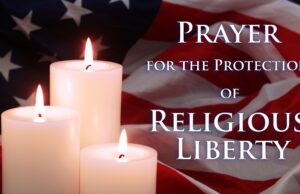
Prayer for the Protection of Religious Liberty

June 14th, 2012 Posted in Uncategorized Tags: ,

By

Comments Off
Marquee Powered By Know How Media.