
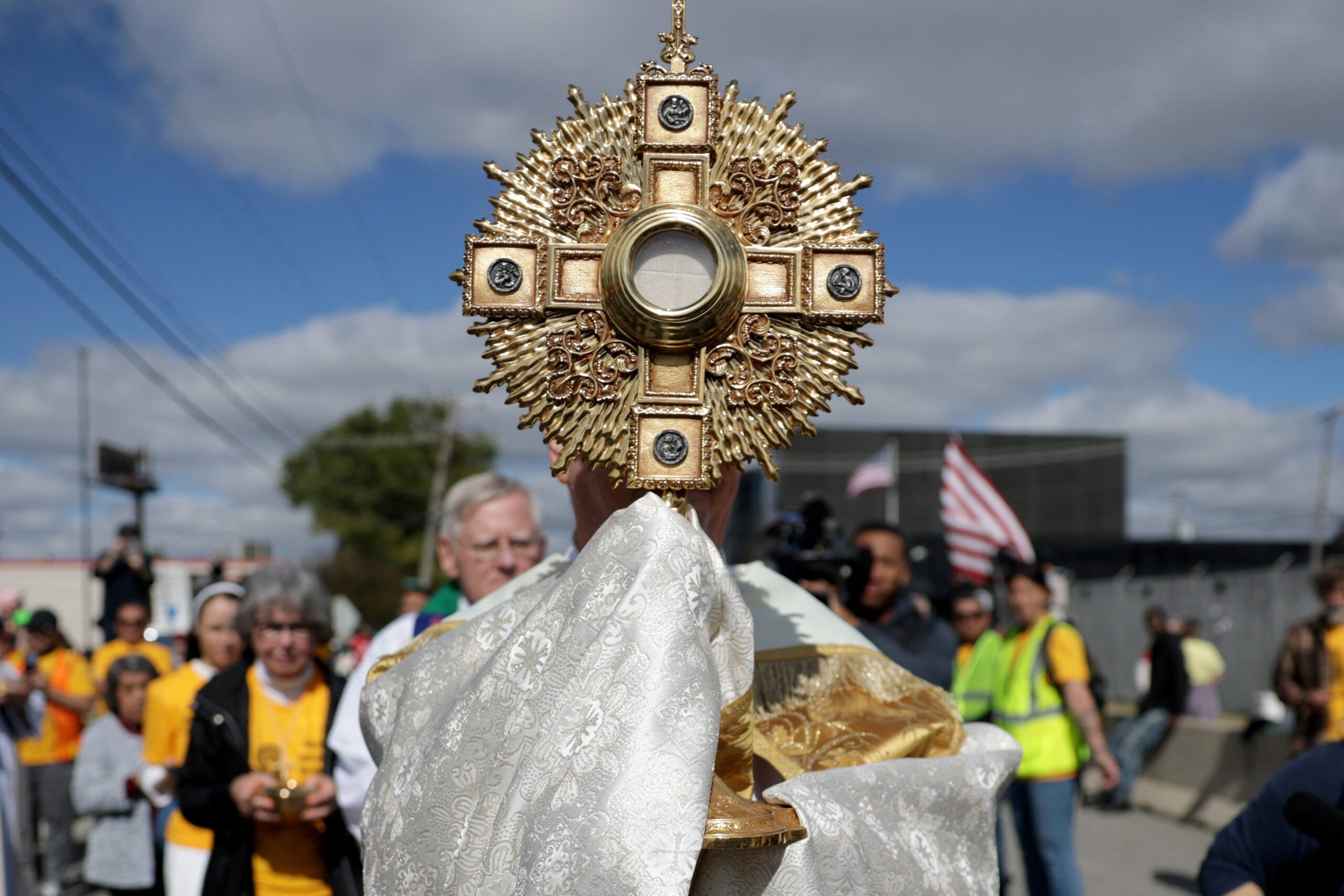

Life issues are perennially critical to the robust public witness of the Catholic Church, but 2025 nonetheless proved a particularly eventful year across a wide spectrum of related concerns.
The year opened with the annual National Prayer Vigil for Life, where worshippers praised and thanked God “for the gift of human life in all its forms and at every stage” and ended with a new coalition of more than 50 organizations pledging to end the death penalty in the United States once and for all.
Remarks by Pope Leo XIV in an impromptu Sept. 30 Castel Gandolfo press scrum demonstrated the expanse — and continuity — of the life issues of concern to the church.

The pope, who shortly after being elected the successor to Pope Francis reaffirmed the church’s teaching against abortion, responded to a media question concerning the Chicago Archdiocese’s plans to give an immigration advocacy award to U.S. Sen. Dick Durbin, D-Ill., a Catholic who supports keeping abortion legal, over the objections of pro-lifers. (Durbin ultimately declined to accept the award.)
“Someone who says, ‘I’m against abortion but says I’m in favor of the death penalty’ is not really pro-life,” the pontiff remarked. “So someone who says that ‘I’m against abortion, but I’m in agreement with the inhuman treatment of immigrants who are in the United States,’ I don’t know if that’s pro-life. … Church teaching on each one of those issues is very clear.”
On the same day as the pope’s remarks, the U.S. Food and Drug Administration announced approval of a new generic form of mifepristone — a pill commonly, but not exclusively, used for early abortion — marking the second time a Trump administration has permitted a generic form of mifepristone.
“It is shockingly inconsistent that the FDA approved a generic for mifepristone, while at the same time reviewing the effects of this lethal drug,” Kat Talalas, assistant director of communications in the U.S. Conference of Catholic Bishops’ Secretariat of Pro-Life Activities, told OSV News on Dec. 3.
On Dec. 9, Susan B. Anthony Pro-Life America called for FDA Commissioner Marty Makary to be fired, arguing that Makary has “slow-walked a promised safety study of women’s real-world experiences taking abortion drugs.” The White House rejected that claim and the call for his firing.
Pro-life groups and politicians characterized the move as an abandonment of pro-life principles, concerns that were reinforced on Oct. 16 when President Donald Trump announced a policy proposal to increase access to in vitro fertilization.
Trump made campaign trail promises to expand IVF, an action the Catholic Church and other experts warn will fuel large-scale destruction of embryonic human life while doing little to increase the nation’s overall birth rate. The U.S bishops expressed concern on Oct. 17, saying that while reproductive technologies such as IVF can be “well intended” to assist infertile couples, they nonetheless “strongly reject” efforts to promote IVF.
Other family life matters — such as health insurance, cash support for parents and food assistance benefits, also known as SNAP — also grabbed headlines in 2025.
Affordable Care Act subsidies — which would cost an estimated $350 billion over the next decade, if extended — cover some 22 million Americans. Set to expire Dec. 31, their absence will result in estimated average health insurance premium increases of 26%, with a congressionally approved extension far from certain.
As a result, the nonpartisan Congressional Budget Office predicted 4.2 million more Americans will go without coverage, while critics point to enrollment fraud and the benefit to insurance companies instead of patients.
The complications of substituting direct subsidies for ACA exchange assistance are a point for current debate, but the U.S. Catholic bishops addressed the need for health care reform as early as 1993 in “A Framework for Comprehensive Health Reform,” insisting “every person has a right to adequate health care.”
The One Big Beautiful Bill Act — signed into law July 4 — is expected to challenge family finances in several ways. Estimated to cut $930 billion from Medicaid and $285 billion from the Supplemental Nutrition Assistance Program, it also increases the national debt on paper by $3.4 trillion.
After the bill’s passage, Archbishop Timothy P. Broglio of the U.S. Archdiocese for the Military Services — then president of the U.S. Conference of Catholic Bishops — issued a statement citing what he described as “unconscionable cuts to health care and food assistance, tax cuts that increase inequality, immigration provisions that harm families and children, and cuts to programs that protect God’s creation.”
Twenty U.S. Catholic bishops signed onto an interfaith effort opposing the One Big Beautiful Bill Act, which would enact key provisions of President Donald Trump’s legislative agenda on taxes and immigration, calling it a “moral failure.”
Republicans have, however, pointed to monetary gains for families. A Dec. 3 House Ways and Means Committee press release noted, “Families are benefiting from a slew of tax cuts, including a bigger child tax credit, a larger standard deduction, making the lower 2017 tax rates permanent and President Trump’s additional tax relief, like no tax on tips, no tax on overtime, and no tax on Social Security.”
A lesser-known provision of the One Big Beautiful Bill Act, dubbed “Trump Accounts,” gives every American newborn $1,000 if parents open a tax-deferred investment account. Private firms invest the money — and parents can make annual pretax contributions up to $2,500 — which can be accessed once a child turns 18. To qualify for an account, a baby must be a U.S. citizen, have a Social Security number and be born between Jan. 1, 2025, and Dec. 31, 2028.
Families coast-to-coast are also being impacted by amplified immigration enforcement policies, including raids, arrests and deportations in multiple cities.
As OSV News reported in July, three Florida immigration detention sites were accused of denying timely medical care (potentially resulting in deaths), having freezing and overcrowded cells with no bedding or hygiene access, and of carrying out degrading treatment — including beatings, shackling and isolation, with detainees being forced to eat with their hands cuffed behind their backs.
“If the administration succeeds in deporting the numbers of people it says it wants to deport, it will not only change the church in America. It will change America,” Archbishop Thomas G. Wenski of Miami told OSV News on Nov. 4.
On July 20, Archbishop Wenski and some 25 Knights of Columbus rode their motorcycles to pray a rosary at the entrance of Alligator Alcatraz, the controversial migrant detention center in the Florida Everglades.
On Nov. 12, the U.S. Conference of Catholic Bishops voted overwhelmingly to issue a rare group statement voicing “our concern here for immigrants” at their annual fall plenary assembly in Baltimore.
A day later, on the feast of the patron saint of immigrants St. Frances Xavier Cabrini — and a day after the U.S. Catholic bishops issued a special pastoral message on immigration — a coalition of Catholic organizations held a second wave of prayer vigils across the country Nov. 13 for what organizers called “a national day of public witness for our immigrant brothers and sisters.”
Assisted suicide and the death penalty also continued to make their mark in 2025, with both the New York Assembly and Senate passing the Medical Aid in Dying Act, a controversial bill now awaiting Gov. Kathy Hochul ‘s signature.
The Albany-based New York Alliance Against Assisted Suicide organized four vigils on Dec. 3 and 4 to urge Hochul to veto a measure its opponents consider “a very dangerous bill.”
On Dec. 12, Illinois became the 12th state, along with the District of Columbia, to legalize assisted suicide, amid outcry among the state’s Catholic bishops and other pro-life and disability advocates. Gov. JB Pritzker signed SB 1950 into law, allowing terminally ill adults who are Illinois residents to end their lives through self-administered lethal drugs prescribed by a physician.
As of Dec. 15, 46 prisoners have been executed in 11 U.S. states, a sharp increase over 25 executions in 2024. According to The Death Penalty Information Center, there are two more executions scheduled for 2025. The center notes, “For every 8.2 people executed in the United States in the modern era of the death penalty, one person on death row has been exonerated.”
On Dec. 3, a new coalition of more than 50 organizations launched the U.S. Campaign to End the Death Penalty. Laura Porter, the campaign’s director, said the coalition comes at “a critical juncture in our country’s history with the death penalty, with executions on the rise and new experimental execution methods being promoted in a handful of states despite growing opposition to the death penalty.”
“It is more important than ever,” said Porter in a statement, “that we shine a light on capital punishment’s failures, and come together to show growing bipartisan support for ending executions.”