

ROSARIO, Argentina — When Pope Leo XIV arrives at the Shrine of St. Turibius of Mogrovejo in Zaña, Peru, Nov. 14, the paths of two missionary bishops separated by more than four centuries will symbolically converge.
Both were born outside Peru. Both came to serve a country whose people and cultures they had to learn. Both traveled beyond the centers of power to reach communities across an immense and diverse territory. And both came to regard Peru as their own.
The Vatican’s itinerary places the pope at the shrine at 5:30 p.m. Nov. 14 for a prayer meeting with the Catholic community marking the conclusion of the jubilee year for the 300th anniversary of St. Toribio de Mogrovejo’s — as he is locally known — canonization.

Zaña is the third and last shrine on Pope Leo’s first apostolic journey to Latin America, after the national Marian shrines of Uruguay and Argentina. His Nov. 11-16 visit to Peru will also take him to Lima, Chiclayo, Santa Cruz de Succhabamba, Cusco and Pucallpa.
Papal tribute to role model bishop
For Pope Leo, the stop in the small town of Zaña in the Diocese of Chiclayo will be intensely personal: a return to a shrine where he prayed repeatedly as the diocese’s bishop, and to a saint whose example helped shape his understanding of episcopal ministry.
Before his episcopal ordination in December 2014, Father Robert Prevost spent time in prayer in Zaña, entrusting the new ministry awaiting him to the saint. He kept returning, sometimes for diocesan events and sometimes simply to pray.
Gloria Burga, a lay pastoral worker in Zaña, told OSV News that as bishop he would set aside April 27, St. Turibius’ feast day, to celebrate Mass at the shrine.
Born in Spain in 1538, Turibius of Mogrovejo was a layman trained in law when King Philip II chose him to become archbishop of Lima. He was ordained a priest and bishop before arriving in Peru in 1581 to lead an ecclesiastical province that then extended across much of Spanish-speaking South America.
During 25 years as archbishop, he devoted approximately 17 years to pastoral visitations, traveling more than 25,000 miles, often on foot or by mule, across the Andes to reach remote Indigenous communities. He convened councils and synods, founded a seminary, confronted abuses by colonial authorities and defended the dignity of Indigenous peoples.
Under his leadership, the Third Council of Lima produced a catechism in Spanish, Quechua and Aymara.
He died in Zaña on Holy Thursday, March 23, 1606, during one of those journeys. He was canonized in 1726 and later named patron of the bishops of Latin America.
Zaña itself was once an important colonial city, but it was devastated by flooding in 1720 and never fully recovered. It is also a major center of Afro-Peruvian history: Enslaved Africans were brought to work in its colonial estates, and their descendants shaped its culture, music and religious traditions. UNESCO recognized Zaña in 2017 as a Site of Memory of Slavery and African Cultural Heritage.
For Cardinal Robert Prevost St. Turibius devotion is personal
In a Sept. 8 letter marking the third centenary of St. Turibius’ canonization, Pope Leo connected the saint’s experience directly with his own.
“There I came to know first-hand the faith of a people from whom I received so much,” the pope wrote of Peru.
That experience, he said, taught him more fully what it meant to be a shepherd and drew him especially close to St. Turibius, another bishop who had “come from afar” and made Peru his own through pastoral charity.
Addressing Latin America’s bishops, the pope wrote that some realities within a diocese are impossible to understand from behind a desk. A bishop, he said, must personally encounter communities, listen to his flock and seek out those who rarely have access to him — with a heart directed toward heaven and feet firmly on the road.
“The best way to honor his memory,” Pope Leo told the bishops, is to be challenged by his ministry and imitate him.
Father David Farfán Guerrero, rector of the shrine for the past 11 years, watched that model take shape in the future pope.
Then-Bishop Prevost received him into the Diocese of Chiclayo, and in July the priest published “Huellas de pastor” (“Footprints of a Shepherd”), a book that traces Father Prevost’s path from Chicago to the papacy and sets his life alongside that of St. Turibius.
“He was so close and attentive,” Father Farfán told OSV News in Spanish. “More than a superior, he was like an older brother in the priesthood. That is what marked me most.”
What impressed him, he said, was the way Bishop Prevost combined personal closeness with the exercise of authority.
“For me, it was an opportunity to see that it really is possible to exercise authority with love, charity, faith and hope,” he said.
Peruvian past of the pope
Father Prevost first arrived in Peru in 1985 as a young Augustinian missionary. His work took him to Chulucanas and Trujillo before he became apostolic administrator and later bishop of Chiclayo, which he led until 2023. He became a naturalized Peruvian citizen in 2015.
Images of him in rubber boots, walking through floodwaters in Chiclayo after severe rains, became emblematic of his ministry. But Father Farfán said that response drew on his earliest years as a missionary.
“He had already experienced that in Chulucanas, the first place where he lived,” he said. “Chiclayo was, in a sense, putting into practice what he had already learned.”
The diocese Bishop Prevost led stretched from coastal communities to Andean parishes thousands of feet above sea level, and Father Farfán said the bishop treated those differences as gifts that could bind the church together.
“He never approached differences as something to be merely tolerated,” he said. “He saw them as a challenge and as a source of greater richness.”
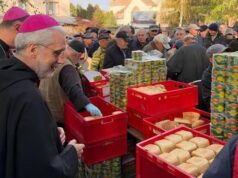
During the COVID-19 pandemic, coastal parishes shared rice through Caritas while highland communities contributed potatoes.
“He helped us a lot during times of need,” Burga, a lay pastoral worker in Zaña, said. “For instance, during the COVID-19 pandemic, we launched an initiative, “aguadito con fe,” and the pope helped us with the rice and other key ingredients so that we could feed the hungry.” Aguadito is a traditional Peruvian chicken soup; the initiative’s name means “aguadito with faith.”
Whatever the region, Father Farfán said, Father Prevost asked his priests the same questions: “What are your people experiencing, and how is the Church responding?”
For the priest, the pope’s decision to include a small, often-overlooked town alongside the major cities of his journey carries its own meaning.
“The presence of the Holy Father in Zaña is a profound message for us,” he said. “God creates perfect works in places that are not perfect, in difficult and distant places where he makes it possible for his infinite love to be revealed.”
On Nov. 14, Pope Leo will not simply honor a saint from Peru’s colonial past. The successor of St. Peter will return to a place of prayer associated with the beginning of his own episcopal ministry, and to a model of missionary leadership he has now offered to bishops across an entire continent.