
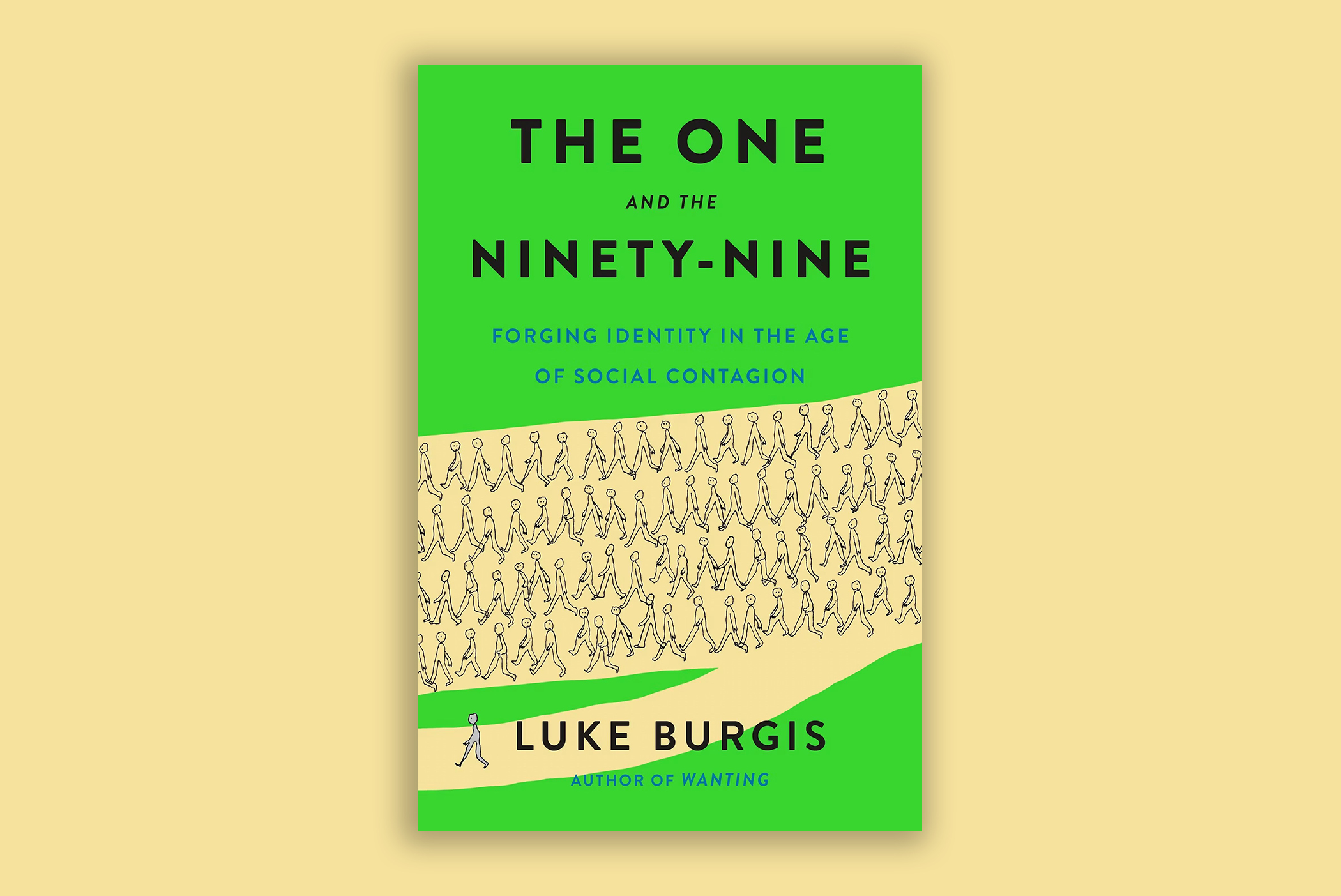



“The One and the Ninety-Nine: Forging Identity in the Age of Social Contagion”
Luke Burgis, St. Martin’s Press (2026)
288 pages, $30
A sea of blue and gold hats and jerseys at a football game. Friendship bracelets at a Taylor Swift concert. Yard signs during an election year. Sourdough bread during the COVID-19 pandemic.
Trends are a part of culture, whether it’s a particular cut of denim jeans or repeating the talking points of a popular podcaster. In his latest book, “The One and the Ninety-Nine: Forging Identity in the Age of Social Contagion,” author Luke Burgis looks at how following the crowd can come at a high cost, not just for society in general, but also for individuals who may lose their sense of self in the process.


Burgis originally began exploring the idea of the mob-mentality and group dynamics in his book “Wanting: The Power of Mimetic Desire in Everyday Life” (St. Martin’s Press, 2021), where he breaks down the work of philosopher René Girard. Girard’s mimetic theory describes human desire as a driving force leading people to imitate one another, fostering a sense of connection in a group through sameness. When a member questions the status quo, the group satisfies any insecurities he or she may have regarding being “right” by creating a scapegoat, whom they then cast out in a metaphorical (or sometimes a literal) act of violence.
Mimesis, this human tendency to imitate or “mimic” one another, can be relatively benign, like when all of the students at a particular school get the same brand of water bottle or co-workers in an office all watch the same streaming series. Imitating one another can also lead to extremely positive end results, such as saints who challenged each other to sanctity, like St. Francis and St. Clare, both of Assisi.
But it’s also not difficult to see where forming in-groups and imitating behavior can lead to vice and some of the greatest horrors humanity has ever known. Mimetic theory can serve as an explanation for everything from the tortures that took place at Abu Ghraib and the horror of addiction to hazing as part of the initiation into fraternities and the volatile comment section on a piece of clickbait.
Burgis makes one thing clear: Mimesis is part of how God created human nature. It is impossible to get away from it. So the task, then, while living in a world that inundates individuals with hundreds if not thousands of models to imitate daily is to form a sense of “solid self,” where one is capable of breaking away from the group when something does not line up with his or her values.
Similar books have been written in the past decade warning readers about the dangers of social media and the negative impact of mindlessly spending a significant portion of our time and attention on platforms ultimately designed to mine data and sell products. “The One and the Ninety-Nine” is different, though, in that it provides a reader experience that is not rooted in scare tactics or straightforward advice, but instead is designed to form the reader’s mind and heart to be able to help create a “solid self” not based on mere imitation.
Part-memoir, Burgis recounts some of the formative experiences of his own life, from being an entrepreneur to entering seminary and leaving seminary, becoming a professor, and his personal life, especially caring for his father with Alzheimer’s disease. Additionally, each chapter is marked by an image or meme that Burgis calls a “probe,” such as a QR code with a warning not to scan it. His personal stories, which he identifies as “thresholds,” along with the “probes” in the book, serve as an examination of conscience and challenge readers to see the areas of their own lives where they just cannot help but follow the crowd.
While not explicitly a Catholic book, Burgis’ worldview is clearly grounded in a Catholic anthropology and the reality that the human heart is made for communion, while also drawing heavily from Catholic sources and tradition, such as the Rule of St. Benedict. He illustrates complex concepts through entertaining anecdotes from history, pop culture, literature and more, which makes a potentially dense book extremely readable.
Mere imitation of one another without a solid sense of self ultimately wrecks communion. It can never be more than a surface-level connection, and when an entire family or parish community or political party operates with a mob mentality, individuals will end up experiencing a form of whiplash where their lives are fragmented and internally inconsistent, like road rage in the church parking lot after Sunday Mass.
In “The One and the Ninety-Nine,” Burgis lays a framework for leaning into human nature as created by God while fighting the tendency of sin to divide and destroy. He says, when participating in any group, “The community will change you, and you will change it.” It is up to the reader to bring his or her whole self to every group they engage with, whether it is online or in person, in a church or on Capitol Hill, to make decisions and act in a way that is in line with his or her values, no matter what the crowd may say.
Cecilia Cicone is an author and communicator who works in diocesan ministry in Northwest Indiana.