
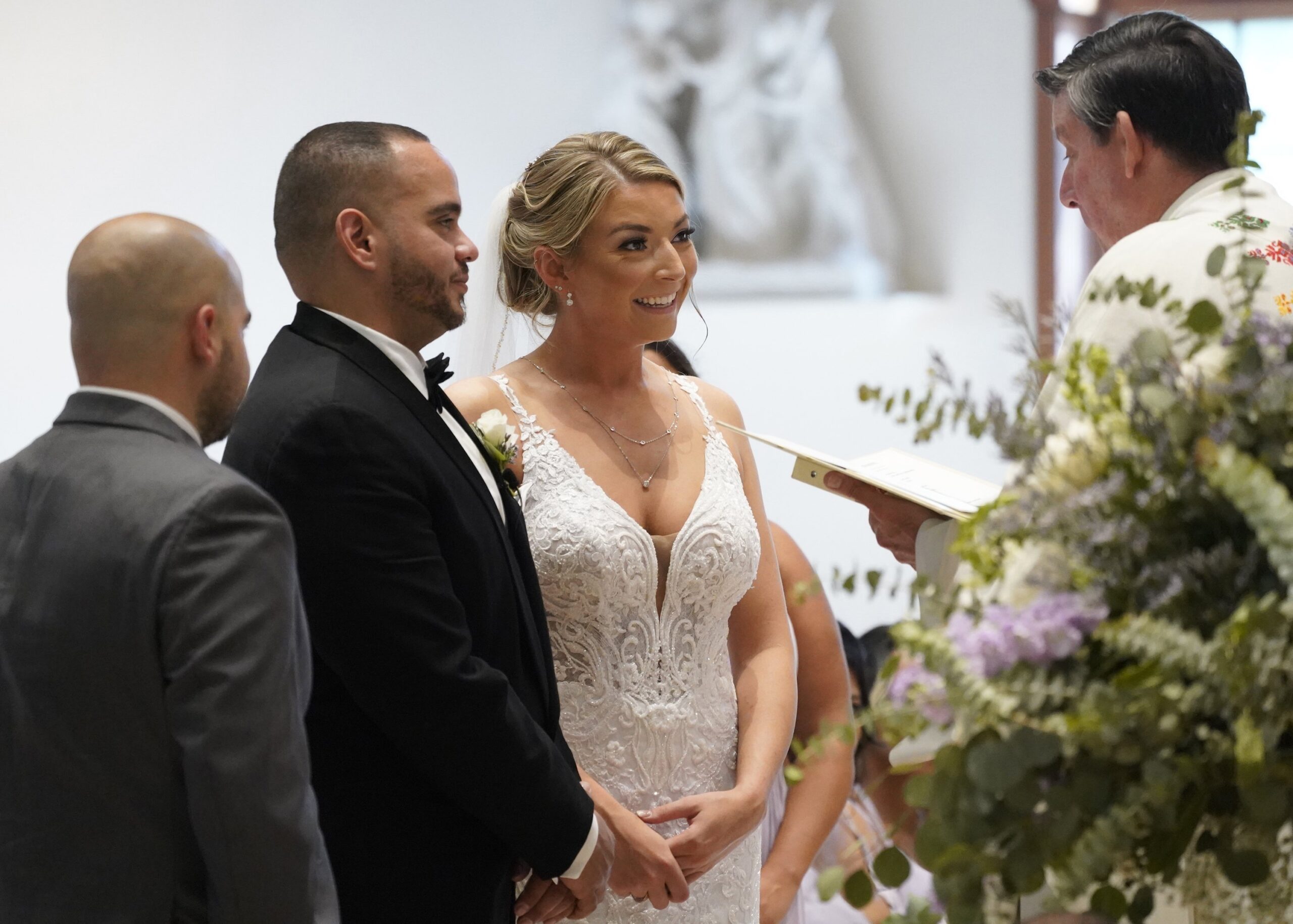

Approaching the twin annual observances of World Marriage Day (Feb. 8) and National Marriage Week (Feb. 7-14), America finds itself at a proverbial sociological crossroads, confronting a disconcerting question about a millennia-old institution: Does marriage matter anymore?
That startling query is prompted by new U.S. Census data from America’s Family and Living Arrangements tables — released this past December — showing that fewer than half (47%) of U.S. households in 2025 were married couples, a significant shift from 50 years earlier when nearly two-thirds (66%) were.
“What this year’s Census release shows is that America is getting older and more lonely,” said Patrick T. Brown, a fellow at the Ethics and Public Policy Center in Washington.
“Our population continues to live longer, have fewer babies and pair off later in life, meaning that the share of Americans who are married with children under 18 is at an all-time low,” he told OSV News. “This is the continuation of a long-run trend, one that unfortunately shows little sign of reversing any time soon.”
While some of this trend may be rooted in young adults’ finances, there are other major factors at play. A 2021 survey by the Institute for Family Studies, American Enterprise Institute and the Wheatley Institution indicated that 58% of unmarried adults ages 18-55 surveyed reported “it is hard to find the right person to marry,” while 33% said they’re “not ready for commitment.”
These responses were consistent across both lower-income and higher-income adults in the marriage market.
“Men and women have fewer social settings in which to meet and are more polarized by online influencers,” observed Julia Dezelski, associate director of marriage and family life in the Secretariat of Laity, Marriage, Family Life and Youth for the U.S. Conference of Catholic Bishops.
“When they do marry, there are fewer social supports for, and more obstacles placed in the way of, their ability to start and maintain flourishing families. These changes have combined to consistently decrease childbirths over time,” she explained.
The data show Catholics are not immune.
In 2024, there were 85,171 Catholic weddings celebrated in the U.S., along with 21,880 interreligious unions, for a total of 107,051 weddings across the 175 Latin-rite dioceses. The number of Catholic marriages in the U.S. has decreased by nearly 60% since 2000, and about 75% since 1970, when there were approximately 426,000 Catholic marriages.
“Catholics … live in a wider social, cultural, political and legal environment, from which they cannot and should not close themselves and their families to their cultural milieu,” said David Crawford, dean and associate professor of moral theology and family law for the Pontifical John Paul II Institute for Studies on Marriage and Family at The Catholic University of America in Washington. “Whatever ails the wider culture will inevitably also weaken Catholic marriages and families.”
“It is difficult — to use an obvious example — to raise one’s children to have a properly balanced sense of the relationship between men and women, when the wider culture is awash in (the) anti-marriage practice of pornography,” he continued. “For this reason, the Church needs to bring light to that wider culture.”
Brown sees these statistics as a call to action for Church leaders.
“If we cannot figure out ways of rebuilding the institution of marriage — making it more attractive, making it easier for young men and women to pair off earlier in life — we will see society continue to become more sterile, more fragile and less optimistic,” he said.
Dezelski agreed.
“Without significant incisive action within the Church and in wider society, these trends will continue and likely worsen,” she said. “The percentage of adults who are married continues to drop, as does the total fertility rate. These related downturns make for an unsustainable society.”
That prediction, she said, is really a matter of math.
“When children and young adults make up a smaller and smaller segment of the population, while the elderly segment expands, it will become harder to ‘keep the lights on’ in many areas of life,” she said.
Including in the Catholic Church.
“These changes will have a downstream impact on the Church’s ability to maintain its institutions, including parishes, schools and nursing homes,” said Dezelski. “Fewer young people (both absolutely and as a percentage) means fewer students, fewer people entering the workforce and fewer people contributing to support the elderly.
“There will also be unforeseeable changes, because these trends have never been observed on this scale over such a long period of time in human history,” she added.
Another factor may be rooted in the myth of overpopulation, which is persistent enough that there are frequent public and private suggestions that having children is irresponsible, Crawford said.
“After so many decades of constant conditioning, it is very difficult for people to wrap their heads around the thought that overpopulation is not our problem,” he said. “In reality, global fertility (the number of children per woman) has been declining for a very long time (about 200 years). This has been true, even though world population has been increasing, due to decreased infant mortality.”
“However,” he continued, “demographers tell us that in the not too distant future world population will cease to increase and in fact will begin to decline, along with the social, economic, and cultural tensions that this trend will entail and which many countries with rapidly graying populations have already begun to experience.”
As the Catechism of the Catholic Church makes clear, marriage is not a human invention: “The intimate community of life and love which constitutes the married state has been established by the Creator and endowed by him with its own proper laws … God himself is the author of marriage.”
It’s a critical bond with both sociological and theological implications, he explained.
“Marriage is the primary means of guaranteeing and bringing stability to this vital social and cultural good. From this point of view, marriage is an act of generosity to our fellow citizens, and indeed to the world as a whole,” Crawford said.
Meanwhile, “marriage is our central image for our relationship with God,” he said. “Christ is the bridegroom, and the Church is the bride, as Scripture and the tradition repeatedly tell us. We are also told that God is our Father, and that the Church is our mother.”
He added, “The decrease of marriage and family life as a widely experienced, concrete, and even existential reality weakens and ultimately deprives Catholics and others of this central Christian image, what John Paul II had referred to as a ‘primordial sacrament.'”
Researchers from the University of Michigan and Singapore Management University recently studied nearly 5,000 adults in the U.S. and Japan to see how being single or married affects their well-being. The results — released in September 2025 — showed that single people in both countries had lower life satisfaction and health compared to married people.
So what can the Church do — in the face of a societal momentum that only seems to gain greater traction with each passing year?
“Everyone — but especially Catholics — should be thinking about how they can orient their institutions and relationships in a more pro-marriage direction,” Brown said.
That includes, he said, “more informal get-to-know-you nights for single Catholics, more conversations about not waiting around if a years-long relationship is showing no signs of leading to a ring and a proposal, more policies and preaching about what we can do to make young men and women more ‘marriageable’ and interested in becoming the type of person worth starting a life with.”
Kimberley Heatherington is an OSV News correspondent based in Virginia.