
PHILADELPHIA — The Trump administration‘s effort to remove a slavery exhibit at a national historic site in Philadelphia distorts history, while eroding racial justice and healing, several Black Catholic leaders told OSV News.
And although the display was reinstalled Feb. 19 under a federal judge’s order — a move the administration has appealed — more work needs to be done overall in countering the sin of racism, they said.
“We cannot erase our history; it will crop up to bite us when we least expect,” said M. Shawn Copeland, professor emerita of systematic theology at Boston College and author of “Knowing Christ Crucified: The Witness of African American Religious Experience.”
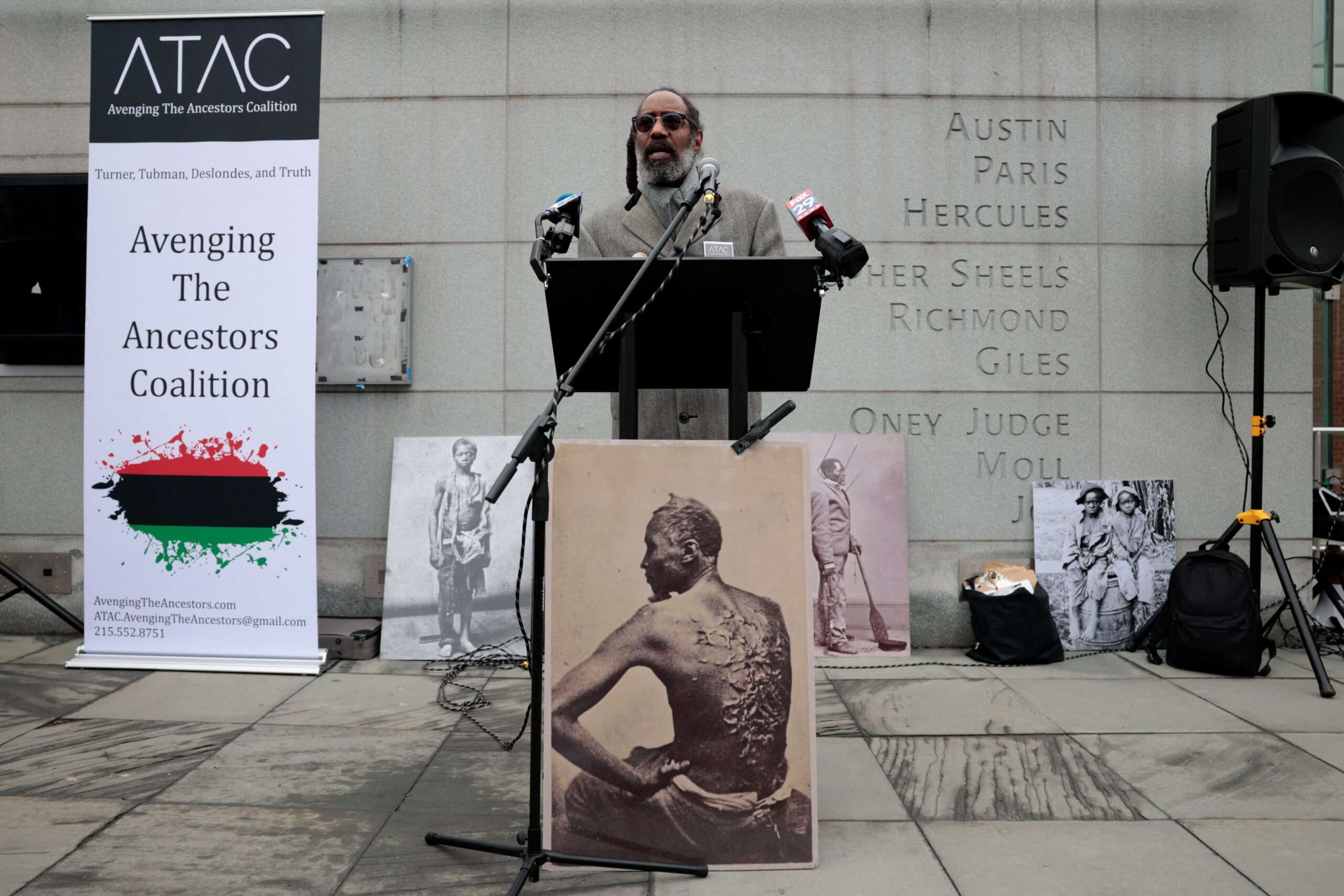
In January, National Park Service workers in Philadelphia dismantled panels commemorating nine slaves owned by President George Washington and his wife, Martha, when they lived in that city, then the nation’s capital.
The display, part of the President’s House Site in Independence National Park, provided biographical information for Austin, Paris, Hercules, Christopher Sheels, Richmond, Giles, Oney Judge, Moll and Joe. In addition, the panels detailed “The Dirty Business of Slavery” in the Americas and the 1787 constitutional compromise that U.S. founders made regarding slavery to rally support for the newly created nation.
But a March 2025 executive order signed by Trump, “Restoring Truth and Sanity to American History,” called for the Department of the Interior — which oversees the NPS — to ensure that its memorials and the like do not “inappropriately disparage Americans past or living (including persons living in colonial times), and instead focus on the greatness of the achievements and progress of the American people.”
The display’s removal prompted outcry, including from city officials, who filed suit Jan. 22 against the Department of the Interior and NPS, citing the breach of a long collaboration and cooperative agreement on the site between municipal and federal officials.
The city said the slavery display removal took place “without notice,” and “presumably pursuant to the mandate in the Executive Order.”
In her Feb. 16 memorandum opinion, U.S. District Judge Cynthia Rufe — who ordered the display restored by Feb. 20 — quoted George Orwell’s dystopian novel “1984,” in which “all history” was “scraped clean and reinscribed exactly as often as was necessary.”
The federal government filed for an emergency stay Feb. 18, with the city opposing the move.
Catholic scholar, author and speaker Gloria Purvis told OSV News the display’s removal was “a larger part … of erasing the Black experience as well as Black accomplishments from American history.”
Purvis said the move also “signals to the country that this history is unimportant,” and “robs us of the ability to understand who we are, where we’re going and the things that we need to do, as well as the things that still plague us.”
Removing references to slavery and racism in American history “really undermines any progress the country could make in terms of racial reconciliation,” Purvis said.
Copeland stressed that “as a nation, we must acknowledge the contradictions in our founding documents and previous vicious practices and behaviors — enslavement, denial of civic rights to white women and women and men of color, oppression of Indigenous peoples.”
She added, “We make reparations for this by living differently, that is, humanely, in authentic solidarity with one another, and actively working everywhere for the flourishing of all.”
Father Reginald Norman, president of the National Association of Black Catholic Administrators and pastor of St. Mark Parish in Stratford, Connecticut, described the display removal as “very oppressive.”
But, he added, “we will march on and we’ll do the work” of healing racial injustice.
“We have an obligation to tell our history properly, even if he (Trump) tries to take away stuff,” Father Norman explained. “They can make laws and do things, but we don’t lose our history until we forget it and we stop telling it.”
Although the removal of the slavery display amounts to “trying to take it out of the public record,” said Father Norman, “it will never stop us, because that’s in our hearts.
“And I think people need to realize that,” he said. “I think people are panicking because they think it’s gone forever. It will never be gone as long as we remember it.”
Father Norman emphasized that “the Black community has always been a people of faith.”
“We always go back to faith. And that’s where we must go now,” he said. “We worship a God who is a peace-loving God, and we turn the other cheek and we go in hope.”
And, he said, “at the end, justice will be there.”