
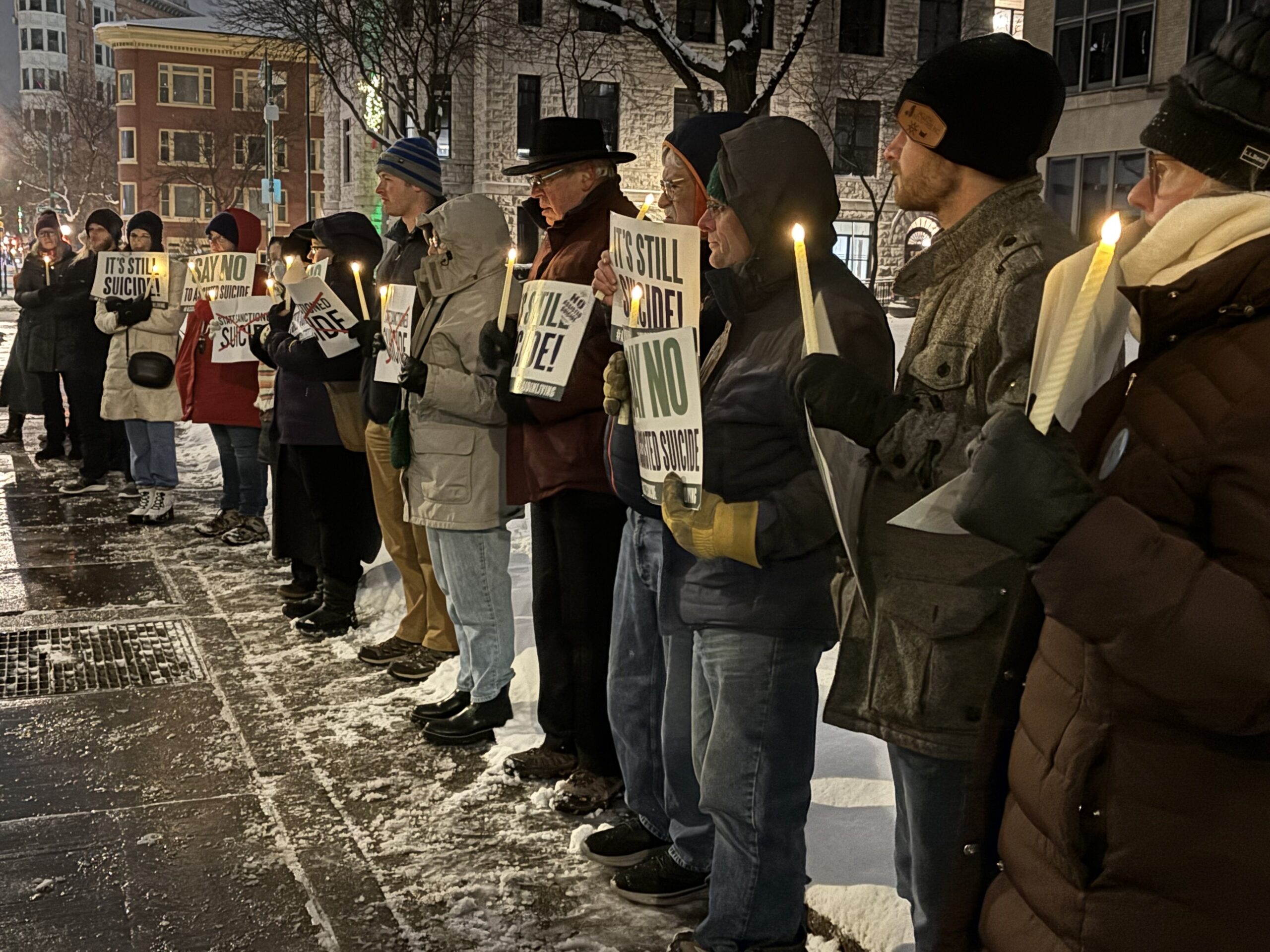



SYRACUSE, N.Y. — With Advent having begun just six days prior — a spiritual season marked by themes of hope, peace, love and joy — more than 30 people braved the bitter cold in Syracuse Dec. 4 to speak out against a controversial bill that, should it pass, would allow physicians to assist terminally ill adults as young as age 18 to die by suicide.
Described by proponents as a compassionate end-of-life option with legal protections in place, the New York Legislature passed the Medical Aid in Dying Act (S. 138/A. 136), or MAiD, on June 9.
The measure currently sits with Gov. Kathy Hochul, who has mentioned possible safeguard amendments. She has the option to sign it into law or veto it and has until Dec. 31 to act.
The candlelight vigil took place outside the Sen. John H. Hughes Office Building in downtown Syracuse.
Organized by Chris Fadden, president of Syracuse Right to Life, in collaboration with the Albany-based New York Alliance Against Assisted Suicide, or NYAAAS, the gathering featured several speakers.
“This is a very dangerous bill,” said Dr. James Mostrom, a retired anesthesiologist from the Syracuse area. “I’m totally against it because it really compromises the physician-patient relationship. The patient can’t be sure that the doctor is always working in their own interest.”
He also emphasized that the American Medical Association is strongly opposed to assisted suicide. “It conflicts with our normal duties. I took an oath (that) I would do no harm. … There’s no place for physicians in suicide.”
The Syracuse vigil was one of four organized by NYAAAS. A second one held the evening of Dec. 4 took place outside Hochul’s office in midtown Manhattan. The evening before a vigil was held just outside the front gates of the governor’s mansion in Albany, the state capital, and another one took place in Tonawanda near Buffalo in western New York.
In all, more than 350 attended the four candlelight vigils.
On its website, the AMA states, “It is understandable, though tragic, that some patients in extreme duress — such as those suffering from a terminal, painful, debilitating illness — may come to decide that death is preferable to life. However, permitting physicians to engage in assisted suicide would ultimately cause more harm than good.”
“The patient wants the doctor to assist them, to take care of them, to basically fight for their best interests in health care. This (law) would just introduce a question in the patient’s mind: Does this doctor really care for me? … Are they for me or really against me?” Mostrom said. “Patients, when they’re seriously ill or very vulnerable, they’re vulnerable to suggestion. … You can’t take advantage of that vulnerability.”
Proponents argue that the safeguards in place would protect people from making an unwanted decision. For instance, the proposed legislation requires two physicians to confirm that the patient is an adult, has a terminal illness with less than six months to live, and has the mental capacity to make an informed decision.
However, Mostrom said doctors are often known to give inaccurate diagnoses and prognoses. “(You) think you’re working with something, and in fact, you find that it’s something totally different. So there are a lot of instances in that regard where it’s not an exact science. That’s one of the difficulties.”
Other safeguards include that the request must be voluntary and coercion-free, and that the patient can self-administer the medication.
“These aren’t safeguards at all, because we’ve seen in other states that have adopted this, in other countries that adopted this, those safeguards very quickly fall by the wayside,” Mostrom said. “Physician-assisted suicide quickly becomes assisted suicide by other health care personnel. It very quickly becomes euthanasia, where the patient really doesn’t have that much say, particularly in patients who are disabled or have trouble communicating their wishes.”
Syracuse Right to Life area director Rhett Cox is a passionate advocate for the vulnerable who has driven to Albany many times to lobby legislators.
“If you look at the number one reason (why) most people in legalized areas want to die, (it) is because they say they feel like somehow they’ve become a burden. This law is only going to increase that feeling. They need the protection to know (their) life is worth living. We’re stripping that away as a society,” Cox said at the vigil.
Syracuse Bishop Douglas J. Lucia was unable to attend due to a longstanding commitment. However, James Salamy, director of public policy for the Syracuse Diocese, read a letter on his behalf, which addressed those gathered.
“I have written to both our governor and the state legislature that my own objection to this legislation is not based only on my religious beliefs, but also on my concern of what ancillary effects it will have on our society,” the bishop wrote. “One of my greatest fears is that as a society we start determining what is “quality of life,” and in turn, start deciding for the voiceless what is a life worth living.”
At the Manhattan vigil site, Sophia Cook, 24, was among the nearly 100 participants. She is a parishioner of St. Agnes Church in Midtown Manhattan.
“It’s important that people stand up against suicide, and stand up for those who are terminally ill,” Cook told The Good Newsroom, the news outlet of the Archdiocese of New York. “I heard about this vigil from one of my friends who is very involved with fighting against physician assisted suicide. I also heard about it from a church group.”
Bishop Robert J. Brennan of Brooklyn and Auxiliary Bishop Peter J. Byrne of New York were among participants of the Manhattan vigil. Bishop Brennan answered questions from reporters, and Bishop Byrne helped lead a rosary prayer along with several nuns from the Sisters of Life.
In response to a question from The Good Newsroom, Bishop Brennan said, “We are grateful that she’s (Hochul) taking this issue so seriously and giving it time and consideration — and so we really want to express our deep concern about this legislation. We want to stand up for the dignity of human life.”
The Catechism of the Catholic Church explicitly condemns the practice of euthanasia and physician-assisted suicide as “morally unacceptable” and a violation of the Fifth Commandment, “You shall not kill.”
As for possible safeguard amendments, he told reporters, “The taking of a life is the taking of a life. … In a situation like this, there is no compromise. I think we have to respond with incredible compassion, first of all — to accompany and to help people in those moments of pain, to make those final moments of life meaningful; there are all kinds of palliative care treatments that are available.”
Bishop Byrne told The Good Newsroom the vigil was “a peaceful witness. We’re petitioning the governor to do the right thing and veto this bill. It’s completely disrespectful of human life.”
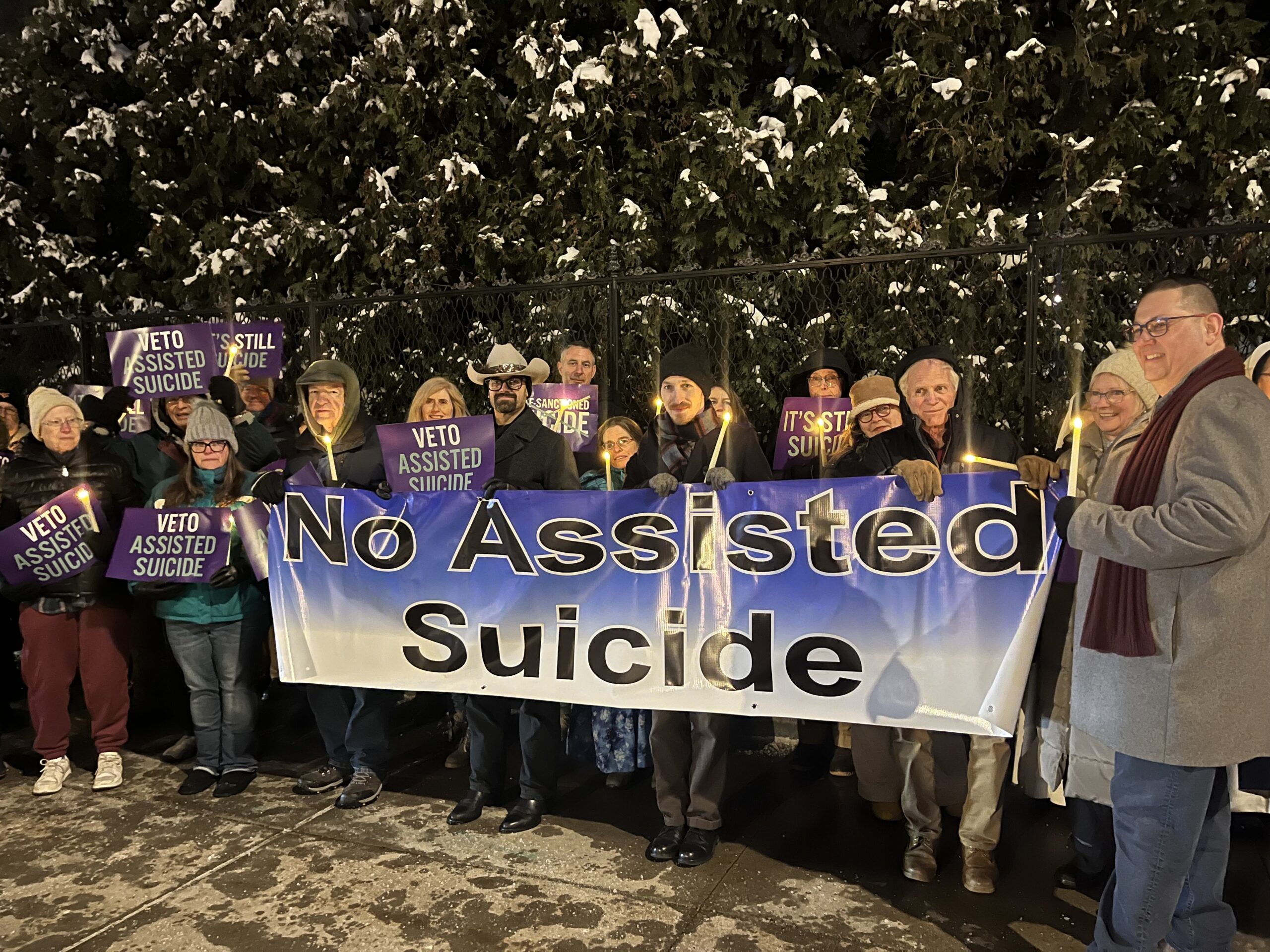
In Albany, stationed just outside the front gates of the governor’s mansion, a line of soft candlelight broke through the darkness.
Honks from cars, followed quickly by cheers and raised candles, rang out across the road as those driving by read the large sign held by the crowd. In large black and white font, it read “No Assisted Suicide.” Over 60 people came out in the cold.
“There is no more critical bill in New York this year — or really in my time at the conference — that has risen to this level,” said Dennis Poust, executive director for the New York State Catholic Conference.
“This is not a Catholic effort,” he continued, “this is Catholic, Christian, evangelical, secular. It doesn’t matter. We all realize that this is a bill that will lead to the vulnerable being targeted for death, and we can’t have it.”
Jason McGuire, executive director of New York Families Foundation, said that New Yorkers were starting to wake up to the weight of the bill.
“There’s a sleeping giant that’s waking up on this issue,” McGuire said. “As people come and get advocated, that’s got to get the governor involved because this is a bad bill.”
“I just know that once you open up the Pandora’s box of assisted suicide — the Pandora’s box of state-sanctioned suicide — there’s no going back,” he said. “Once you open that, it expands. And so we’ve got to stop this.”
Max Rodriguez, manager of government affairs for the Center for Disability Rights, said that making the bill law would tell New Yorkers “we’d rather see you dead than take care of you.”
“I think people are really waking up to this issue and becoming more passionate about it,” Rodriguez told The Evangelist, Albany’s diocesan news outlet. “It’s not an issue that people talk about every day, and that kind of makes it harder. I think a lot of people aren’t aware of what’s going on.”
But the turnout that night gave him hope.
“It really meant a lot to see a diverse group of individuals get together and be so passionate about an issue that’s so important, and to think about others beyond themselves.”