
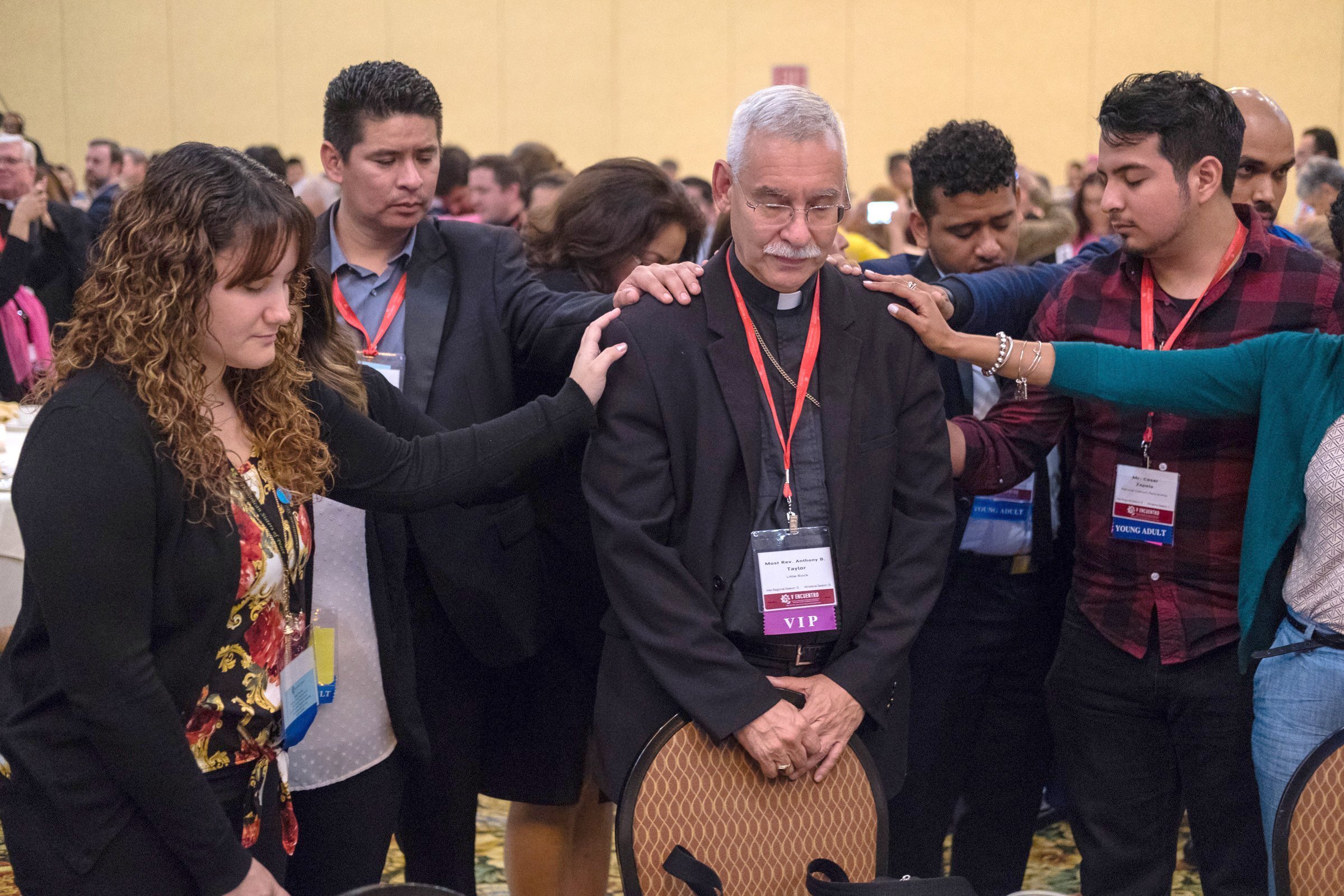



Younger Catholic adults in the U.S. are more likely to be Hispanic or Latino, while just over half of Gen-Z individuals raised Catholic are likely to retain that identity in adulthood.
Those and other insights on the nation’s adult Catholics were shared by researcher Mark Gray in a March 23 analysis posted to Nineteen Sixty-four, the blog of the Center for Applied Research in the Apostolate at Georgetown University.
“We heard a lot in 2025 about a possible religious revival and about Catholics outnumbering Protestants in this younger demographic. What’s in the numbers?” wrote Gray, director of CARA Catholic Polls, research associate professor at Georgetown, and editor of the blog.
To find out, CARA drew on data from the Comparative Election Survey (CES) in 2023 and the General Social Survey (GSS), a nationally representative survey of adults in the U.S. conducted since 1972.
CARA researchers used Pew Research Center’s generational year definitions, which classify Gen-Z as those born between 1997 and 2012, Millennials as between 1981-1996, Generation X as between 1965-1980, and Baby Boomers as between 1946-1964. The Silent Generation was born between 1928 and 1945.
Baby Boomers represent one third (33%, or 17.2 million) of the nation’s adult Catholics, with Gen-X (13.1 million) and Millennials (12.7 million) each representing a quarter.
The Silent Generation counts 2.8 million, or 5% of U.S. adult Catholics.
Gray noted in his post that researchers could only “see” Gen-Z adults (age 18 and up), not younger members, in the survey data, but presently they comprise 13% (7.1 million) of adult Catholics.
“It’s with these youngest Catholics that there seems to be the greatest interest in data,” he said.
He noted the data available now shows that 2023 CES data showing Millennial and Gen-Z Catholics appearing to “match or eclipse” their Protestant counterparts was “more than likely” a fluctuation in the survey’s margin of error. The CES data before and after 2023 doesn’t align with that finding, and the GSS also did not show “any similar jump in Catholic affiliation” in those generations either.
“Surveys are always blurry images rather than picture portraits,” he explained in his post.
For older generations, “Catholics trail Protestants in all observations” of CES and GSS data since 1972, he said.
Still, Gray told OSV News, “there is a narrowing” between Catholics and Protestants in the younger age cohorts.
“Protestants have really seen their affiliation rates decline over time, much more than Catholics,” Gray said, speaking by phone with OSV News. “In fact, Catholics have remained relatively stable, between 20% and 25%.”
CARA found that in 2024, 36% of adult Catholics attended Mass at least once a month, 65% prayed at least once a week, and 76% said their religion is “somewhat” or “very” important to them.
Gen-Z adult Catholics were more likely to attend Mass at least once a month (39%) than Gen-X (30%) and Baby Boomer (35%) Catholics.
At the same time, Gray wrote, “Gen-Z were less likely than older Catholics to pray at least weekly and to say that their religion is ‘somewhat’ or ‘very’ important to them.”
Data indicates those in Gen-Z who are raised Catholic are less likely than other age cohorts to retain that identity in adulthood.
Gray observed that since 2021 — when Gen-Z numbers became “visible in large enough numbers in the GSS” to be statistically significant — their retention rates in the Catholic faith have “fallen each year to 52% in 2024.”
In other words, “only about half of Gen-Z who are raised as Catholic remain Catholic as adults,” he said.
However, Gray told OSV News he “would expect that number to rise” over time, since many young adults raised Catholic often distance themselves from their childhood faith before eventually returning to it.
By comparison, between 2014 and 2024, higher retention rates of the Catholic faith were seen in Baby Boomers (68% to 62%), Generation X (70% to 60%) and Millennials (64% to 53%) even as those cohorts saw overall declines during that decade.
Adult conversions to the Catholic faith after the age of 16 remain in the range of 2% to 3% of the share of U.S. adults across all age cohorts, said Gray.
Conversions among Gen-Z adults in the U.S. increased from 0.4% in 2021 and 0.3% in 2022. In 2024, that share rose to 2.9%, consistent with other generations in recent years.
“A 2.9% convert percentage in 2024 is not an outlier from other generations in recent years and brings Gen-Z in line with prevailing patterns,” Gray wrote.
Gray said the low rates in 2021 and 2022 may have been due to two factors.
First, as a younger generation, the Gen-Z cohort has had “less time” to “make a religious switch,” he said.
Secondly, he said, the period “overlaps with the COVID-19 pandemic,” when potential converts may have been unable to enroll in OCIA (Order of Christian Initiation for Adults) classes.
He also pointed out that “significant change” could be seen across generations in “racial and ethnic diversity.”
Data shows that 40% of Gen-Z Catholics self-identify as Hispanic or Latino, compared to 18% among their Baby Boomer counterparts, he wrote.
Less than half of Gen-Z (47%) and Millennial (46%) Catholic adults identify themselves as white and non-Hispanic, Gray noted. He added that “the number of Catholics who self-identify as something other than Hispanic or non-Hispanic white is also larger among Millennials and Gen-Z than older Catholics.”
Gray told OSV News that statistical evidence of an overall rise in Catholics is not yet available.
“It could be true. We hope it’s true; we hope that there’s this big influx of new Catholics,” he said. “We won’t know until next year.”