
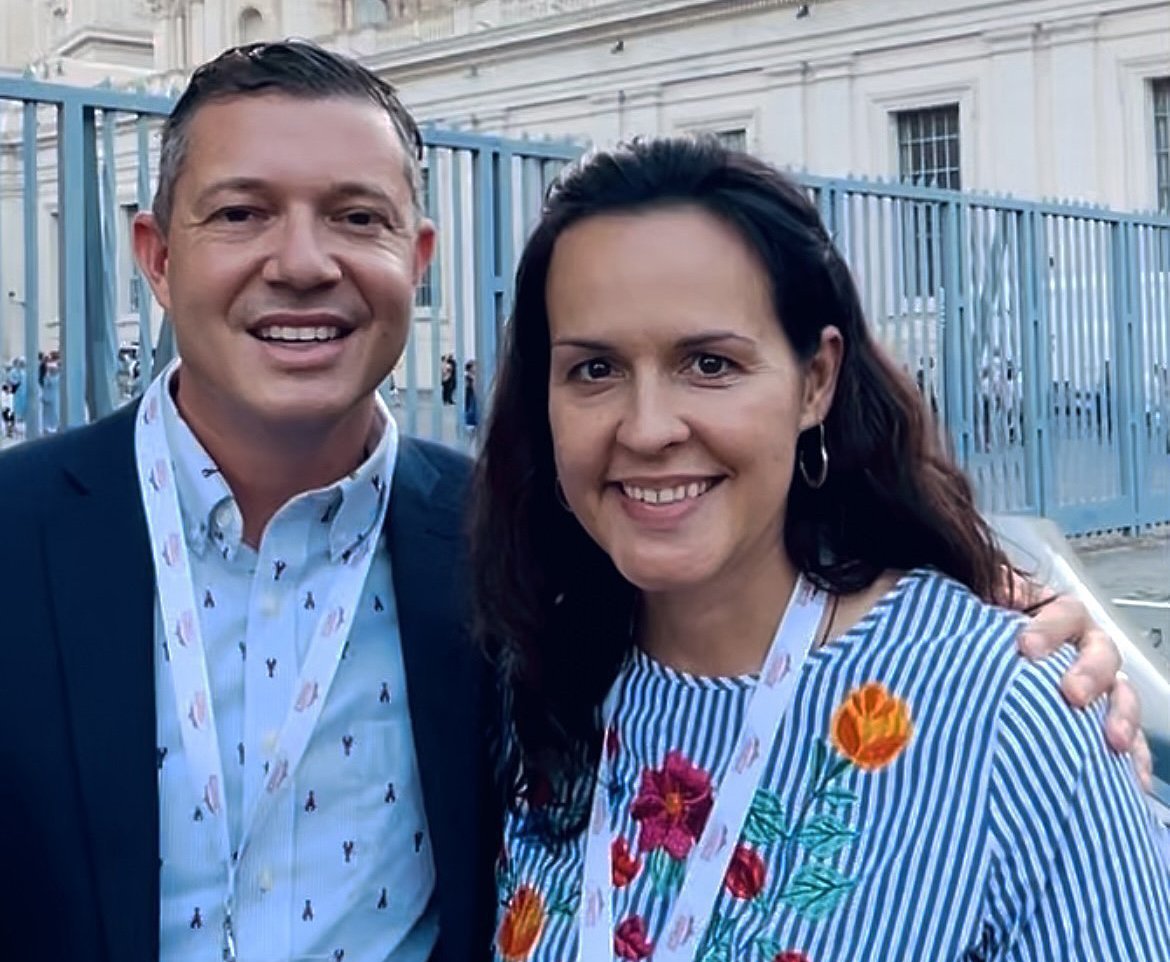

For the last four years, Mary-Rose and Ryan Verret, co-founders of Witness to Love, a Catholic marriage formation and renewal ministry, have convened dozens of diocesan leaders from across the U.S. and Canada for the North American Marriage Catechumenate Summit.
It’s a gathering — this year held March 16-18 in Grand Coteau, Louisiana, in the Diocese of Lafayette — designed to explore the implications of “Catechumenal Pathways for Married Life,” a pastoral tool issued in 2022 by the Vatican’s Dicastery for Laity, Family and Life.
And while those not involved with marriage ministry might think of “Catechumenal Pathways” as just another document released from Rome, those who are involved will tell you this: It’s changing the way the Catholic Church prepares couples for — and supports them in — the sacrament of matrimony.
“Anyone who’s operating in the old version of marriage prep — which is, take a couple of classes online, or in a church basement, or with strangers, or just kind of a one-time thing — those are very much the old model, and they’re very institutional; transactional; information-based,” explained Mary-Rose Verret. “But what the Church is calling for right now is a catechumenal approach — an OCIA approach — which is a focus on conversion; on the journey; on accompaniment; on formation for a sacrament.”
The “OCIA approach” Verret refers to is the Order of Christian Initiation of Adults, the structured formation process that prepares adults to enter the Catholic Church.
“It has been a heavy lift in the Church, globally, to bring about this change — because change is hard,” she admitted.
Verret said that with the 10th anniversary of “Amoris Laetitia,” Pope Francis’ wide-ranging document on pastoral care for the family, “we’re finally seeing openness; momentum; conversation; discernment — especially among the bishops and our diocesan leaders — to say, ‘I know what we’re doing is not working. But what would work — and how would it work, and who would help me do that? And how do the laity and the clergy really have this co-responsibility of formation for the sacrament of marriage?’“ Verret recounted. “That’s really what the focus of this conversation was about.”
The 90-some participants — including bishops, priests and family ministry leaders — received a message from Cardinal Kevin J. Farrell, prefect of the Vatican’s Dicastery for Laity, Family and Life.
Cardinal Farrell suggested a vibrant relationship with Jesus Christ is essential to a successful marriage.
“This is the most effective preparation for future married life, because only the discovery of Jesus’ loving gaze helps young people to have a positive outlook on life, on the future, and on human love itself, which draws strength and stability from the love of Christ,” explained the cardinal. “Those who have known the love of Christ also value human love!”
The Catholic Church’s marriage catechumenate offers a path of formation first advanced by the 1980 Synod of Bishops on the Family, and championed by St. John Paul II in his 1981 apostolic exhortation “Familiaris Consortio.” It was formalized in June 2022 with the dicastery’s release of “Catechumenal Pathways for Married Life.”
This fourth year of the North American Marriage Catechumenate Summit has witnessed a shift take place, said Mary-Rose Verret.
“This was the first year that I feel like people really came not just to receive — but to participate, and to share, and to discern,” she reflected. “Especially the bishops. They were so encouraged, and so excited, and so desiring their brother bishops to be a part of this conversation — seeing that there is a new path forward, and that it’s not an easy path, but it’s a necessary path and a fruitful path.”
Ryan Verret said he encouraged attendees to recognize the urgent issues facing the faith.
“Marriage is meant to be a foundational, and essential, and necessary element that the Church, that God, uses for the transmission of faith,” he noted. “We started the conference by asking this question: ‘Do people recognize what is the deepest, most profound challenge of the Church in the world today?’ We recognize that challenge is the transmission of faith.”
He also told the participants, “If marriage is where faith is most often passed or lost, how we form couples can no longer be secondary.”
The message was clearly received.
“Everyone said, ‘We just have to move beyond the Band-Aid approach. … We have to get to the core issues; we have to address them,” said Mary-Rose Verret. “We can’t do this light touch on marriage prep … that’s been repackaged over and over for 40 years, and given a new name. That is not what couples need.’“
“And so,” she continued, “if the Church is asking for accompaniment, mentorship, witnesses, formation, connection to community — this whole transformation of life, so that they can pass on their faith to their children — then we have to actually give them a preparation that allows that to happen.”
Bishop David A. Konderla, an attendee who shepherds the Diocese of Tulsa, Oklahoma, emphasized the element of discipleship.
“We’re seeking to build models where couples who approach the parish for marriage preparation are invited into a discipling relationship,” he told OSV News. “What we want is for them to come out on the other end of it, married — but also feeling like they belong now to a community of disciples, and they themselves are growing as disciples, so that they can in their own turn, when they have some experience in marriage, begin to disciple others.”
That often requires starting with the basics, something OCIA assumes as a necessity.
“With marriage preparation, we haven’t typically done that,” he noted. “A couple who didn’t have a deeply-rooted Christian faith could nonetheless go through the various steps and never have experienced any deeper conversion; but for various reasons, they wanted to have a Catholic wedding. They go through the Catholic wedding — and then we’re saddened a few years later when they’re divorced, or when their marriage is in trouble.”
Bishop Brendan J. Cahill of Victoria, Texas, another summit participant, told OSV News that marriage preparation is integrated throughout his diocese’s ministries.
“The marriage catechumenate can fit well with what we’re already doing, and can give a broader vision of unifying our ministries,” he said. “For example, our group that went this year had our catechetical leader; youth/young adult leader; Hispanic ministry leader; and marriage/family life.”
“It was kind of having all those groups come together — that sometimes operate on our different programs — to see, well, actually all of our programs are about fostering family life. And,” Bishop Cahill stressed, “family life is the key.”
Father Dan Tracy, associate pastor of St. Patrick Parish in Hudson, Wisconsin, who was attending his second summit, emphasized the marriage catechumenate is not simply ministry repackaging.
“This is not just the Church putting a new name on marriage prep. It’s really not that,” he said. “And that’s why it will take many years for dioceses to implement it. It’s a real re-understanding of — and lengthening of — the process of formation and accompaniment.”
Rachael Tvrdy, director of family life and discipleship in the Diocese of Lincoln, Nebraska, agreed that implementation will be incremental.
“Many diocesan directors were encouraged by the reality of the timeline. In any innovation, it takes an average three to 7 years” to implement the change, she remarked. “You don’t need everyone on board; only the top 10-15% who are ready. Once that group feels supported, the rest will observe the fruit and follow.”
Julia Dezelski, associate director of marriage and family life in the U.S. Conference of Catholic Bishops’ Secretariat of Laity, Marriage, Family Life and Youth, said the summit “offers a unique opportunity for the Church’s leaders to understand and discern how to evangelize marriages and families, for the revitalization of the Church.”
The Verrets know that evangelization is critical to marriage, marriage is critical to family — and both are critical to the future of the faith.
“If the main goal is that they can share the faith with their family, they first have to have it,” observed Mary-Rose Verret.
“And if we’re not helping them be open to the faith and forming them in the faith during the preparation for a sacrament,” she concluded, “then what we’re doing is just paperwork.”
The author, Kimberley Heatherington, is an OSV News correspondent. She writes from Virginia.