
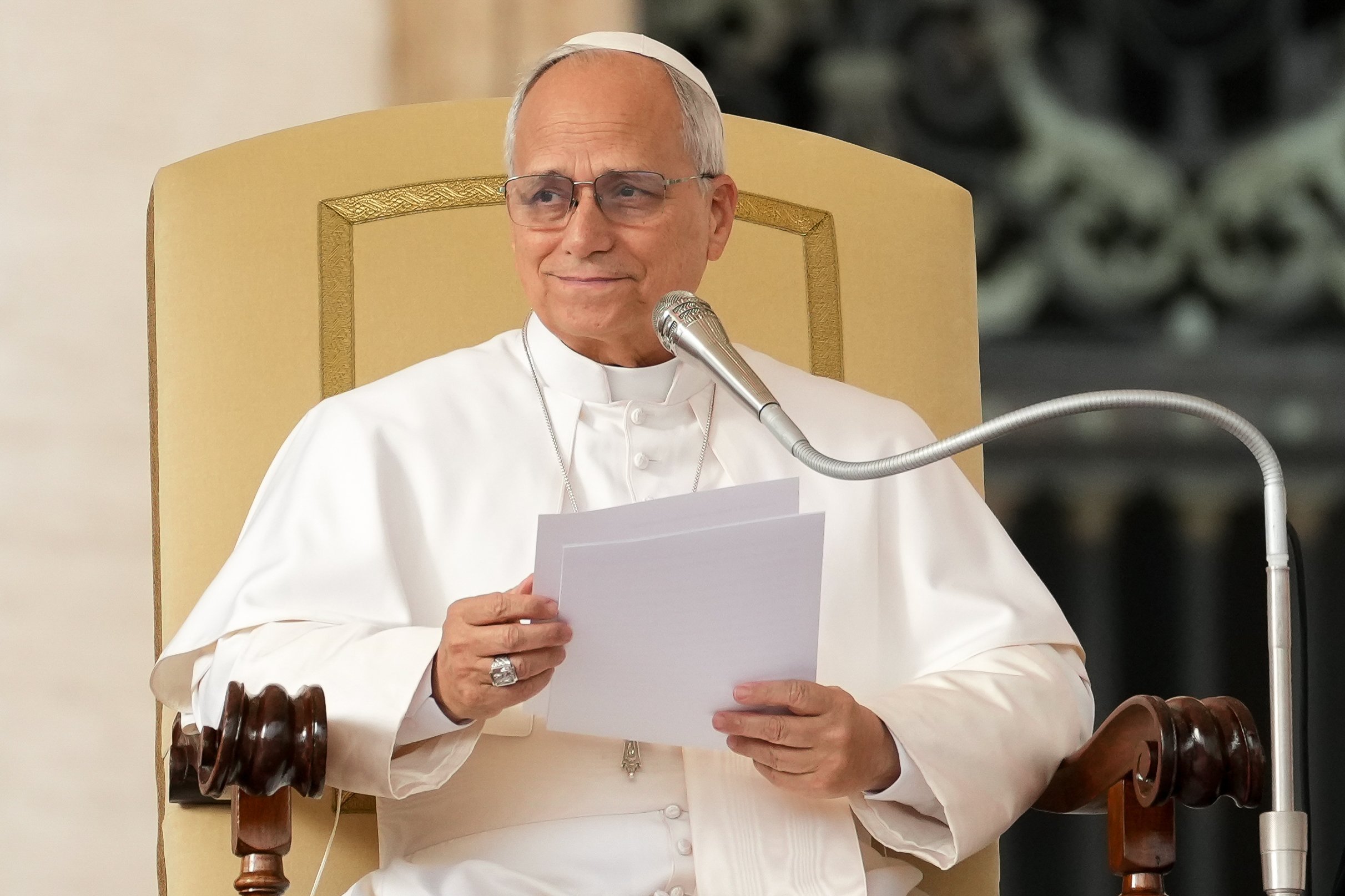

This is the text from Pope Leo XIV’s Dec. 17, 2025 general audience given in St. Peter’s Square.
Dear brothers and sisters, good morning and welcome!
Human life is characterized by a constant movement that drives us to do, to act. Nowadays speed is required everywhere in order to achieve optimal results in a wide variety of fields. How does Jesus’ resurrection shed light on this aspect of our experience? When we participate in his victory over death, will we rest? Faith tells us: yes, we will rest. We will not be inactive, but we will enter into God’s repose, which is peace and joy. So, should we just wait, or can this change us right now?
We are absorbed by many activities that do not always leave us satisfied. A lot of our actions have to do with practical, concrete things. We have to assume responsibility for many commitments, solve problems, face difficulties. Jesus too was involved with people and with life, not sparing himself, but rather giving himself to the end. Yet we often perceive how too much doing, instead of giving us fulfillment, becomes a vortex that overwhelms us, takes away our serenity, and prevents us from living to the fullest what is truly important in our lives. We then feel tired and dissatisfied: time seems to be wasted on a thousand practical things that do not, however, resolve the ultimate meaning of our existence. Sometimes, at the end of days full of activities, we feel empty. Why? Because we are not machines, we have a “heart;” indeed, we can say that we are a heart.
The heart is the symbol of all our humanity, the sum of our thoughts, feelings and desires, the invisible centre of our selves. The evangelist Matthew invites us to reflect on the importance of the heart, quoting this beautiful phrase of Jesus: “For where your treasure is, there will your heart be also” (Mt 6:21).
It is therefore in the heart that true treasure is kept, not in earthly safes, not in large financial investments, which today more than ever before are out of control and unjustly concentrated at the bloody price of millions of human lives and the devastation of God’s creation.
It is important to reflect on these aspects, because in the numerous commitments we continually face, there is an increasing risk of dispersion, sometimes of despair, of meaninglessness, even in apparently successful people. Instead, interpreting life in the light of Easter, looking at it with the risen Jesus, means finding access to the essence of the human person, to our heart: cor inquietum. With this adjective “restless,” Saint Augustine helps us understand the human being’s yearning for fulfillment. The full sentence refers to the beginning of the Confessions, where Augustine writes: “Lord, you have made us for yourself, and our hearts are restless until they rest in you” (I, 1,1).
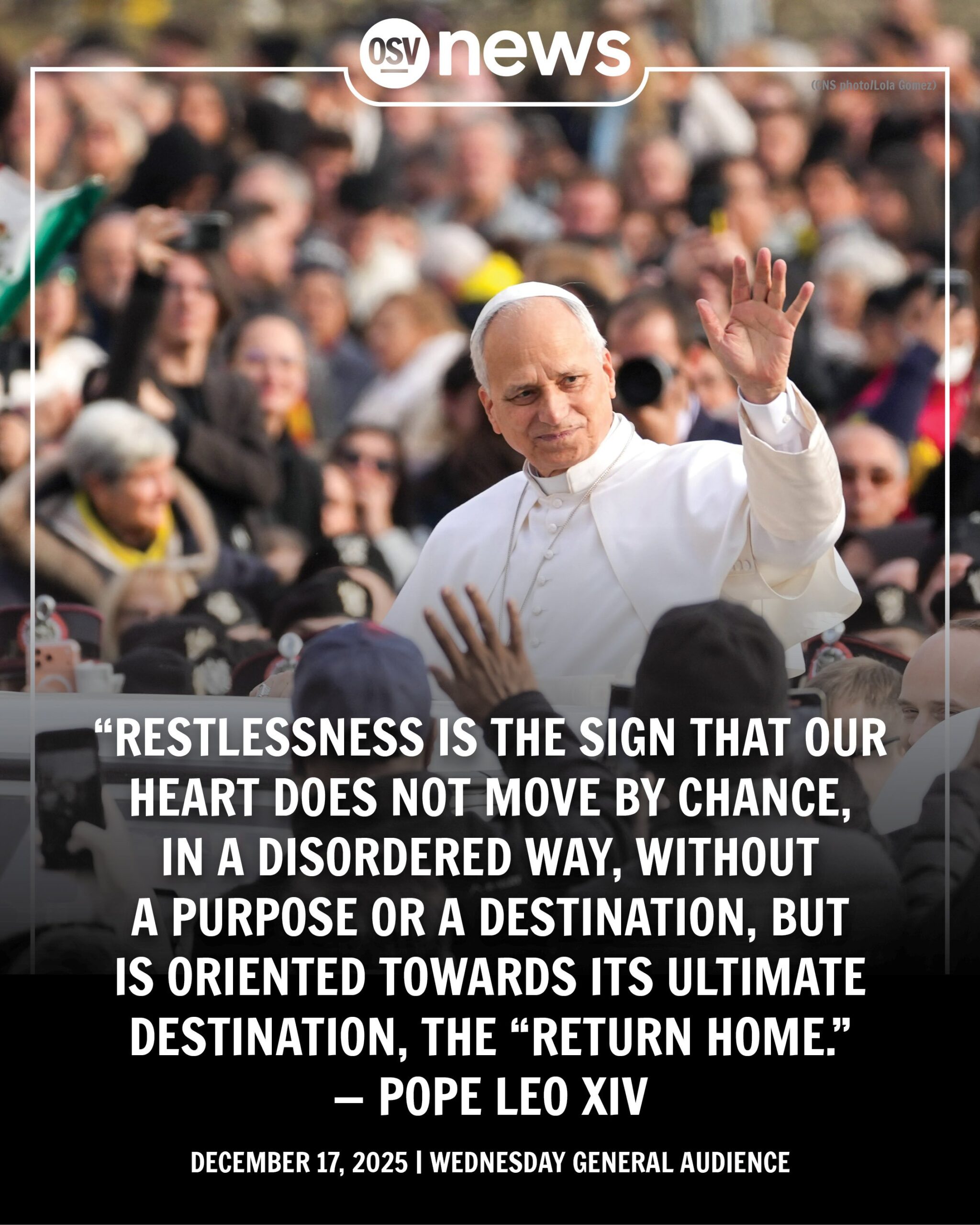
Restlessness is the sign that our heart does not move by chance, in a disordered way, without a purpose or a destination, but is oriented towards its ultimate destination, the “return home.” The authentic approach of the heart does not consist in possessing the goods of this world, but in achieving what can fill it completely; namely, the love of God, or rather, God who is Love. This treasure, however, can only be found by loving the neighbor we meet along the way: brothers and sisters in flesh and blood, whose presence stirs and questions our heart, calling it to open up and give itself. Our neighbor asks us to slow down, to look them in the eye, sometimes to change our plans, perhaps even to change direction.
Dear friends, here is the secret of the movement of the human heart: returning to the source of its being, delighting in the joy that never fails, that never disappoints. No one can live without a meaning that goes beyond the contingent, beyond what passes away. The human heart cannot live without hope, without knowing that it is made for fullness, not for want.
Jesus Christ, with his incarnation, passion, death and resurrection, has given us a solid foundation for this hope. The restless heart will not be disappointed, if it enters into the dynamism of the love for which it was created. The destination is certain, life has triumphed, and in Christ it will continue to triumph in every death of daily life. This is Christian hope: let us always bless and thank the Lord who has given it to us!
— Greeting in English —
I extend a warm welcome this morning to all the English-speaking pilgrims and visitors taking part in today’s audience, especially those coming from Nigeria, Indonesia and the United States of America. I pray that each of you, and your families, may experience a blessed Advent in preparation for the coming of the new born Jesus, Son of God and Savior of the world. God bless you all!
— Summary of the Holy Father’s words —
Dear brothers and sisters, in our catechesis on the Jubilee theme of “Jesus Christ our Hope,” today we reflect on the resurrection as the firm foundation of our hope in our daily lives. In our fast-paced society, we can often feel overwhelmed by pressures and expectations for greater efficiency and optimal results. When we feel this way, let us remember the words that we just heard from the gospel of Saint Matthew: “For where your treasure is, there your heart will be also” (Mt 6:21). Our heart’s treasure is not the goods of this world, neither prosperity, nor success, nor admirable achievements! Indeed, Saint Augustine described our hearts as restless. That restlessness is not arbitrary and disordered; it is oriented towards heaven, whose doors are open to us thanks to the incarnation, passion, death and resurrection of Jesus Christ. If we enter into the dynamism of his love and grace, he will be victorious in us — not just at the hour of our death, but also today, right now, and every day hereafter.


