
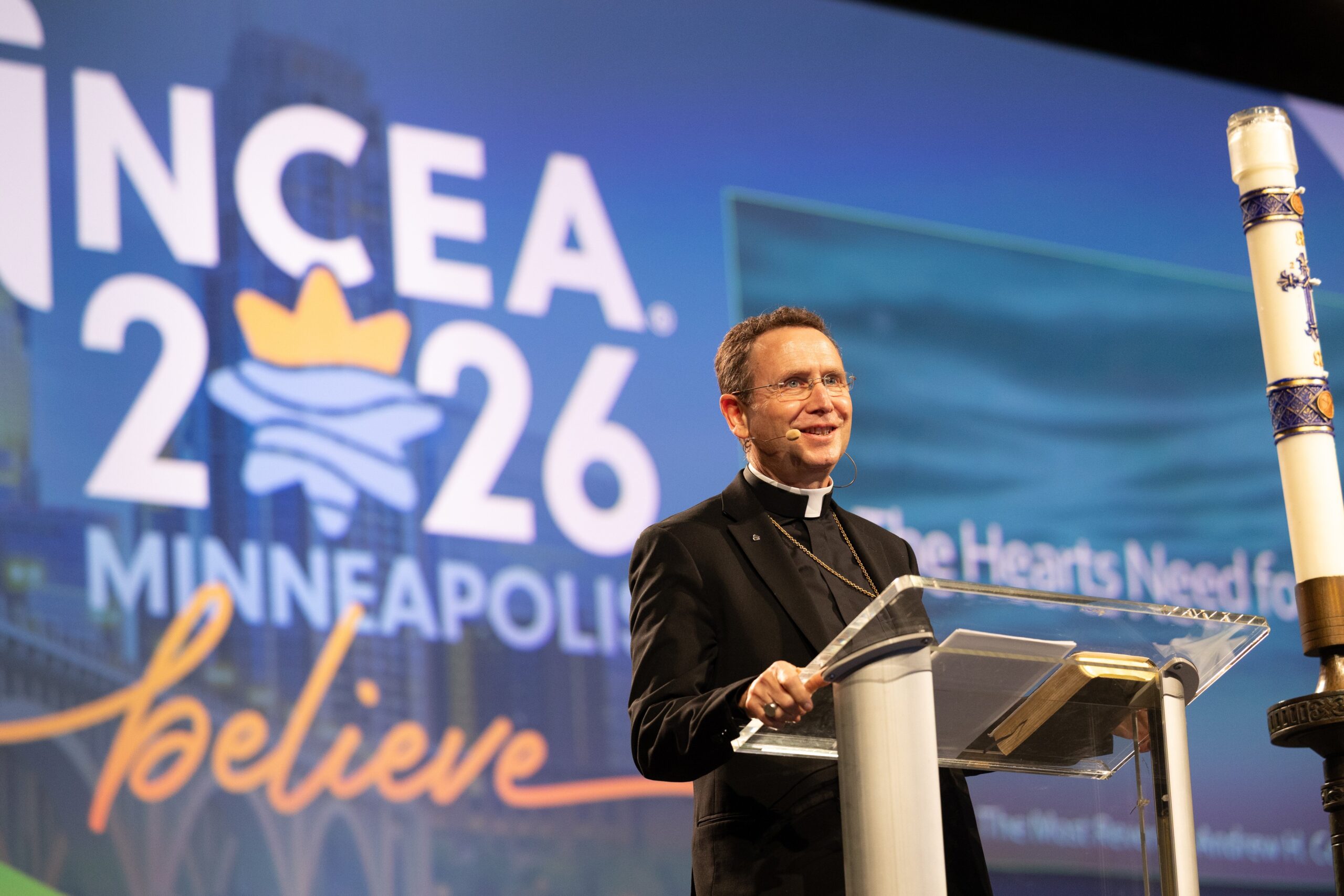

MINNEAPOLIS — Too many people have wounded hearts, and it is the job of Catholic educators to help heal them, Bishop Andrew H. Cozzens of Crookston said April 7 in a keynote opening the National Catholic Educational Association convention.
NCEA 2026 marked the first time in 17 years the conference was held in Minneapolis. Catholic and religious educators from around the country gathered at the Minneapolis Convention Center to exchange ideas and research related to education.
Steven Cheeseman, president and CEO of the NCEA, helped welcome about 3,800 educators to the April 7-9 conference. He said what people learn at the 2026 conference is not meant to remain in a notebook, but is meant “to be lived, meant to be implemented. It’s meant to be shared.”

Bishop Cozzens stressed that like a spiritual director or pastor, a Catholic educator’s vocation is rooted in helping heal the heart. He shared a video recording of the singer Gracie Abrams during one of her concerts, singing her introspective song “Camden.”
The video, Bishop Cozzens pointed out, showed a young woman who is talented, beautiful, successful and “seems to have everything going for her,” he said. But the lyrics Abrams sings speak to someone who is experiencing sorrow.
“The poetry that she sings about expresses the depth of pain that she carries in her heart, and what’s even more clear is that it resonates with tens of thousands of people in the stadium all her same age,” Bishop Cozzens said. “Many people in the stadium also feel like singing … . Brother(s), sisters, this is the height of popular culture. This is what our young people are singing about, the gaping wounds in their hearts.”
A great evil that comes from social media, Bishop Cozzens said, is that a person’s value comes from their social media likes, and their identity is tied to how they are seen. At the center of his life, Bishop Cozzens said, are three words: relationship, identity and mission. The order is important, he said.
“The most fundamental thing in any person’s life is their relationship, and my identity comes from my relationship,” Bishop Cozzens said. “I’m meant to know who I am, and I’m meant to experience my goodness, because I know I am loved by God. And then my mission comes from my identity. The problem is we get the order all messed up. We learn to take our identity from what we do, not from who we are. We start to take our value from our success and what other people think of us.”
Artificial intelligence can’t help heal the human heart, Bishop Cozzens said. Neither can technology, popular culture or politics. “In fact, it seems to be making it worse,” he said.
Bishop Cozzens asked, “How can we speak to that wound in their hearts?”
“Brothers and sisters, this is why Jesus came,” Bishop Cozzens said. “He cares about those tens of thousands of people in that stadium. He wants to speak to the wound in their hearts. He understands that wound because he created the human heart, and he knows why it’s wounded. He has an answer for it. In fact, brothers and sisters, this is why he opened his own heart.”
It is the job of Catholic educators to invite people to let their hearts be healed by an encounter with the heart of Christ, the one who reveals what it means to be human, the “God who became human to heal our humanity,” Bishop Cozzens said.
Bishop Cozzens said his talk was inspired by a quote from Pope Leo XIV when he spoke to Catholic educators in October 2025 during the Jubilee of the World of Education. Bishop Cozzens said Catholic educators need to know the truth of their own hearts in encounters with the Lord to be able to invite other people to encounter Christ.
“This first must begin with you,” Bishop Cozzens told the crowd. “(The heart) is the place where our deepest longings live, our deepest hopes live, and also our deepest fears. It’s the place where we are meant to know ourselves.
“It can be the place where we love ourselves or the place where we experience shame or even embarrassment. … It can be the place of truth, where we see our dignity, who God created us to be, but it can also be the place where lies live about myself, half-truths, and based on how my heart is, what I believe about myself.”
Bishop Cozzens said there are three practical steps to teach young people that might lead to the healing of their hearts. The first is to understand that hearts are broken. The second is to open young people to the truth that love can heal their hearts. The third is to teach that “when their hearts are healed, they’ll find joy in making a gift of themselves,” Bishop Cozzens said.
Our hearts, Bishop Cozzens explained, are broken because they are affected by sin.
“Healing of the human heart has to happen by experience and it happens primarily through the experience of being loved,” Bishop Cozzens said. “We call it mercy: unearned love. It restores. It regenerates. It reveals the truth about ourselves. This is the love that our young people are longing for, that you and I are longing for, and that God is longing to give.”
To be redeemed is to discover “that I am loved, to discover my own value, because God found me valuable, and thinks I’m valuable, valuable enough to die for,” Bishop Cozzens said.
“You have the opportunity to teach your young people the value of their hearts,” Bishop Cozzens said.
The author, Josh McGovern, is a reporter at The Catholic Spirit, newspaper of the Archdiocese of St. Paul and Minneapolis. This story was originally published by The Catholic Spirit and is distributed through a partnership with OSV News.