


Mass at the Eucharistic Procession
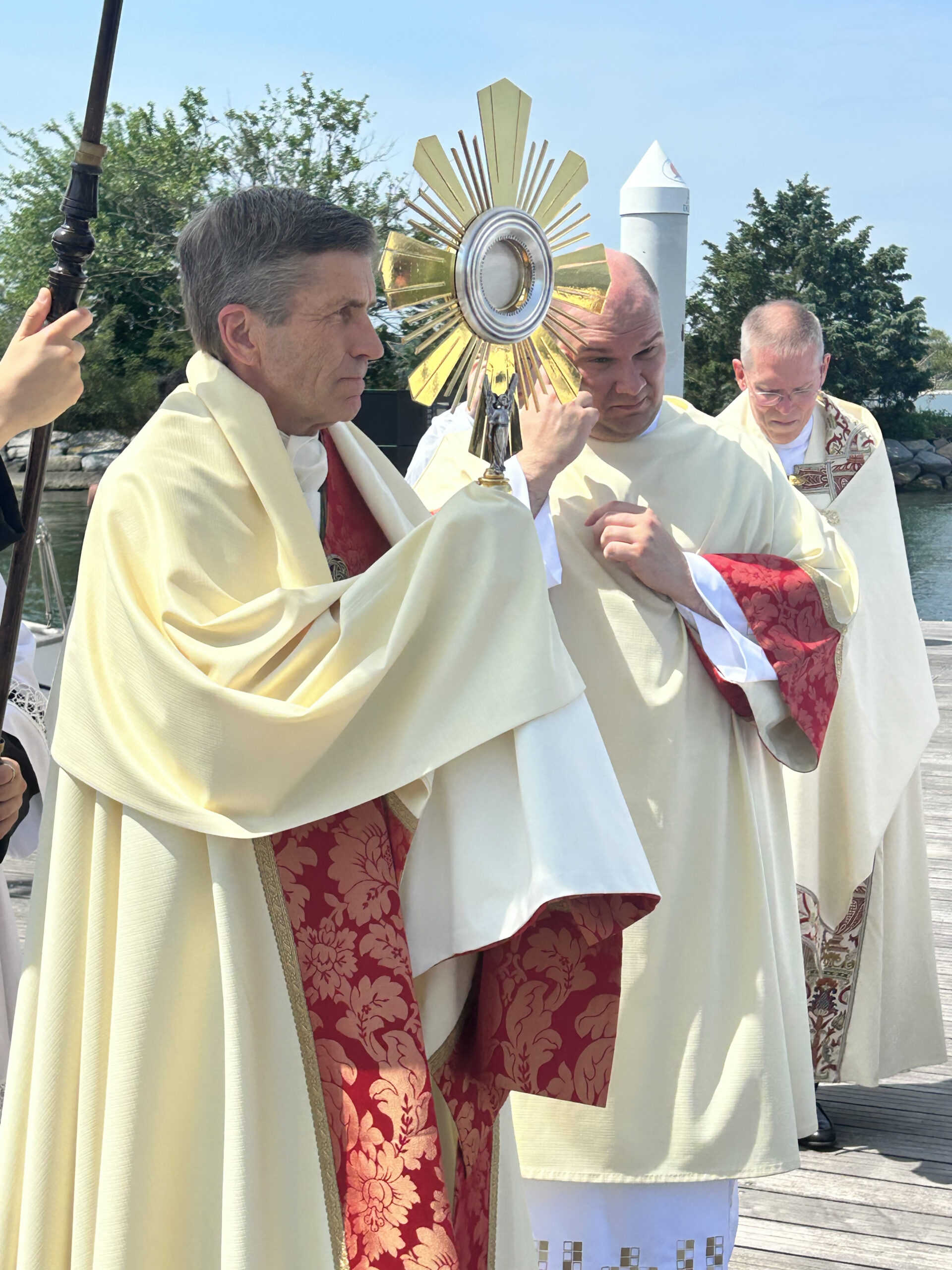
As we gather this morning as part of the National Eucharistic Pilgrimage, may we be amazed, may we be nourished and may we be sent. Amazement, nourishment and sent. A word on each.
Amazement
While we begin with amazement, we start not with our own amazement but the amazement that we heard about in today’s Gospel. The lead-in to today’s story is the multiplication of fishes and loaves that took place the day before. You undoubtedly know the story. Jesus was moved with pity for the crowd of thousands who had come out to a deserted place in order to hear him speak. While there is no record of the specific message that Jesus gave that day, there was a far more memorable event that took place late that afternoon. Taking two fish and five barley loaves, Jesus was able to provide enough food to feed 5,000 men not to mention the women and children. It is the only miracle other than the resurrection that is mentioned in all four of the Gospels. Truly amazing was it not?
But even more amazing is what we now hear Jesus telling his disciples in today’s Gospel. It is the story of what took place the day after the multiplication of the fishes and loaves. Jesus cuts to the chase and tells those who had followed after him that the only reason they were looking for him was in the hopes of getting more free bread. Why, after all, pass up a good thing? He was their kind of Messiah and he certainly had their vote to be king.


But then Jesus offers something far greater than free bread. He tells them that He is the Bread of Life and anyone who eats his flesh and drinks His blood remains in Him and has eternal life. Pope Benedict explains that in saying this, Jesus “affirms that he has been sent to offer his own life and he who wants to follow him must join him in a deep and personal way, participating in his sacrifice of love… Those loaves, broken for thousands, were not meant,” Pope Benedict continues, “to result in a triumphal march but to foretell the sacrifice on the Cross when Jesus was to become Bread, Body and Blood, offered in expiation” (8/19/2012).
And now, amazingly enough, thousands of years later, Jesus’ sacrifice on Calvary is once again made present as we gather at Mass. He offers to us his Body and Blood so that we might have eternal life. The beautiful Eucharistic hymn of St. Thomas Aquinas’ captures it well: Tantum ergo sacramentum, veneremur cernui—Down in adoration falling, Lo! The sacred host we hail.
The Eucharist is Jesus. Not a symbol of Jesus. Not a reminder of Jesus. Jesus himself. We can be amazed as we stand in awe before the Grand Canyon. Or the technology enabling a person to walk on the moon. Or the power of Niagara Falls. Yet every Mass places us before a miracle far greater than all of those. The King of Kings becomes present upon this altar and gives Himself to us. The God who created the stars, the oceans, and the mountains chooses to remain with us under the humble appearances of bread and wine. He stays with us. He feeds us. He nourishes us.
Nourishment
And that brings us to our second point—nourishment. Unlike ordinary food that, when ingested, becomes part of us, the Eucharist works in exactly the opposite way. The Eucharist enables us in the teaching of St. Augustine to become what we receive. Our nourishment enables us to be transformed more and more into the Christ.
The life and words of Cardinal Francis Xavier Van Thuan are a beautiful illustration of the power of the Eucharist. He had been the archbishop of Saigon for only a short time when he was arrested by the Communists in 1975 and began 13 long years of imprisonment and isolation. He directly attributes his ability to live those years with evangelical joy to the way he was able, through the sacrifice of the Mass, to offer to God the two fish and five loaves of his suffering and how as a result Christ came to him to strengthen and provide for him. He would do this daily at around 3 p.m., the time Jesus died on the cross. From the small amount of wine that had been smuggled into the prison, he would take three drops in his hand and mixing it with one drop of water and crumbs from a host, he would celebrate Mass and be fed with the Body and Blood of Jesus.
In the words of Cardinal Van Thuan, “As the drop of water put into the chalice mingles with the wine, so your life should become one with Christ’s.” I dare say that none of us will experience the harshness of a Vietnamese prison camp. All of us, however, are invited to unite our joys and sufferings with the bread and wine that is offered to God at Mass so that we too might be transformed. Cardinal Van Thuan’s sacrifice was certainly different from the offering we make. What is not different, however, is the opportunity that each of us have in placing the individual offering of ourselves on the paten as it is offered and know the evangelical joy of Christ’s life within us.
Mission
And now for our final point—our mission to be Christ for others. Our national pilgrimage is a beautiful example of who and what we are called to be. Just as we welcomed the Eucharistic procession from the Archdiocese of Baltimore and will bring the Eucharist to the Diocese of Camden tomorrow, we who have received Christ are called to go forth and bring Christ to others.
As we mark the 250 years of the founding of the United States, let us be reminded that long before there was a United States, missionaries carried the Blessed Sacraments across forests, rivers, mountains and plains. They traveled among Native peoples, settlers, immigrants, and frontier communities. Mass was celebrated here on Kent Island as early as 1639 as well as at St. Francis Xavier in Old Bohemia in St. Mary of the Assumption near Hockessin, Delaware, in the early 1700’s, long before 13 colonies came together to form the United States.
As we commemorate the 250th Anniversary of the founding of the United States, may we especially remember the faith that preceded its founding and sustained its flourishing. And may we, as who receive Communion today, be strengthened to go forth and bring Christ to others.
May we be missionaries carrying Christ into our homes, into our schools, into our workplaces, into our public life.
Eternal Life
I began this homily by telling what took place prior to the words that Jesus spoke in today’s Gospel. I end by mentioning what happened after Jesus spoke the words of today’s Gospel to his disciples.
St. John tells us that after hearing these words from Jesus, people began turning away and leaving. What he had said was just too much for them. Jesus, then turns to the Apostles and asked whether they too would leave. Peter answers for the group and asks, “Lord, to whom shall we go, you have the words of eternal life?” May that Eternal Life grow ever deeper within us as we are fed with the Bread of Life.