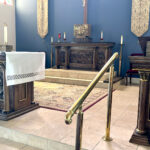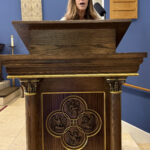

It’s not often that a parish replaces its altar. But at St. John Neumann Parish in Berlin, Maryland, it’s something Father Joseph MPR Cocucci had wanted to do for 14 years, ever since he was appointed pastor.
Historically, altars were made of stone, and, in fact, the Church’s Code of Canon Law assumes a stone altar, though a local Bishops Conference can permit the use of any “worthy, solid material.” As Father explained, “Because the altar is a sign of God’s presence, it should be made of something that is clearly solid and permanent.”
Stone represents permanence and symbolizes Christ as our spiritual rock and cornerstone. The Catholic Church allows wood to be used mainly for moveable altars of less permanence and prefers the use of stone for all permanent altars, such as those in a parish.

Father Cocucci had kept his eyes open for a new altar for years.
Some months ago, when he celebrated Mass for students, faculty and staff at the developing Holy Cross High School in Dover, it occurred to him that his parish’s wooden altar might find a new home.
“I knew they were building a permanent location and that they would have a chapel. It occurred to me that it would be nice for them to have an altar from a local diocesan parish,” said Father Cocucci.
The parish donated its wooden altar and ambo (where the Scriptures are read and homily given) along with a matching pillar on which a tabernacle could be set. That pillar would serve as an “altar of repose,” which is usually located behind the main altar (formally called the “altar of sacrifice”).
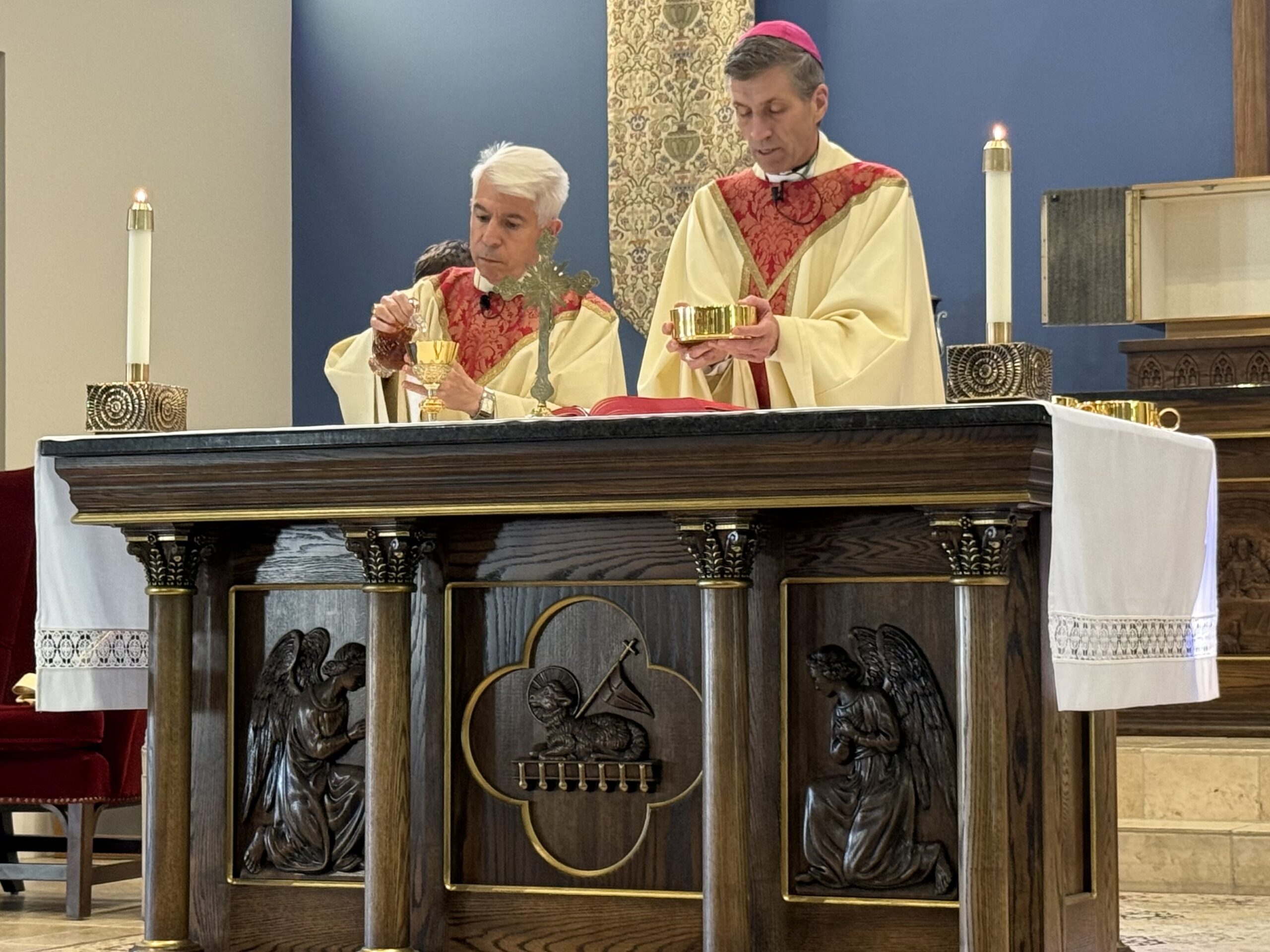
The new altars and ambo were found with the help of the St. Jude Shop in Havertown, PA. They identified a professional artisan who could make an altar with a meticulously carved dark wood base and marbled granite stone on top.
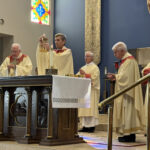
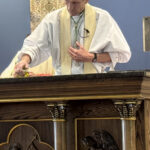
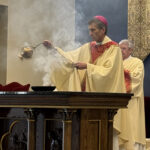
On Saturday, June 20, Bishop William Koenig celebrated a special Mass and ritual for the Rite of Dedication of an Altar, which included the Deposition of a Relic of St. John Neumann in the new altar, Prayer of Dedication, Anointing and Incensation of the Altar and Covering and Lighting of the Altar.
In the early Church, Mass was often celebrated over the graves of martyrs. As the Church grew and many places were needed for the celebration of Mass, the custom arose of placing a relic of a martyr or of another saint underneath (and sometimes within) the altar. In this case, the first class relic of the patron saint of the parish was gifted by a parishioner and placed in a special compartment on the priest side of the altar along with a document proving the authenticity of the relic and a document signed by the Bishop, Pastor, and the two Trustees of the parish, stating that on June 20, 2026, Bishop Koenig consecrated the altar. With all items inside, the compartment was sealed permanently.
“The Altar and its position in the center of the Church signifies how Christ is the center of our life,” said Bishop Koenig. “At the table, the sacrificial banquet nourishes us. And the candles show us that Christ is the light of the world. We are called to bring Christ to people and people to Christ.”
Because the dedication occurred on Father’s Day weekend, Father Cocucci thanked all fathers for nourishing their families as well.
“It was a historical ritual that you don’t see very often,” said Cantor Christine Scott. “And, it was beautiful.”
19-year-old Brian Herbert radiated his own joy about the new altar. Herbert, who served as Lector, recently suffered with lymphoma in part of his leg, enduring multiple rounds of chemotherapy. Herbert affirms the foundational strength his faith gave him through illness and recovery.
“It’s a beautiful altar; I love it because it changes the look of the church and symbolizes Christ as our rock.”