
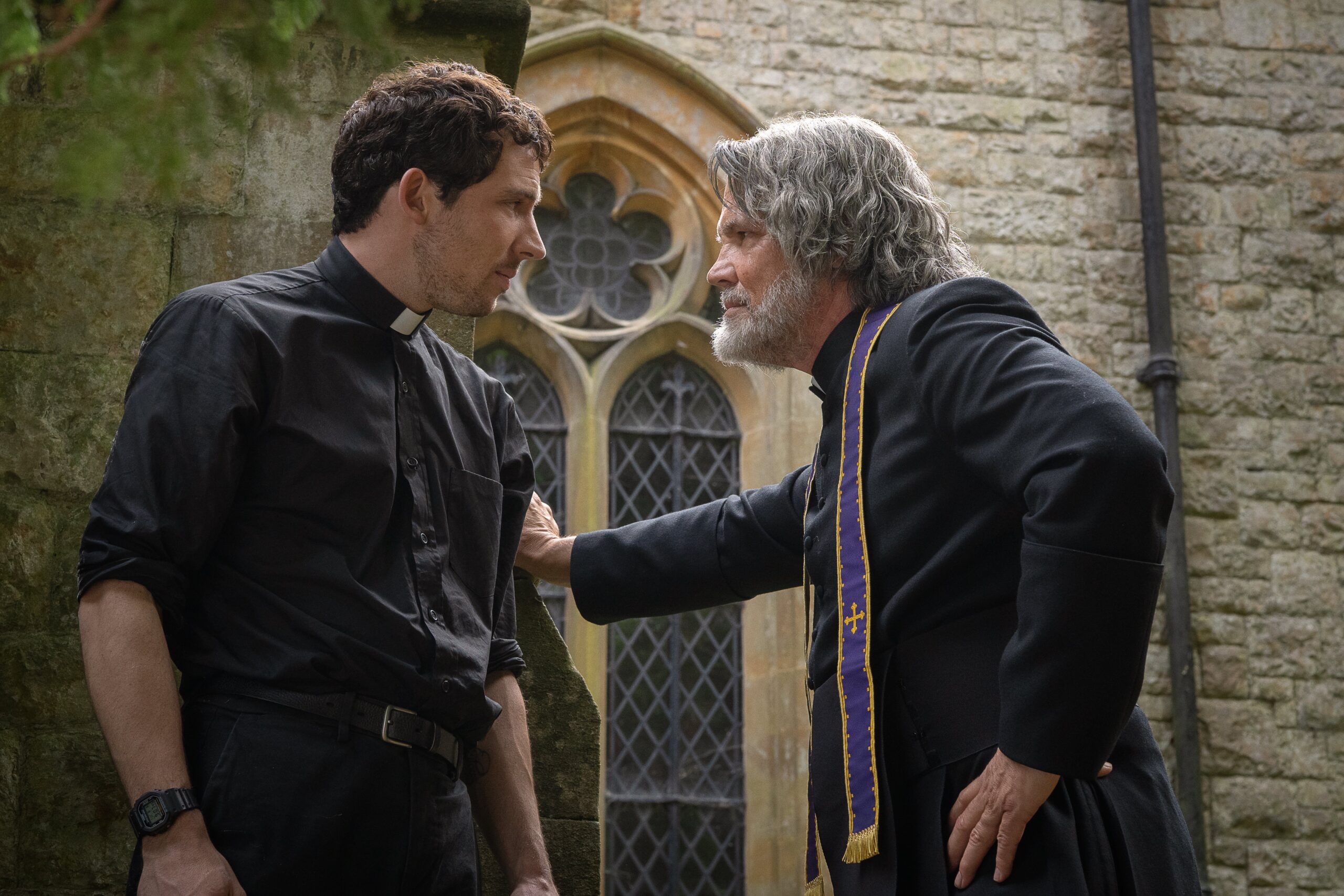



The new “Knives Out” movie is out on Netflix, and Catholic commentators are rightly fascinated by its winsome portrayal of a young Catholic priest, the protagonist accused of committing the film’s locked-room murder.
Most reviews have zeroed in on a scene that is arguably the moral heart of the film: Father Jud Duplenticy (Josh O’Connor), on the phone with a stranger, chooses to set aside his (extremely pressing) needs in order to be a pastor to someone who needs one. He does what every priest I know would do if, say, asked in an airport to hear an impromptu confession or while driving past a bad accident: He stops. Indeed, time itself seems to stop. He diminishes, setting himself aside, yet at the same time fills the moment with a deeper presence.
This character trait is clearly meant to be a positive one by director Rian Johnson, a quiet heroism juxtaposed to the crude and brash culture warrior (an older priest) who is murdered in the middle of the Good Friday liturgy. And it also clearly flummoxes Benoit Blanc (Daniel Craig), our detective hero from the previous two “Knives Out” movies.
This gets at the dynamic I found most compelling in “Knives Out: Wake Up Dead Man.” As much as Father Jud’s Pope Francis-esque, open arms of mercy are meant to contrast with the murder victim’s literal fist shaking and condemnations from the pulpit, Blanc’s rationalism serves a different type of foil to Father Jud’s deep, abiding faith in the midst of turmoil.
When Blanc and Father Jud first meet, their dialogue in the church — a stone structure that could’ve been plucked out of a British vicarage detective show — draws out their differing visions.
“I feel the grandeur, the mystery, the intended emotional effect,” Blanc begins to soliloquize in his trademark over-the-top drawl and diction. Then, a moment of vulnerability: “It’s like someone has shone a story at me that I do not believe. It’s built upon the empty promise of a child’s fairy tale, filled with malevolence and misogyny and homophobia and its justified untold acts of violence and cruelty while all the while, and still, hiding its own shameful acts. So like an ornery mule kicking back, I want to pick it apart and pop its perfidious bubble of belief and get to a truth I can swallow without choking.”
Blanc’s bracing assessment of Christianity’s beauty, its stains, and his own inability to accept it wins an unoffended nod from Father Jud. This is not new territory for the priest. He might be distraught over the murderous turn of events and what it might mean for his vocation, but he can respond to Blanc with winsome sincerity, unshaken.
“You’re right. It’s storytelling,” he says. “The rites and rituals and costumes, all of it.” Voice cracking, he continues: “I guess the question is, do these stories convince us of a lie? Or do they resonate with something deep inside us that’s profoundly true? That we can’t express any other way except storytelling?”
It’s a response that wins Blanc’s respect, and their mystery-solving capers go from there. In terms of telling the story of Catholicism, “Wake Up Dead Man” does seem to stumble. Rian Johnson consulted with a Catholic priest prior to filming (and by all indications, approached those conversations in good faith), but as Leah Libresco Sargeant points out at Word on Fire, the film takes some liberties with its depiction of confession.
At times, its depiction of the church feels more like a tour of American evangelicalism. (Johnson himself grew up immersed in evangelical culture). And like Blanc’s exaggerated speech, the Catholic characters are absurd: the wannabe GOP hotshot/social media maven who livestreams every interaction, the conservative novelist whose descent into an embattled mentality includes digging a literal moat around his cabin.
To use Blanc’s image, many Catholics who identify as conservative will likely find “Wake Up Dead Man” hard to swallow.
Yet, I keep coming back to two things: First, in turning to satire and caricature — the bread and butter of the whole “Knives Out” franchise — Johnson is also using storytelling techniques to express something about reality. Some early scenes featuring confession are absurd, but a character is also treating the sacrament like a sham, a tool of abuse and humiliation. Toward the movie’s conclusion, a sincere confession takes place (both in terms of the sacrament and the murder mystery), and even viewers unfamiliar with the rite will clearly see the difference. The words of absolution are spoken tenderly and carry weight. Grace is here, where before there was shame; there is reverence at what is transpiring at a deep, spiritual level.
Johnson builds up a world of ridiculous characters and conceits (including Benoit Blanc himself) so that in the moment of truth, hyperbole can fall away and leave us simply with what is real. In all three “Knives Out” movies, the heroes share a virtue of normalcy among absurdity — their stability derives from their goodness, and vice versa. It is incredible to me that in “Wake Up Dead Man,” the truth that endures is Christianity.
Which brings me to my second point, and back to Father Jud and Blanc’s exchange about storytelling. Johnson has described that scene as “nakedly the two things inside of me going at it” — Christianity’s scandals versus its compelling story. “Wake Up Dead Man” dismisses neither. As seriously as the film portrays a priest who embodies the Good News of grace and redemption, it does not shy away from depicting real tendencies to twist that Gospel into a grasp for power. It is clear what vision of Christianity attracts Johnson, just as it catches Benoit Blanc off guard.
I am reminded of a quote by one the past century’s greatest storytellers, Madeline L’Engle: “We draw people to Christ not by loudly discrediting what they believe, by telling them how wrong they are and how right we are, but by showing them a light that is so lovely that they want with all their hearts to know the source of it.”
“Wake Up Dead Man” may not share your politics, but it offers a timeless reminder that transcends ideology: The Gospel’s saving message is attractive and compelling, even in a skeptical world. We need only step aside and let false fronts fall away.
Liz Hansen writes for OSV News from Michigan.