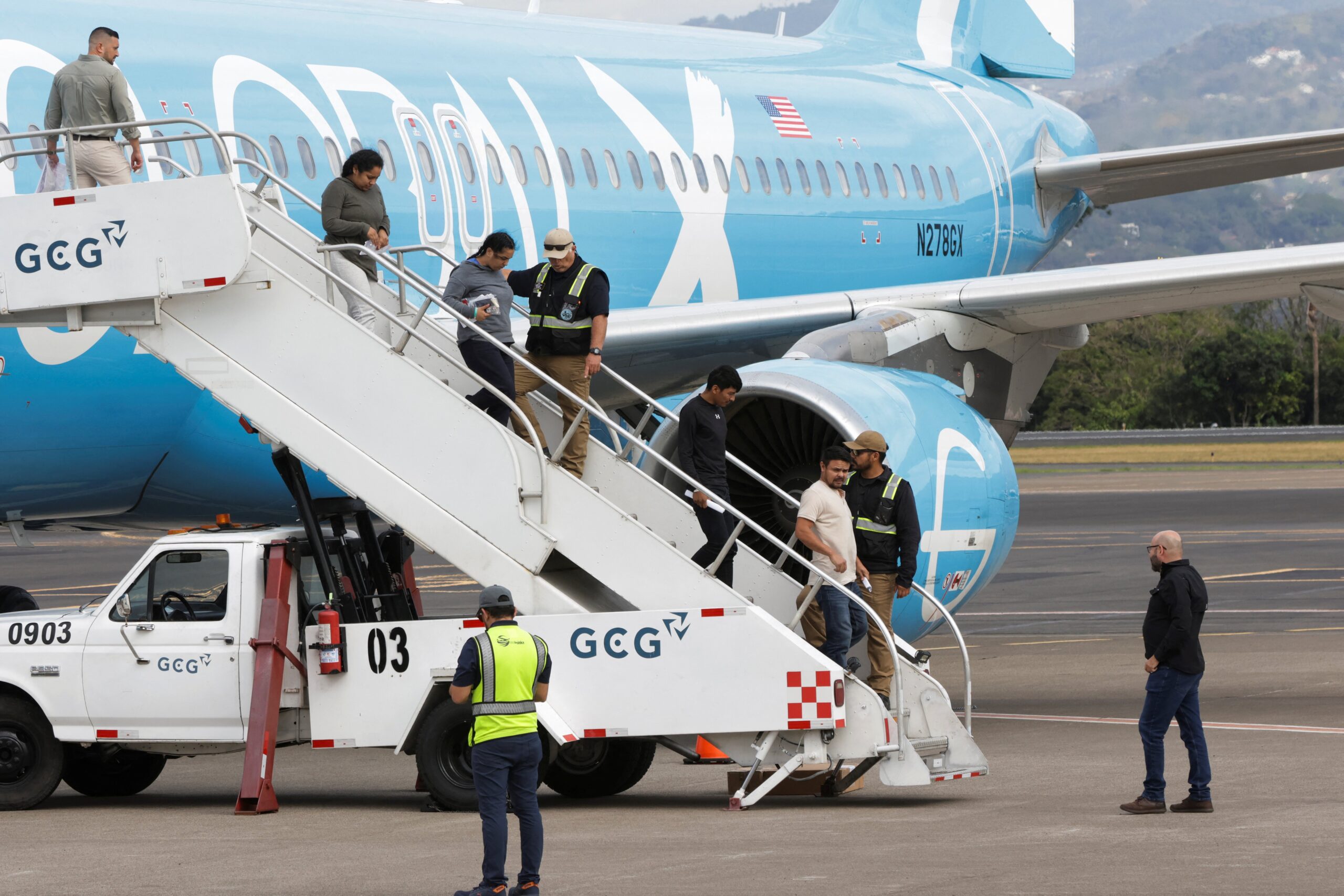

The Catholic Church in Costa Rica has expressed concern over an agreement signed by the government and the United States under which the Central American country will receive up to 25 migrants per week deported by Washington.
The first flight, carrying citizens from Albania, Cameroon, China, Guatemala, Honduras, India, Kenya and Morocco, arrived April 11 in San José, according to Costa Rica’s General Directorate of Migration.
The memorandum of understanding, signed in March by outgoing President Rodrigo Chaves — who will step down May 7 and be replaced by President-elect Laura Fernández Delgado — and U.S. envoy Kristi Noem, stipulates that Costa Rica will receive groups of third-country nationals each week.

Each group will be sent to a hotel and will spend the first seven days under the auspices of the International Organization for Migration. After that, it is unclear how the program will continue.
“The church was not consulted by the government before the agreement was signed,” Auxiliary Bishop Daniel Blanco Méndez of San José told OSV News.
Bishop Blanco, who leads the Costa Rican bishops’ conference’s Human Mobility Pastoral Ministry, said that the church has much to contribute to the government when it comes to immigration.
Catholic organizations work directly on the issue, providing support to people traveling north to reach the United States or south to return to their countries of origin after encountering problems with U.S. immigration authorities.
“We can offer not only spiritual assistance, but also help through our immigrant centers, temporary shelters, and so on,” Bishop Blanco said.
The Human Mobility Pastoral Ministry expressed concerns about the process because of a previous experience. In 2025, nearly 200 foreigners were sent by the United States on a plane and housed in a so-called Temporary Migrant Care Center, or CATEM, located in a remote forested area near the border with Panama.
“If it were not for a court ruling that restored their rights, they would probably still be facing adverse conditions,” Father Gustavo Meneses Castro, executive secretary of the Human Mobility Pastoral Ministry, told OSV News.
The group was effectively detained in the CATEM for two months. After the Costa Rican Constitutional Court ruled the situation unconstitutional, many returned to their home countries or moved to third nations.
Now, a year later, the church has reason to believe that the country remains unprepared to receive and handle such a diversity of nationalities.
“I doubt the government has the capacity to deal with such diversity. How can you provide adequate assistance without speaking their languages, for instance?” Father Meneses said.
Sending people back to their countries without knowing the conditions they will face there is also dangerous, he added.
He also expressed concern about the lack of a program to integrate into society those who may wish to remain in Costa Rica.
“The government said there will be a special regime for those who want to apply for refugee status or temporary work. But immigration authorities have already received a large number of requests, especially from Nicaraguans and Venezuelans, and have been unable to process them,” the priest explained.
Father Meneses said that the Human Mobility Pastoral Ministry had requested a meeting with the General Directorate of Migration in March, but it was canceled just a few hours before the scheduled time.
The pastoral ministry released a statement April 6 on the memorandum of understanding. In the document, it said that “every migration policy must focus on human dignity and on the unrestricted respect for fundamental rights.”
The statement also listed the human principles that must be upheld by the agreement, mentioning the need to offer “dignified conditions of reception, with assistance, safety, and well-being.”
“The Gospel reminds us: ‘I was a stranger and you welcomed me,'” the letter concluded.
Father Meneses told OSV News that Costa Rica has been accepting such agreements with the United States due to diplomatic pressure.
“The new Immigration and Customs Enforcement (ICE) measures have been overcrowding U.S. facilities, so they now need to send some deportees to other countries,” he said.
Bishop Blanco told OSV News that President-elect Fernández had met with members of the bishops’ conference and hopes that she will meet again with church leaders in May.
“She showed herself open to dialogue and willing to receive the Church’s help,” he said.