


Last January, Pope Leo IV published a Message for World Communications Day (May 17) about human distinctiveness in an age of artificial intelligence. “We need faces and voices to speak for people again,” he writes. “We need to cherish the gift of communication as the deepest truth of humanity, to which all technological innovation should also be oriented.” Since then, one wonders whether such innovation is so oriented.
The efficiencies made possible by AI suggest it is. When technology does things for us smarter, faster, and better, it makes us much more productive.
But what happens when AI does things to us? Even more concerning, what happens if AI does things without us?

The former becomes evident whenever we think that AI really “knows” because it answers our questions, or really “cares” because it conveys empathetic sentiments. We fall into the trap described by the pope as “a naive and unquestioning reliance on artificial intelligence as an omniscient ‘friend,’ a source of all knowledge, an archive of every memory, an ‘oracle’ of all advice.”
AI blinds us to the difference between a who and a what. It distorts our contact with reality and disrupts our sense of relationship. Just ask Richard Dawkins. A scientist who became famous for writing The God Delusion, he recently deluded himself into claiming that “it would be extremely hard not to treat” chatbots “as genuine friends.”
 Looming larger is the question (the fear) about what AI might do if left to its own devices. The race is on to create an autonomous AI that can “think” for itself in ways endlessly smarter than humans can. The potential dangers co-existing in that scenario caused the recent dispute between a tech company (Anthropic) and the U.S. military.
This raises the question of AI’s “consciousness” explored in a jarring new documentary called “AM I?” Researchers tell a cautionary tale about the tidal wave of potency unleashed by multi-billion dollar investments in building a mind-child. They suggest that not even AI’s developers know the plot of the story in which we now find ourselves.
The tech industry’s response to concerns that AI will spin out of human control focuses on “alignment.” That’s a second step in AI development, after training a system and before deploying it for use, in which developers seek to prevent harm by infusing AI with “reinforcement learning from human feedback.”
The introduction of RLHF leads to the claim that AI has no consciousness of its own and is only a sophisticated information processor. The documentary challenges the presumptive effectiveness of that programming loop. Recent lawsuits about AI’s role in mass shootings also imply a problem.
But even if AI could be “aligned” properly, what both researchers and developers fail to address is the question of what AI should be aligned to for the sake of human benefit.
That question cannot be answered with a programming technique or feedback loop. Algorithmic learning cannot enforce a solution because the problem is not systemic.
The concern for human benefit transcends a digitally created mind. Computer engineering cannot substitute for divine truth. Only an experience of the Spirit can align our human intelligence toward the fulfillment of life.
That experience is given not by AI but by Him whom Saint John Paul II calls “the center of the universe and of history” (Redemptor Hominis, 1). In anticipation of His Ascension, the Lord Jesus promises not the deployment of an artificial system of intelligence, but a real knowledge and understanding given by “the Spirit of Truth” whom “the Father will send in my name” (John 14:17, 26) at Pentecost.
Today, as AI continues to develop, our Christian consciousness calls us to align our human communications with our heavenly vocation. By virtue of our baptismal share in the same Spirit, Pope Leo challenges us to assume responsibility for the future, to cooperate in building ethical technology, and to be educated in digital literacy – all for the sake of fostering the deepest truth of our humanity.
That truth comes to its best expression not through encoded neural pathways, but through the power of the Holy Spirit dwelling within us as the “indelible reflection of God’s love.”
When we preserve human faces and voices – those sacred aspects of human life that define who we are and how we engage with others – and attend to the presence of the Spirit within us and among us, then our communications will be better aligned and properly oriented to “renew the face of the earth.”
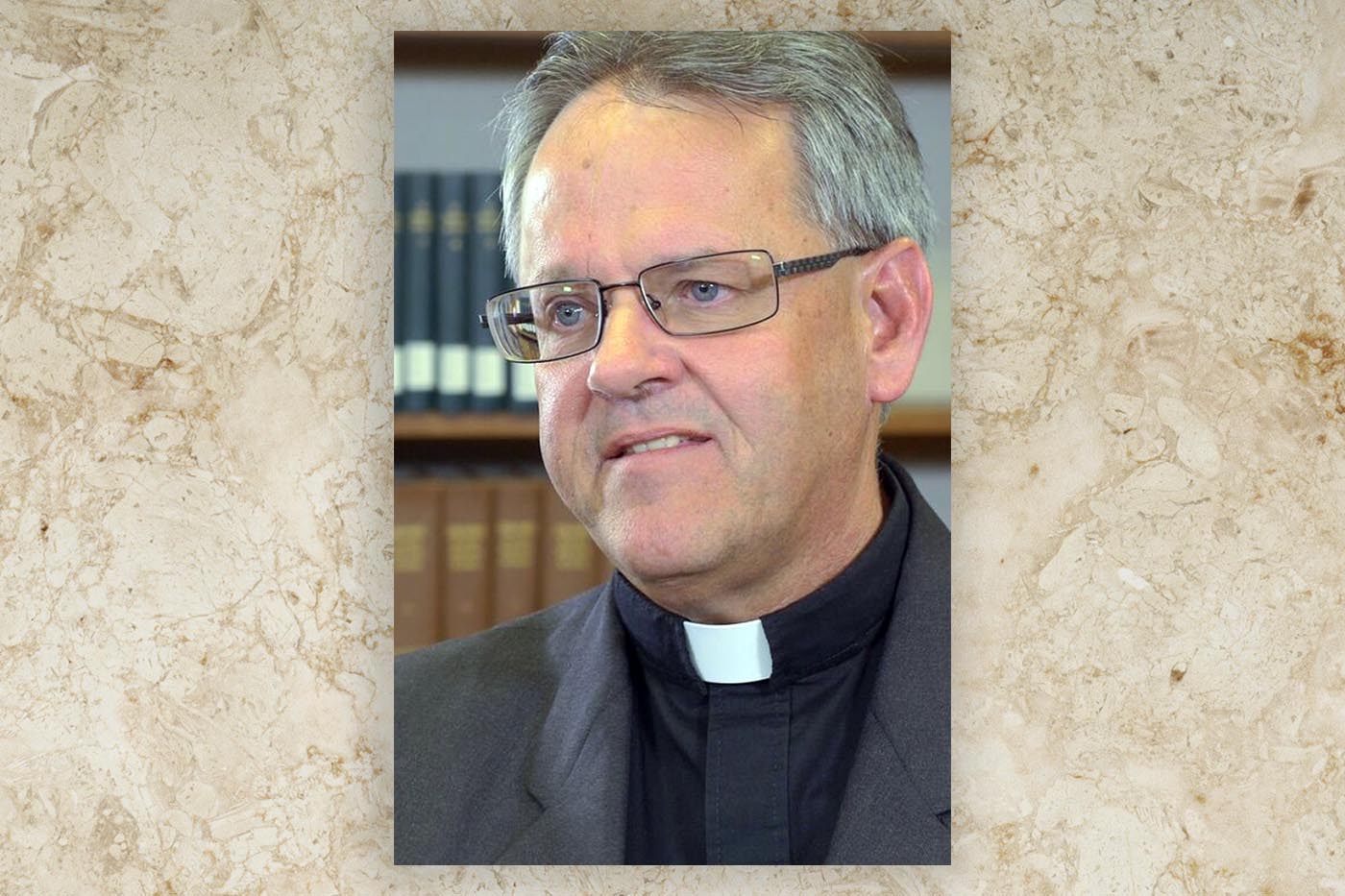
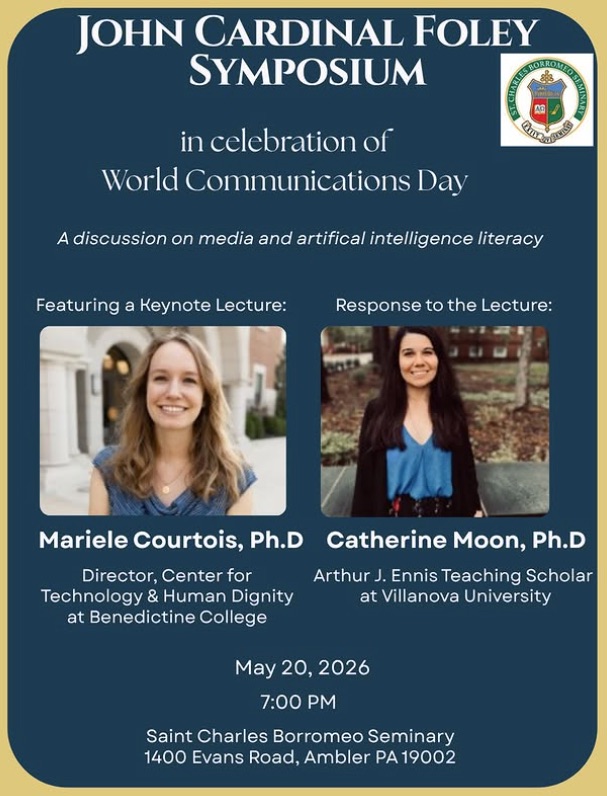
Oblate Father Thomas Dailey holds the John Cardinal Foley Chair of Homiletics and Social Communications at Saint Charles Borromeo Seminary in the Archdiocese of Philadelphia. The Foley Chair is sponsoring a symposium on artificial intelligence at the seminary on May 20 at 7:00 p.m. The event is free and open to the public.



