

Scripture readings for Jan. 11, 2026, Baptism of the Lord
Is 42:1-4, 6-7 Ps 29:1-2, 3-4, 3, 9-10 Acts 10:34-38 Mt 3:13-17
Our liturgies carry us to Christ; our worship becomes an encounter. What we adore is revealed in sacrament, revealing our intimate God, the God who draws near, who touches us — again, in sacrament.

What I am talking about is what we celebrate this Sunday: the baptism of the Lord. Our Advent longing and our Christmas adoration draw now to a close, and they culminate in this sacramental moment, the baptism of Jesus. In Advent, we sought him; at Christmas, we adored him; on the feast of the Holy Family, we contemplated him; at Epiphany, we paid him homage as Lord of all.
And now, we encounter him in sacrament. Baptized because he was first baptized, we can’t help but recall our own baptism, the sacrament of death and rebirth in Christ, which is how we encounter the Lord. That’s how the birth of Jesus is made relevant, how Christmas comes to us — in the sacraments we celebrate. I am trying to underline the beautiful mystery our liturgies accomplish, the work of our redemption, our sacramental union with Christ.
This Sunday we celebrate the simple yet marvelous fact that the Christ born at Christmas is the same Christ who submitted to baptism “to fulfill all righteousness” (Mt 3:15). Which is the baptism we know, our baptism into Christ Jesus, into his death, so that we can be raised from the dead like him, that “we too might walk in newness of life” (Rom 6:3-4).
I am, of course, coming at this backwards. I am trying to describe what happens in the liturgical mystery at Christmas. Christ is born for us in mystery; we encounter him in mystery; the name of that encounter is baptism. And that is how we are born into Christ, how we become Christians; it’s how it is no longer we but Christ who lives in us (Gal 2:20).
Which brings us to this passage from Matthew, his account of Jesus’ baptism. In it is revealed just who this Jesus is and what he intends to do. In it thus is revealed also something about who we are and what we are to do since by baptism we are now in Christ.
Coming out of the water, the “heavens were opened for him” and the Spirit falls upon Jesus; in his baptism earth and heaven are joined; the divine and the created come together (Mt 3:16). Just think what this says about your own baptism, how it opens heaven!
But then, pay attention to the voice from the heavens: “This is my beloved son, with whom I am well pleased” (Mt 3:17). What does this teach us? In calling Jesus “my … Son,” his Davidic kingship is evoked (Ps 2:7). In calling him “beloved,” sacrifice is evoked, that is Jesus’ likeness to Isaac (Gn 22:2). In saying that in him God is “well pleased,” Isaiah is evoked, the idea that Jesus is God’s “servant,” the prophetic figure meant to establish “justice on earth” (Is 42:4).
This is who Jesus is. And in these words from heaven are revealed also what he’ll accomplish.
But what does this mean? Now that we’ve been given some clue as to Jesus’ true identity, what comes next? Well, open your Bible and keep reading. For in the very next verse, Matthew writes, “Then Jesus was led up by the Spirit into the wilderness to be tempted by the devil” (Mt 4:1).
After the revelation of God in Christ, the battle begins. After your baptism in Christ, the struggle begins. The mind here already begins to wander toward Lent, soon enough to come. But really, the lesson is more immediately moral, and it’s that although baptism is indeed the sacrament of salvation, that doesn’t mean it signifies the end of the struggle but rather the beginning. That is, once baptized, now you’re ready to take on the devil.
Thus, recalling Christ’s baptism, we should recall ours. Understanding Christ’s identity, we should understand ours. Seeing Christ’s battle against the devil and his sacrifice, we should see ours.
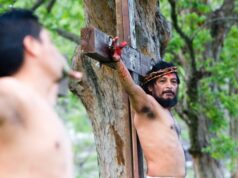
Doesn’t it seem that in the feast of the Baptism of Jesus we begin to turn from Bethlehem to Jerusalem, from the crèche to Calvary? What are we to do with the Christmas we just celebrated but to make our way into the desert, to prepare ourselves, to strengthen ourselves to take up our cross and follow?
Because, of course, baptized into Christ, his life is now ours.
Father Joshua J. Whitfield is pastor of St. Rita Catholic Community in Dallas and author of “The Crisis of Bad Preaching” (Ave Maria Press, $17.95) and other books.