

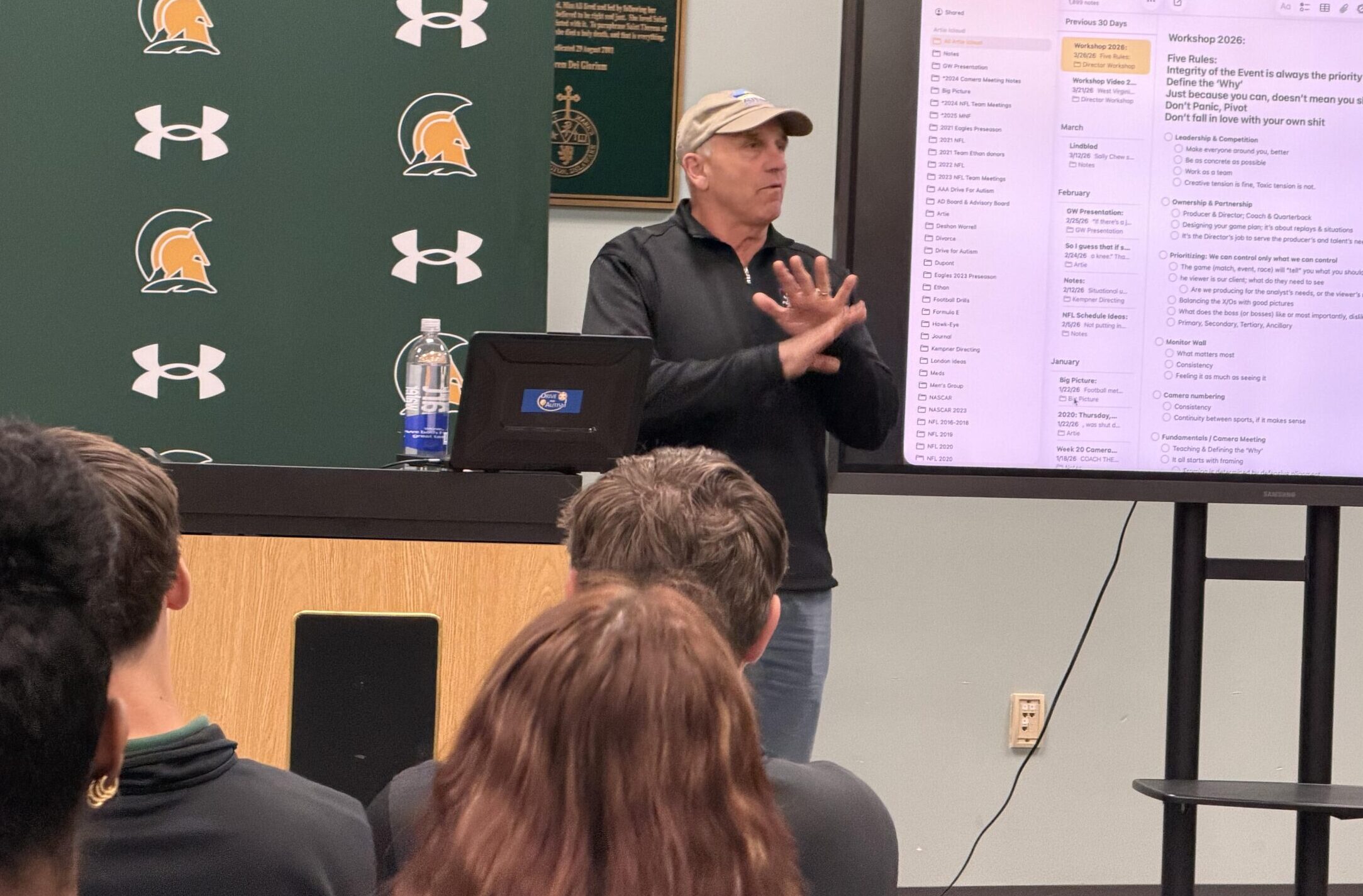

WILMINGTON — A group of students who work in the broadcast studio at Saint Mark’s High School had an opportunity to learn from one of the best in the business.
Artie Kempner, who has spent more than four decades in sports television and the current director of Monday Night Football for ESPN, visited the school on April 21. After a brief introduction, he took questions from students before heading to the school’s broadcast studio, where he sat for an interview.
Kempner told the students he was playing football at the University of Florida back in the late 1970s and early ’80s when he realized he wouldn’t be playing after college. He volunteered to work at an NCAA swimming event, and when he stepped into the television production truck, he was hooked. Forty-four years later, he still gets a thrill from the chaos that is a televised sporting event, and he tried to convey that to the students. Most of his visit was spent answering questions.

One student asked what makes a broadcast special. Kempner said he tries to remember that the broadcast is for the viewer, and he tries to show why and how something worked.
“If we cover the game well, make it entertaining and engaging,” then they have done their job well, he said.
He keeps a list of principles in mind for each broadcast — and in all aspects of his life. The action on the field is most important. He wants to “define the why” — why do things a certain way? Third, just because you can do something doesn’t mean you should, and don’t panic. We should learn to pivot from our mistakes.
Kempner, who lives in Wilmington, said football is the best television sport for a few reasons. One is that there are normally 25 to 30 seconds between plays, which allows for replays and analysis. That doesn’t happen in every sport, and he’s worked on most of them, including stock-car racing and golf.
Kempner worked for Fox Sports for decades before moving to ESPN last year. He said one of the things he had to realize was that the Monday event is more than a game.
“Monday night’s a show,” he said. “It’s prime time.”
The production includes upward of 40 cameras, including one on the quarterback, each receiver and the best defensive end. A typical Sunday game has 13 cameras, he noted.
One student asked about his biggest technological challenges. Kempner said one he recalls happened in the 2017 preseason, when the production truck lost communication with the announcers.
“I’ve worked around a lot of technological malfunctions,” he said. He likened those situations to losing a player to injury.
Kempner was asked how he finds “clarity in the chaos.” He recommended that the students have a plan B and C, and sometimes a D and E.
The best play he can recall is the catch by New York Giants wide receiver David Tyree in Super Bowl XLII in February 2008. Tyree caught a pass from Eli Manning by pressing the ball against his helmet, resulting in a 32-yard gain in the closing minutes. The drive resulted in a Giants touchdown and Super Bowl championship that denied the New England Patriots a perfect season. Kempner directed that telecast.
“That was my resume tape that got me the job at ESPN,” he said. “I’ve just been really blessed to have these opportunities.”
He advised the students to learn where there are opportunities and take advantage of them. That could be right at Saint Mark’s, he said.
“Always look for the unexpected opportunity in life,” he said.
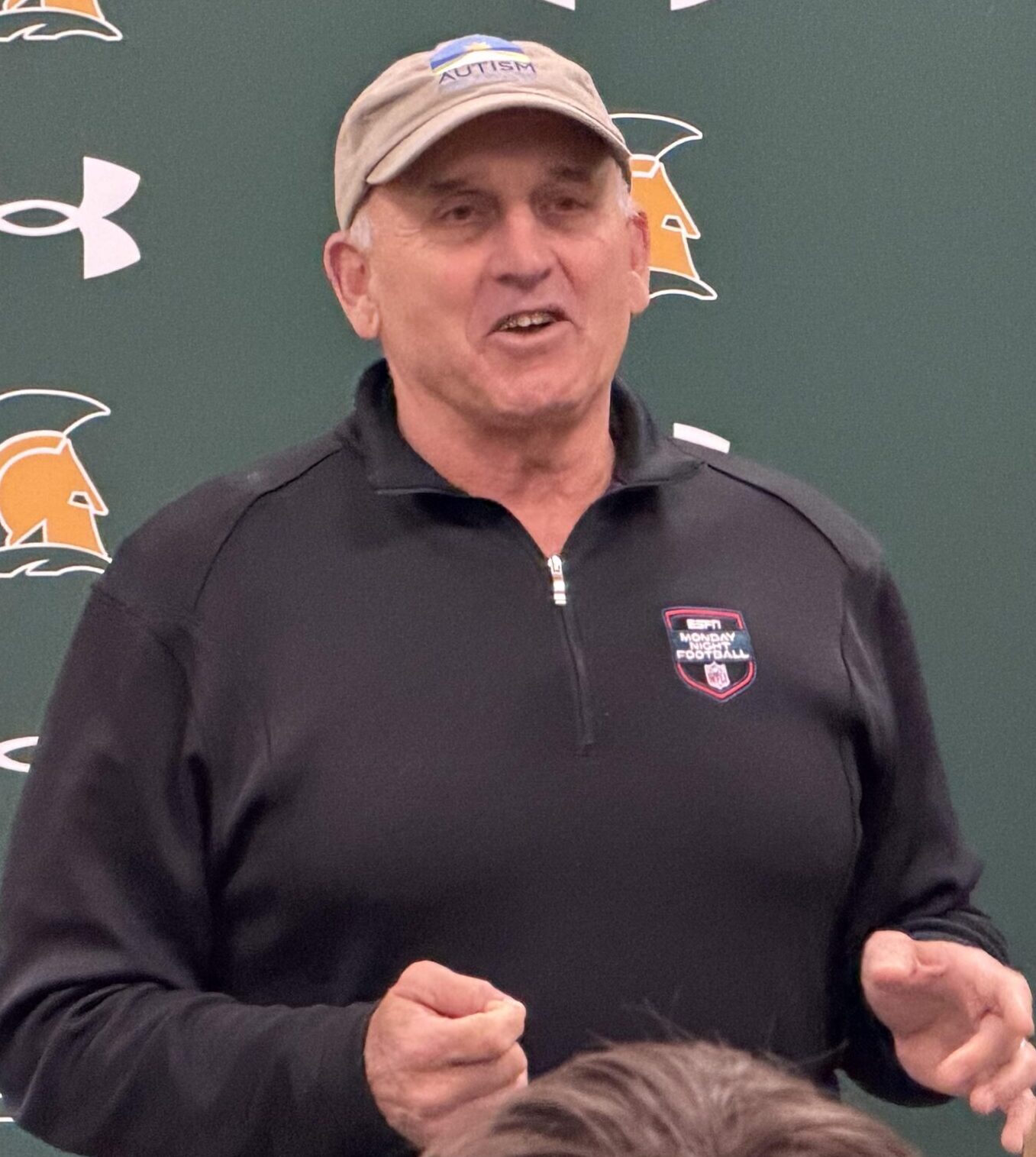
One non-football and non-television topic Kempner mentioned was his work with the autism community. He began his advocacy for that population in 1998 after his son Ethan was diagnosed, and Kempner is the founding president of Autism Delaware. He wore an Autism Delaware baseball cap to Saint Mark’s.
“People with autism on the spectrum are not disabled,” he said. “They are differently abled. Autism acceptance is so important. Welcoming differences is so important.”