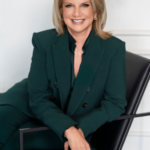



MILLTOWN — Catholic school educators should remember that even if the fruits of their labor are not evident immediately, they are still making an impact on their students. It is a lesson Tracy Davidson learned from her own upbringing.
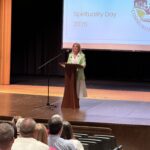
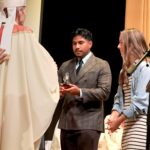
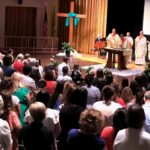
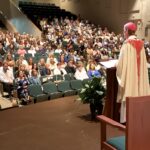
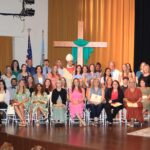
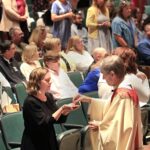
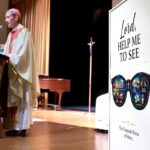
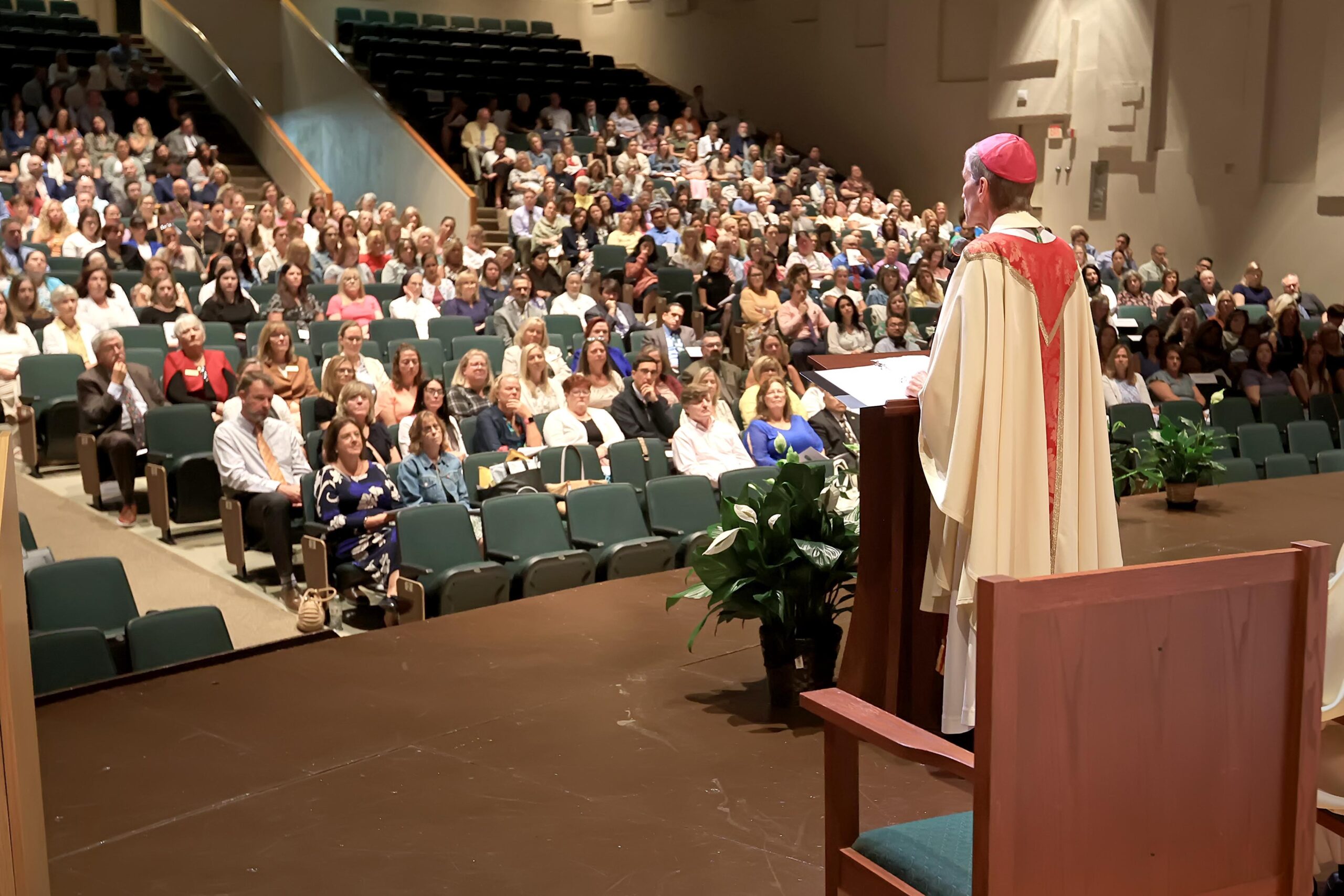
Davidson, the former longtime Philadelphia television news personality, delivered the message as the keynote speaker at the annual spirituality day sponsored by the diocesan Office of Catholic Education. It was held Aug. 25 at Saint Mark’s High School.
She described her own background as “Catholic-lite,” growing up with a mother who battled addiction but made sure her children received their sacraments and prayed every night before bed. Davidson said her mother planted the seeds of her faith.

“Every one of you is in a profession that plants seeds,” she said. “You may never get to stand in the soil where those seeds flourish.
“No matter if you think your words and your care are falling on deaf ears … know that rooted seeds will yield fruit. It may take decades.”
Her own life provides an example. Davidson spent 40 years in television, including three decades at NBC10 in Philadelphia. During that time, her faith strengthened.
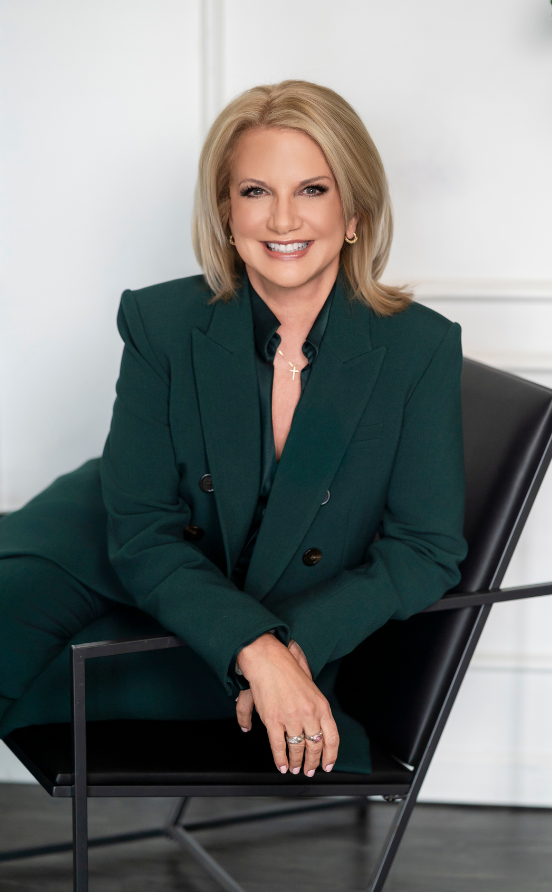
In the early 2000s, she was anchoring the 4 and 5 p.m. newscasts and was the station’s consumer reporter. She also spoke to community groups and served on several boards. She also was training for a 60-mile breast cancer walk.
“I was so busy my head was spinning,” she recalled.
She felt an urge to learn more about her faith and was attending church more often. Some Christian friends invited her to Bible study, and she enjoyed that.
“The next thing I knew, I was thinking maybe I should get a degree in theology,” she said.
Davidson would head to St. Charles Borromeo Seminary near Philadelphia straight from the studio and earned a certificate in religious studies. She received a master’s degree in holistic spirituality from Chestnut Hill College. She wanted others to know that nothing was impossible with God’s love.
“I wanted to be able to talk to people about God’s love, and who’s going to listen to the girl on TV?” she said.
Davidson had covered some significant religious stories while at NBC10. After the death of Mother Teresa, she reported from St. Charles Borromeo, standing in the choir loft while the seminarians were singing.
“It was a very, very special moment,” she said.
Then, in 2013, she traveled to Vatican City for the papal conclave where Pope Francis was elected. She said she called everyone she knew to find out more about the conclave so that she could report on it accurately.
“I hope that I delivered to the Catholic community in our region with my coverage there,” she said.
She kept a meditation prayer book on her desk at work, and she used to read Scripture with interns each day and prayed after the newscast went off the air. Davidson said her faith was a source of comfort on bad days, with weather emergencies, mass shootings and the like. She said she would recite a prayer when news like that broke.
“After something like that happens, a lot of us feel a little hopeless,” she told the teachers. “Obviously, we can pray, and, I always say to myself, ‘I am not hopeless.’ I can put more good into the world, right here, right now. I can be more kind, right here, right now. I can be fully present to anyone I come across today. That’s my power, and that’s your power, too.”
Davidson left television last November despite being offered a new contract. She took a chance by venturing instead into motivational speaking, remembering the advice she had given graduates during a commencement address at Chestnut Hill College in 2013. She encouraged them to take chances but wasn’t doing so herself.
Davidson acknowledged the stress that is part of teaching and of everyday life. Too much stress is not optimal for performance or for health. She offered two ways to cope when you begin to feel like a stretched-out rubber band. The first is emotion regulation.
“Emotions are not good or bad,” she said. “They are helpful. They are information. But some of us, because of our lived experiences, tend to go to one emotion.”
When we get to a “flight or fight” place, our response is one that may bring regret at a later date. She encouraged the educators to “see your emotion” and choose how they want to respond. Step back and realize that they have been doing this a long time, and they have colleagues who are willing to help.
The other technique is to increase the capacity of what we can handle. When a person feels connected and seen, it increases the production of the hormone oxytocin and also social bonding. People are “wired for connection,” although people are lonelier than ever, Davidson said.
She encouraged the crowd to see the face of Jesus in others.
“When you start there, it changes everything,” she said.
She also encouraged them to be fully present for their students.
“What an incredible gift actually to be fully present for someone,” she said. “You have no idea the seeds that you can plant when you choose to offer your full attention, authentic presence, when you see the person in front of you.”
Her assignment for the teachers was to ask someone, “How are you?” and wait for an answer.
“You have the potential to change someone’s life. You have the power to plant seeds that will yield fruit long after the school year ends.”