



By Josephine Peterson, Catholic News Service
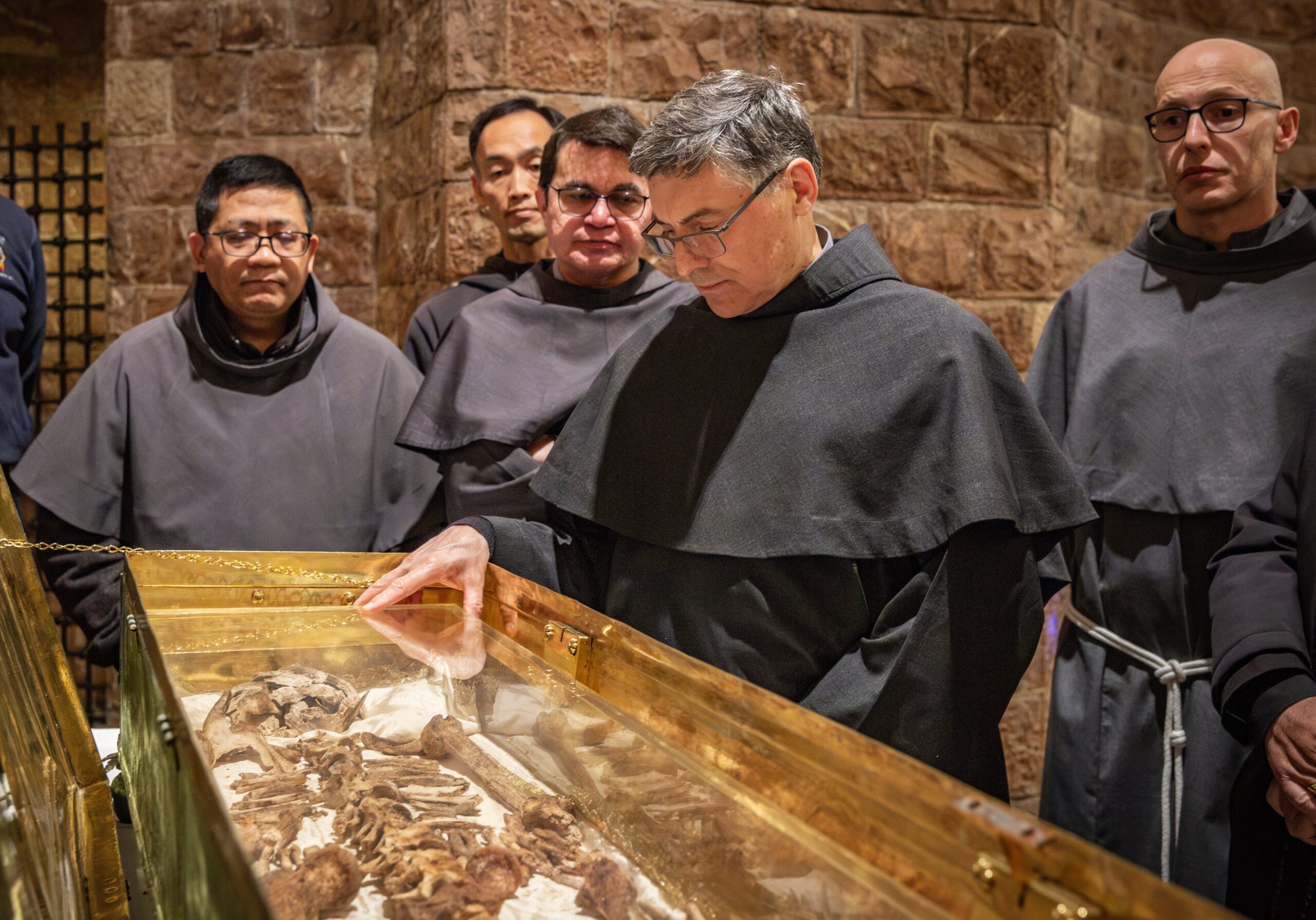
ROME — Eight hundred years after his death, the bones of St. Francis of Assisi have been placed on public display for the first extended public viewing in history, drawing hundreds of thousands of pilgrims to the hilltop town.
Following Pope Leo XIV’s approval and blessing of this exposition, St. Francis’ skeleton was exhumed Feb. 21 from the sarcophagus where it normally rests and placed on a specially prepared table in the crypt of the Basilica of Saint Francis of Assisi. His remains will be on display until March 22, when Cardinal Matteo Maria Zuppi, archbishop of Bologna and president of the Italian bishops’ conference, is to preside over a closing celebration.

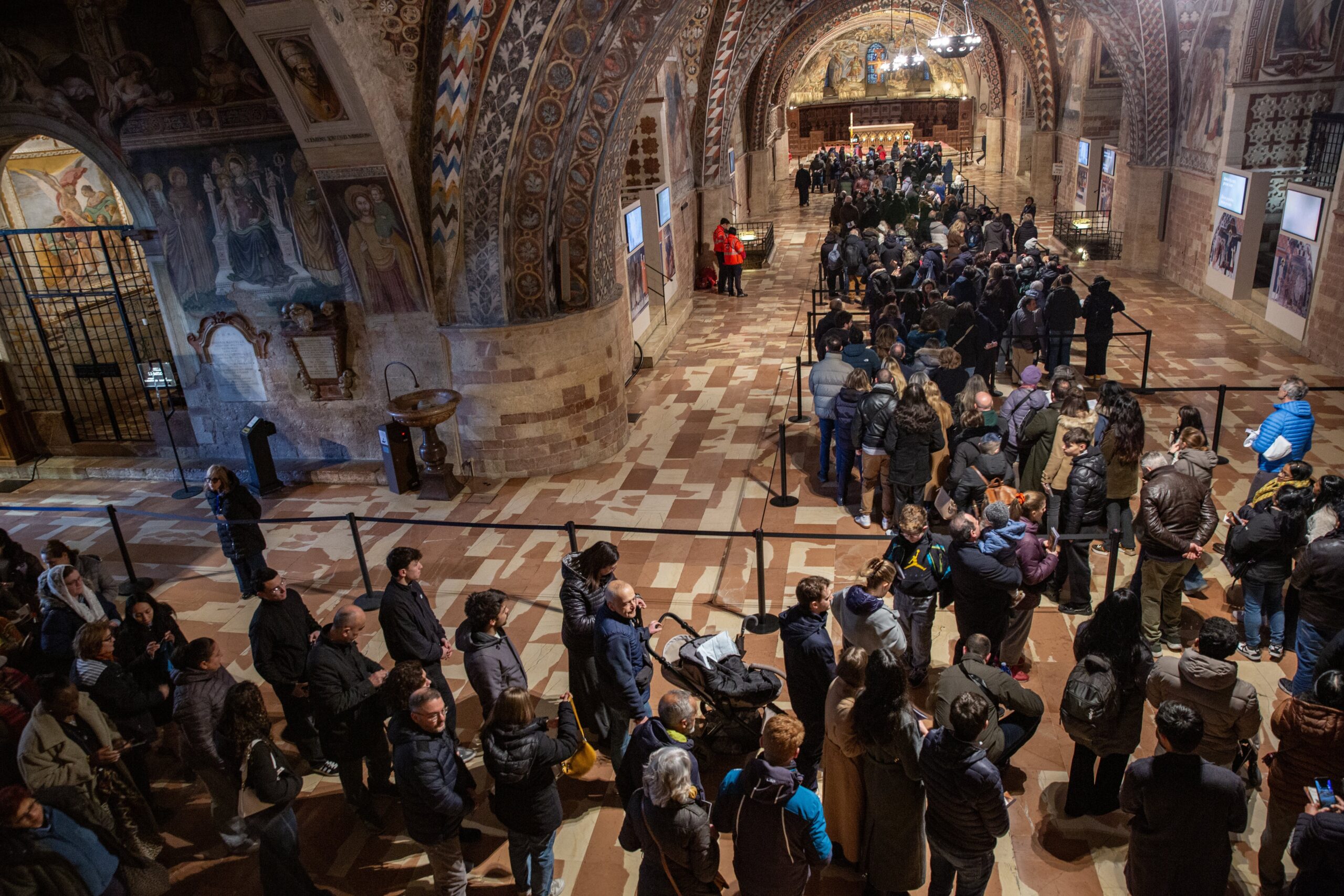
As of the opening day Feb. 22, more than 370,000 people had registered to venerate the remains, according to the Franciscan community at the Sacred Convent of Assisi. The majority have been Italian pilgrims, though the second-highest number of registrations have so far come from the United States.
The friars at the Sacred Convent in Assisi described the exposition as “an invitation to rediscover the legacy of Francis, a man whose message of peace and fraternity continues to resonate deeply with humanity.”
For some, the sight of a saint’s bones inspires devotion. For others, it may provoke discomfort or morbid curiosity about why the Catholic Church displays the physical remains of its holy men and women.
According to Catholic tradition, the physical remains of a saint are known as first-class relics. They are venerated not as magical objects, but as tangible reminders that holiness touches both body and soul.
Elizabeth Lev, a U.S. art historian who teaches in Rome, said relics serve as “a concrete reminder that the blessed or saint’s body is here on earth and his or her soul is with God.”
“It feels like you’ve got almost like a hotline into heaven,” she told Catholic News Service in 2011. The relic is “something we can see and touch, and it becomes our portal to a world we cannot see and cannot touch.”
Relics, she emphasized, are not charms or spiritual talismans.
“God controls what he’s going to do and how he’s going to do it,” she said.
The object itself has no power; it is understood as a channel through which believers direct their prayers.
Even in a secularized age, relics continue to draw large crowds. Tours of saints’ remains in Europe and the United States in recent decades have attracted hundreds of thousands of visitors, including many who might not otherwise attend church regularly.
Assisi also holds the remains of the first millennial saint, St. Carlo Acutis, who was canonized last year. His body can be found at the Church of St. Mary Major, where more than 620,000 individuals visited in the first eight months of 2025, according to the Diocese of Assisi.
While in Paris, an estimated 2-3 million annual visitors come to see St. Catherine Labouré’s preserved body. Next to the altar, she lies in a glass shrine in the Chapel of Our Lady of the Miraculous Medal, where she is reported to have seen the Virgin Mary in 1830.
The body of St. Thérèse of Lisieux went on a tour of the United States last year, attracting an estimated one million visits across more than 30 stops. Her permanent shrine in Lisieux brings more than 600,000 visitors annually.
Lev suggested that the enduring appeal may reflect a deeper hunger.
“An over-secularized world that rejects the divine and embraces the finite and man-made leaves a void in people,” she had said. Relics, and the traditions surrounding them, offer a reminder that death does not sever the bonds between the living and the dead in the Christian imagination.
At the Basilica of Saint Francis in Assisi, the friars said in the press release that they invite the faithful to be inspired by the mortal remains of St. Francis, that death can bear fruit.
“This awareness, eloquently expressed through the mortal remains of St. Francis, serves as an invitation to view one’s personal life in a similar light: like Francis, each person is called to give themselves generously in relationships, becoming a living tree of fraternity that continues to bear fruit in the history of the Church and the world,” the convent’s press release said.
The monthlong exposition includes a vigil with members of the Italian Parliament, a youth gathering titled “Sister Death: An Experience to Embrace,” and a theological conference exploring St. Francis’ understanding of death not as an end, but as a passage.
Though he died 800 years ago, St. Francis is still reminding the faithful that death should be viewed as a transition. During his life, he was known for his love of nature, renounced his wealthy upbringing to live as a beggar, and restored several chapels. He viewed death not with fear, but as a sibling, calling it “Sister Death.” For the saint, death was not the end, but a peaceful transition to eternal life with God.