

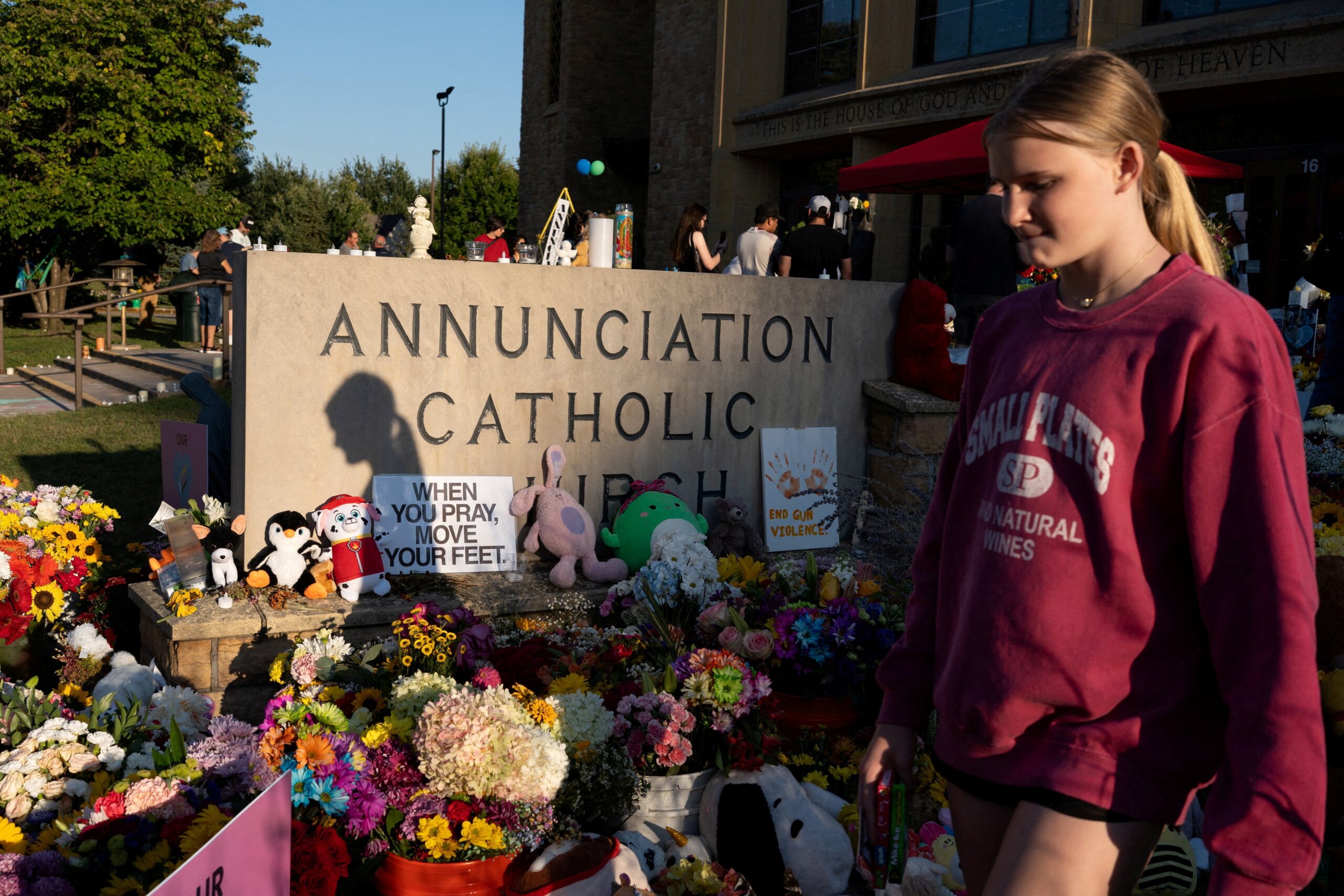



More than six months after the deadly mass shooting at Annunciation Catholic Church in Minneapolis, a law enforcement investigation remains ongoing — but security analysts report that a cluster of violent online communities played a role in the attacker’s motivation.
“The Annunciation shooting was, from our perspective, a remarkably clear example of a violent attack” that reflected no “clear ideology at play,” Amy Cooter, co-founder and deputy director of the Institute for Countering Digital Extremism, told OSV News.
Two children were killed and 21 other people were injured when 23-year-old Robin Westman, a former Annunciation student, opened fire during a parish school liturgy Aug. 27, 2025. Westman died on the scene of an apparent self-inflicted gunshot.

Both the Minneapolis Police Department and the Federal Bureau of Investigation recently confirmed to OSV News that they are continuing their inquiry, although neither agency could provide further details on the case.
Yet hours after the attack, several counterterrorism experts began sounding the alarm that the Annunciation shooting appeared to be part of a rapidly emerging trend in which youth are radicalized in diffuse, online networks to commit real-world violence against others and themselves.
Cooter and her colleagues at ICDE, a nonprofit think tank and consulting firm focused on counterterrorism strategies, quickly detected telling markers in Westman’s “digital footprint” — specifically, YouTube videos posted ahead of the attack that showed Westman’s symbolically graffitied weapons as well as a handwritten manifesto.
That content in turn pointed to a murky online world where hatred and hopelessness become intertwined, spreading across multiple virtual communities that promote antisocial worldviews and behaviors.
Among those are antisemitism, neo-Nazism, white supremacy, neo-fascism, satanism, child exploitation and militant accelerationism, which seeks the destruction of society itself.
Perhaps the most troubling of all those strands is the one known as nihilistic violent extremism, or NVE, whose adherents espouse violence for its own sake as they seek standing among their likeminded online peers.
The Annunciation shooting bespeaks what Cooter described to OSV News as a “mishmash of ideology that’s not entirely consistent.”
While Americans are “unfortunately” accustomed to mass violence “very clearly driven by antisemitism, or a particular version of racism,” NVE “doesn’t have a clear ideological through-thread,” Cooter said.
Instead, “the perpetrators tend to express multiple different ideologies,” she said, noting that “some of them are contradictory,” and “very often, it seems like they don’t genuinely believe any of them.”
In its intelligence bulletin, ICDE determined there was “no single clear ideological motivation for Westman,” who appeared to be “a violent actor” motivated by militant accelerationism and mass shooter culture, and, potentially NVE.
Cooter said that the “overwhelming, coherent ideology” is actually violence itself.
ICDE said Westman’s videos showed weapons and magazines elaborately marked with phrases, symbols and names in white ink, parroting mass shooter Brenton Tarrant, who killed 51 and injured close to 100 during a 2019 attack in Christchurch, New Zealand.
In 2022, shooter Payton Gendron “cemented the practice,” labeling his firearms before his killing spree at a supermarket in Buffalo, New York, said ICDE.
ICDE found that Westman’s weapons name-checked some 15 mass shooters and other terrorist actors, including the 9/11 attackers and the late “Unabomber” Theodore “Ted” Kaczynski.
Cooter said that weapons lettering has become a “hallmark” associated with NVE and other online communities, with adherents also labeling clothing and other items to “indicate familiarity” with what’s known as “saints’ culture” — a perverse pantheon in which “they elevate people who have just done mass carnage and harmed society.”
Among those “saints” is Natalie Rupnow, the mass shooter who in December 2024 killed two and wounded six at Abundant Life Christian School in Madison, Wisconsin, before taking her own life.
The name of Rupnow — who was “heavily embedded in NVE spaces” and their “adjacent true crime community (TCC) spaces,” or fandom communities glorifying mass atrocities — appeared on Westman’s arsenal, said ICDE in its intelligence briefing.
ICDE said Westman had written “more than ten” on one of his magazines, referencing Terrorgram — a transnational criminal group operating on the social media platform Telegram — and its “discussions about requirements for achieving Sainthood” in NVE spaces, “including the number of victims one must have to be worthy of veneration.”
Westman demonstrated “familiarity with NVE spaces and cultural scripts,” said ICDE.
Another key indicator was his use of Cyrillic, with Westman alternating between actual Russian words and transliterations of English words into the script, said ICDE.
That “stylistic choice” may have been a nod to the group MKY, or “Maniac Murder Cult,” which “emerged in Eastern European spaces and is widely recognized as a genesis point for much of NVE culture,” said ICDE.
Westman’s use of the script suggested “some strong aesthetic elements” pointing to Russian references among some militant accelerationists, said Cooter.
She stressed that unlike many real-world parallels, online radicalization takes place in a “much shorter” time frame — “months and maybe in some cases even less.”
Cooter cited a recent case where a victim was lured into a violent space through the Discord platform and was groomed to commit “very serious self-harm” in “less than 24 hours.”
She encouraged parents “to proactively have really uncomfortable conversations with kids” about online dangers.
“A lot of kids genuinely don’t know” that they can be lured while gaming on Roblox or similar sites, she said, encouraging parents to instruct children to leave a space immediately and notify them if they are approached online.
Other signals of possible online radicalization and victimization include withdrawing from family and friends, as well as “cutting names or words or symbols into the skin” and harming family pets, she said.
All children, even those in the most stable environments, are at risk, said Cooter.
“We have seen cases of very well supported, very stable kids getting drawn into this space,” she said. “Every single family needs to know this is a risk.”