


Non-Catholic friends are often puzzled by our calendar of memorials and solemnities, particularly the solemnity of the Annunciation — a moment that usually only hits their awareness in the days leading up to Christmas.
I have been asked more than once why we remember it in March or, in fact, at all. “Jesus came once for all; he doesn’t keep coming, so what’s the point?”
To which (when cranky) I respond, “Well, OK, what’s the point of celebrating Christmas every year, then?” In better moods I like to say that we recall this moment all year long, whenever we pray the joyful mysteries of the rosary, because it’s worth recalling and contemplating. But that still doesn’t answer their essential (and perfectly sound) question, which is “why?”
Stripped down to fundamentals, the answer is both simple and deep. It’s because this single moment contains within it the foremost lesson of Christianity — the one around which every other lesson whirls: Our salvation hinges upon our consent to being saved, and it is a consent that must be given over and over again, every day.

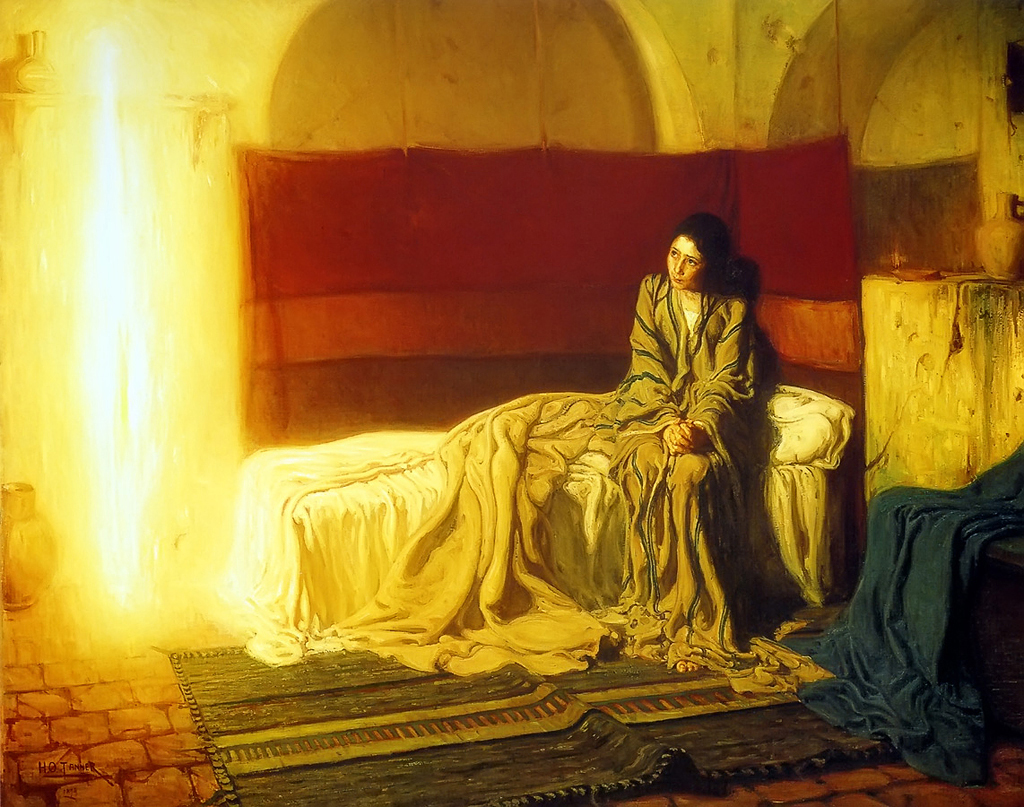
The Annunciation is the full-on proof of Augustine’s words: “God created us without us, but he will not save us without us.” Just as God’s own Word of assent was necessary for the creation and sustained expansion of the universe, Mary’s “yes” was necessary to its salvation.
In the beginning was the Word. God said, “Let there be …” (Gn 1:3), bringing forth light.
At the Annunciation, Mary embraced the Word, saying “Let it be,” (Lk 1:38), bringing forth the light of the world.
Mary’s fiat, given on our behalf, puts us created creatures at the threshold of an altogether new beginning, one wherein we actively cooperate with God to co-create an altogether new world. We participate in the story of salvation, where our every “yes” or “let it be” matters.
The Church keeps this stunning truth ever before us by recommending the daily recitation of the Angelus, so we’ll remember that our every yes keeps us on a God-directed path. That recollection also plops us right into a mystery whose depths can never be fully plumbed: The Word was made flesh and dwelt among us (Jn 1:14).
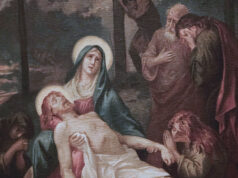
To remember the Annunciation is to also remember the passion and death of Christ Jesus, and that there is nothing we suffer in life that God himself did not consent to suffer as well, out of sheer love for us, in his “mad eros” of the cross. It is, finally, to remember that this love, this consent, this yes, has conquered all, which means we are — with every surrender, every yes of our own — made continually free, in Christ.
What a tonic that can be for us in these days of worrisome doomscrolling and the confusion wrought by AI, to have the Annunciation continually drawing us back to what is real, and true, constructive and salvific. Our perspective becomes trained to take the long view of things. “Behold the handmaid of the Lord: Be it done unto me according to thy word” … “And the Word was made flesh and dwelt among us.”
On March 25, we are precisely nine months ahead of Christmas Day, so in a way — even though we are in Lent — we are already moving toward the cave of the Nativity along with the shepherds and kings. And toward everything that follows, passion, death and resurrection. The seasons of salvation layer into and upon one another, ages unto ages.
God being outside of time, inviting us into such constant wonder can be fun like that.
Elizabeth Scalia is editor-at-large for OSV. Follow her on X @theanchoress.