


By Father Romanus Cessario, O.P. , OSV News
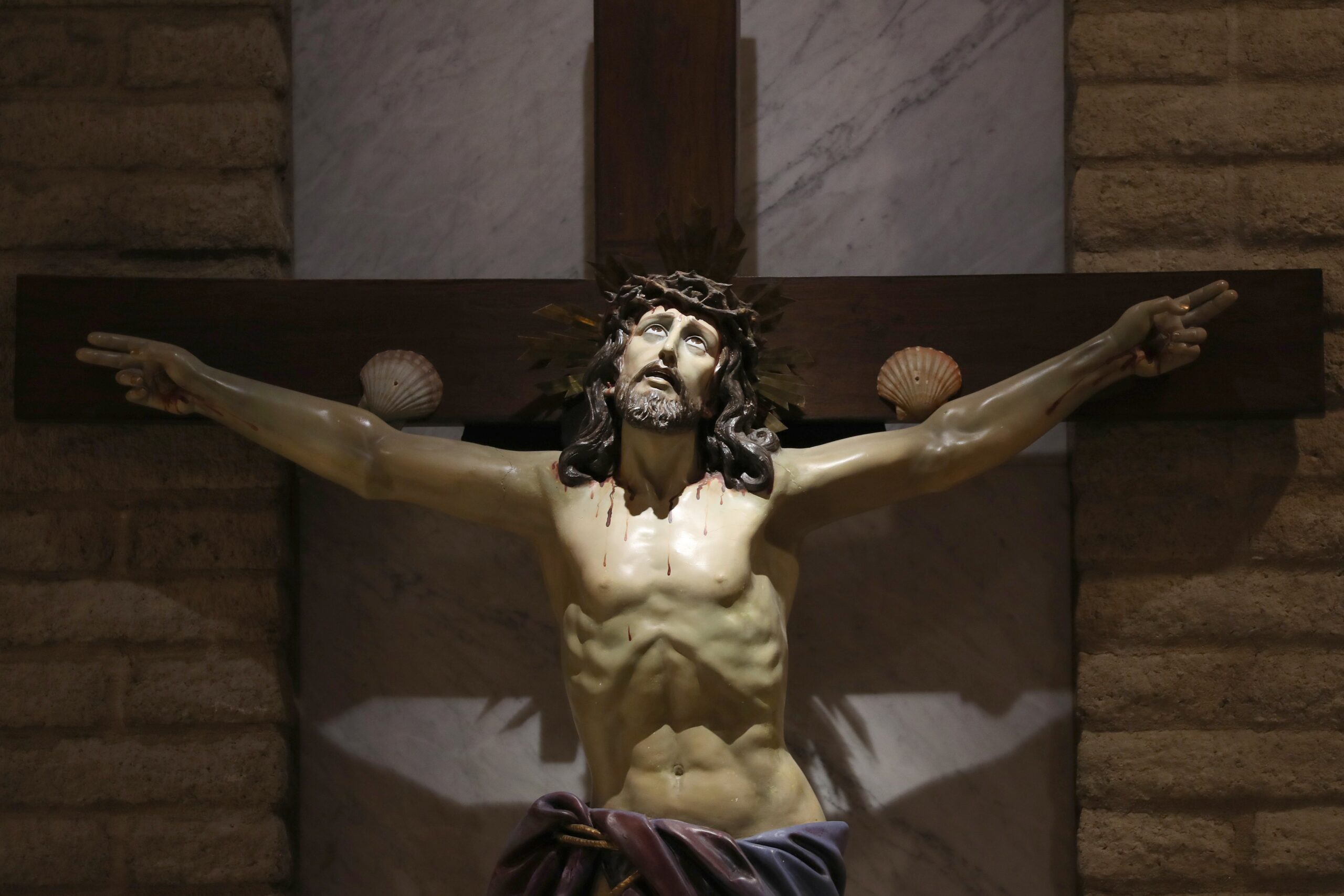
On Good Friday, the altars of the world stand bare. In place of the daily Eucharistic action, the Church centers her liturgy around Scripture readings, especially the Passion narrative, solemn petitions and the veneration of the cross.
The reception of Holy Communion concludes the Good Friday service. But today there is no Mass. No Eucharistizing. No sacrifice. The Church, it is true, today, commemorates “the once and for all” sacrifice of the New Law, but she refrains from celebrating the true sacramental re-enactment of her atonement.

The priest, instead of taking bread and wine, holds up the cross. This liturgical practice is ancient. As early as the third century, the Christian theologian Tertullian explained: “It is not fitting that we should celebrate a feast on the day on which the bridegroom is taken from us.” Yet the world still calls the day dear, holy, good. Kar Freitag. Vendredi saint. Good Friday.
What makes this Friday so dear, so holy, so good? The Gospel of John, which is always sung on this day, suggests an answer. Only the passion account of the Fourth Gospel includes Christ’s last words addressed to the disciple whom he loved: “Behold, your mother.”
For Christian believers, these words surely afford each one a special consolation. One of Christ’s disciples is the first person to discover what makes Good Friday good. “And from that hour the disciple took her into his home.”
John the Evangelist first receives Mary, in whom everything that the Church will become already flourishes. It is she who first embodies the dearness, the holiness, the goodness of the redemption accomplished by her Son on Good Friday.
It is little wonder the Church so much esteems the Gospel of John: “The Gospels,” wrote Origen, also in the third century, “are the first fruit of all Scripture, and the Gospel of John is the first of all Gospels: No one can grasp its meaning without having leaned his head on Jesus’ breast and having received from Jesus, Mary as his mother.”
`
Origen expresses a truth that will be repeated throughout the Christian centuries: Only Mary introduces us into the mystery of divine love that Jesus enacts on the cross. Observe, for instance, that in churches, her image and altar ordinarily occupy a place close to where Christ is loved daily.
The liturgy from an ancient Church of the East helps us enter into Our Lady’s experience of divine love. In a hymn (that once may have formed part of a liturgical drama), we hear words ascribed to Mary when she encounters Jesus on the way to Jerusalem: “Wither goest thou, my Son? Wherefore this hurried step? Is it to a second marriage feast at Cana that thou thus hastenest, there to turn water into wine? Must I come with thee, my Son?”
No Christian can fail to make this same question his or her own: Must I come with you, Jesus? Good Friday’s veneration of the cross allows only one reply: We must accompany Jesus.
During the Good Friday Liturgy, the congregation will process to the altar, genuflect and kiss the cross of Jesus. We must approach Jesus.
The Bridegroom is taken away, but divine love still abides, and so we, too, hasten toward the cross. We must embrace Jesus.
In a celebrated woodcut, Albrecht Dürer (1471-1528) captures the central moment of the Good Friday liturgy. He pictures Mary Magdalene prostrate at the foot of the cross. She is kissing the feet of Jesus. But the 16th-century engraver portrays the face of Christ so as to prompt the question, Who kisses whom? If we observe another ancient liturgical text, this time from the Gallican West, we are led to conclude that it is Christ Who kisses the Magdalene: “O beloved Spouse of souls, kiss us at this hour from thy cross, for the cross is the trophy of thy victory.”
The trophy of Christ’s victory!
Wherein the victory? Christ’s obedient love reveals his submission to the Father and restores to the human race a divine friendship lost through Adam’s sin. This restoration reaches everywhere.
Wherever Christians adore the cross, there the restoration happens. In diocesan presbyterates, Christ from the cross sustains the life and ministry of his bishops and priests. In religious communities and other institutes of consecrated life, Christ from the cross sustains the contemplation and sacrifice that should characterize their daily routines. In Christian families, Christ from the cross sustains the sharing of the “all of life” that distinguishes the chaste love of husband and wife and enables them to bear and rear children.
To those who in faith embrace his cross, Christ restores divine friendship. How does the Savior accomplish this restoration? In a word, he kisses us; Christ kisses us with the power of his divinity. “O Almighty God, our Jesus,” continues the Gallican liturgy, “kiss us, we beseech Thee, Beloved Lord, Who didst triumphantly return to the Father with Whom Thou wast and art, for ever one.”
The Church firmly believes that Christ’s triumph is complete, and that it signals the effective start of the new creation. The Letter to the Hebrews makes the point with great insistence: “But when Christ had offered for all time a single sacrifice for sins, he sat down at the right hand of God. For by a single offering he has perfected for all time those who are sanctified” (10:12,14).
No human being escapes the need to enter into Christ’s perfect sacrifice. At the start of the 18th century, St. Louis-Marie Grigñon de Montfort, a great apostle of Our Lady, urged his hearers to recognize this truth when he candidly described our personal dispositions outside of Jesus: “We are naturally prouder than peacocks, more groveling than toads, more vile than unclean animals, / more envious than serpents, more gluttonous than hogs, more furious than tigers, / lazier than tortoises, weaker than reeds, and more capricious than weathercocks. We have within ourselves nothing but nothingness and sin” (“True Devotion”).
Louis de Montfort harbored no illusions about sinful man. What separates him from postmodern nihilists? The saint confessed the power of Christ’s victory. He believed in the new creation.
His striking psychological portrait of unredeemed nature aims to console, not crush, us. Whatever our personal states; whatever our conditions according to the flesh; whatever, even, our dispositions toward attaining holiness. Christ touches them. He transforms them. He makes them all new. The kiss of Christ illuminates our minds so that we see the truth. It strengthens our wills so that we love the good. It even envelops our emotions so that, in faith, we experience the order and, yes, the tranquillity of rectitude.
In truth, Jesus does kiss us. From the cross, the Innocent One, the Lamb without blemish, embraces his own suffering, mystical body. Wherever sin runs deep in our souls, Jesus heals it.
The Passion of Christ, we are told, contains all the virtues and so heals every wound of sin. Arrogance and rebellion — the obedience of Christ heals us. Ambition and self-seeking — the humility of Christ heals us. Unchastity and immoderateness of all kinds — the patience of Christ heals us.
When you move forward to venerate the cross on Good Friday, listen to Jesus saying: “Come over to me you who labor and are heavy burdened, and I will give you rest” (Mt 11:28). At the foot of the cross, receive the “sacrament” of Good Friday. Let Jesus kiss you from the cross.
“O beloved Spouse of souls, kiss us at this hour from thy cross.”
Father Romanus Cessario, O.P., is the Adam Cardinal Maida Professor of Theology at Ave Maria University in Naples, Florida.