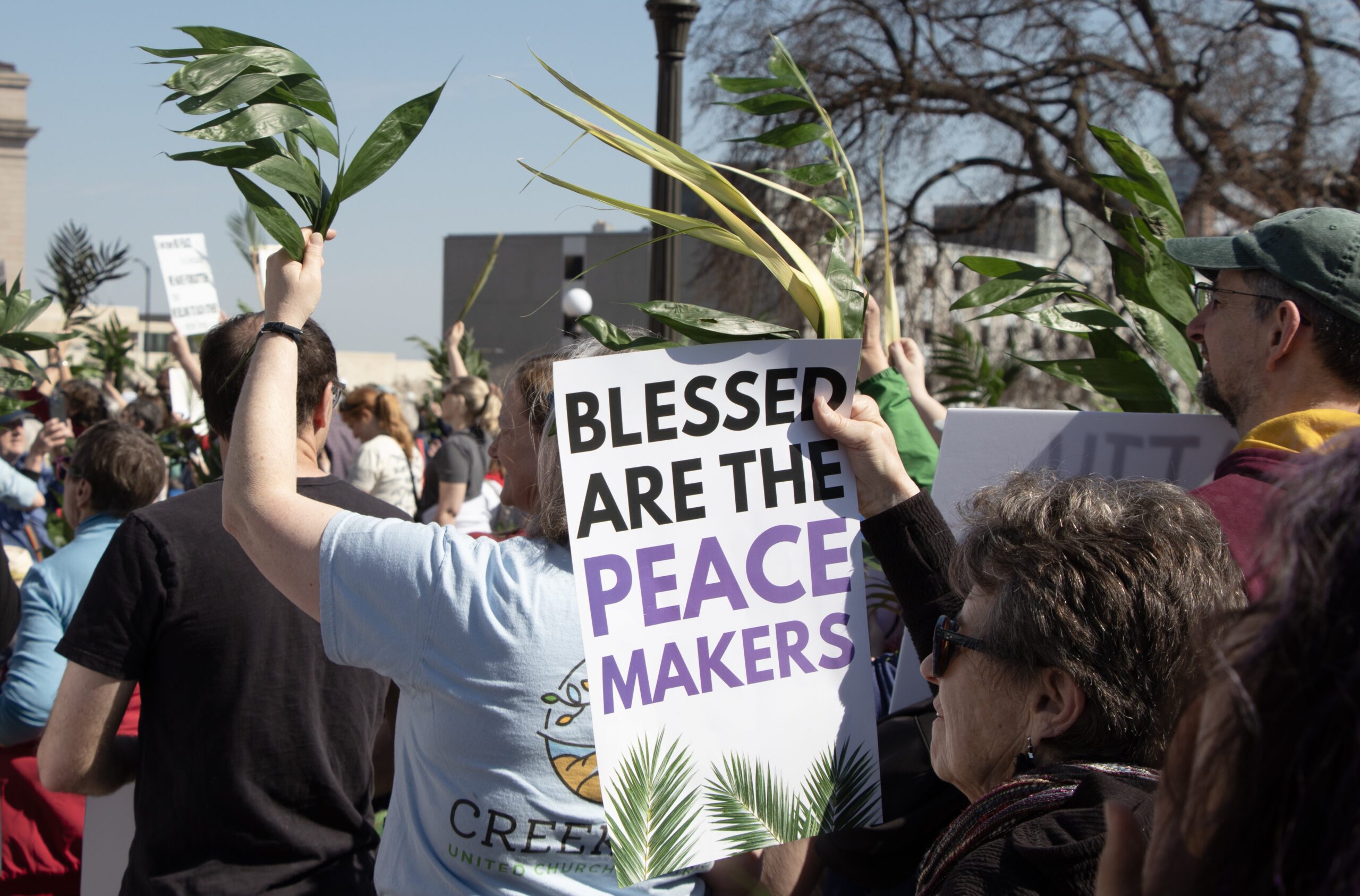


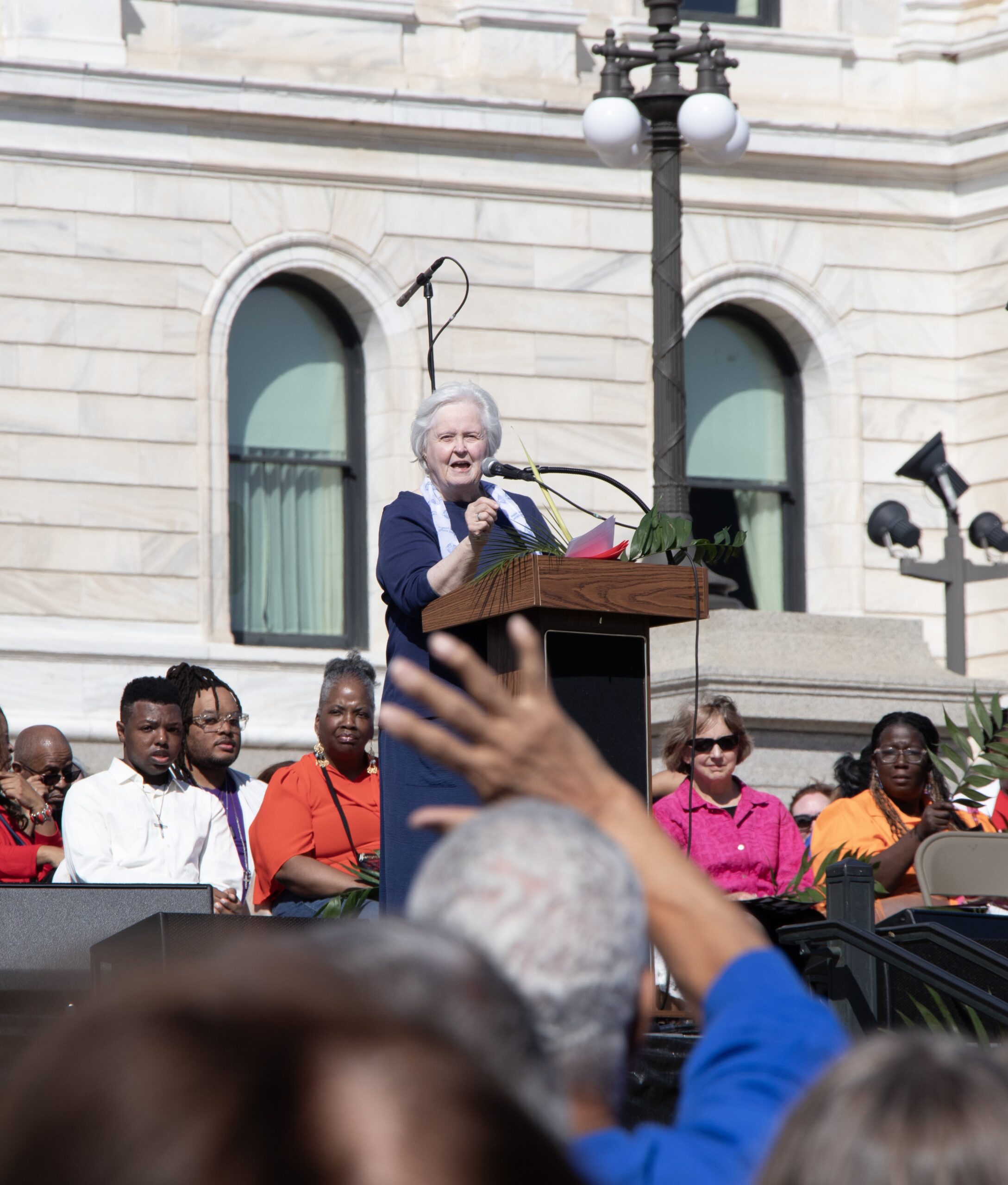
ST. PAUL, Minn. — On the front lawn of the Minnesota State Capitol in St. Paul, more than 7,000 Christians from different denominations gathered for a Palm Sunday prayer service March 29 called Palm Sunday Path.
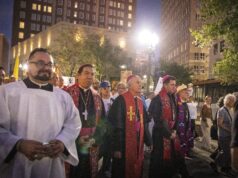
The prayer service began with a procession of signs, palm fronds and prayers to the Capitol steps.
One speaker called the service an act of resistance with participants walking into places of power to challenge policies that keep food from the hungry, snatch safety from strangers and deny health care.

“When policies wound the poor, creation groans with them, and our faith compels us to respond,” said Sister Kathleen Storms, a School Sister of Notre Dame. “I am here today because we are here today, people of faith, refusing to be silent when human dignity is threatened.”
True security, she said, comes from trust, justice and solidarity among people.
Sister Kathleen was among local Christian leaders addressing the gathering for two and a half hours. Members of churches with predominantly Black congregations in the Twin Cities performed praise and worship music, including Shiloh Temple International Ministries and Greater Friendship Missionary Baptist Church, both in Minneapolis, and St. James A.M.E. in St. Paul.
The prayer service was supported by the Minnesota chapter of the Laudato Si’ Movement, and similar gatherings were held throughout the state, including Rochester, Mankato, St. Cloud and Duluth.
Across the country, Palm Sunday Path prayer services were held in a dozen states.
The Laudato Si’ Movement is a nonprofit organized to help Catholics translate into action Pope Francis’ encyclical “Laudato Si’: On Care for Our Common Home,” said Mike Harley, a member of the Laudato Si’ Minnesota chapter and a parishioner of Lumen Christi in St. Paul.
“That is a document about climate change and the environment and sustainability,” Harley said. “Care for creation is how we have talked about those things in the Catholic world and Catholic teaching for a long time.”
“Laudato Si'” and its concern for creation extends beyond the environment, Harley said, and includes care for the marginalized, the poor and the vulnerable.
Though Palm Sunday Path was not created by the movement, the Minnesota chapter of Laudato Si’ supported the prayer service because it aligned with the many of the goals of the movement and the teachings of the Catholic Church, Harley told The Catholic Spirit, the newspaper of the Archdiocese of St. Paul and Minneapolis.
“(Palm Sunday Path) is an opportunity for thousands of Christians to show up publicly in faith and prayer, and then a show of love for God and a show of love for neighbor,” Harley said. “And when we talk about love for neighbor, we really understand that in the context of Matthew 25. Jesus has called us to feed the hungry and heal the sick and welcome the stranger among us.”
Harley said that as the word spread about Palm Sunday Path, many Catholics were enthused about being part of the ecumenical prayer service to “see (that) the Catholic voice be represented and be visible and present.”
Catholic parishes including Lumen Christi and St. Thomas More, both in St. Paul organized buses to bring parishioners to the Capitol. An organizer of the prayer service estimated more than 7,000 people attended.
Faith is never private, but rather “public, courageous and lived in the streets,” Sister Kathleen said in her remarks to the crowd.
“Today we accompany people in 17 countries around the world where governments silence dissent, restrict freedoms and strip away basic human rights,” she said. “Here at home in my parish of Lumen Christi Catholic Community in St. Paul, we walk with Indigenous people, Indigenous relatives, racially ostracized families and immigrant neighbors who still face exclusion and fear.”
Mentioning the Laudato Si’ chapter in Minnesota, Sister Kathleen said that when creation is harmed, people are harmed. When legislative policies “poison water, pollute air or destroy land,” it is the vulnerable who suffer first and most, she said.
“Our faith demands that we act together,” Sister Kathleen said.
Archbishop Bernard A. Hebda of St. Paul and Minneapolis “sends his regrets that he cannot be with us today,” she said. “He promises his prayers for those gathered to express publicly our commitment to the Gospel and our connectedness to people of faith charged with serving Christ by lovingly serving the most vulnerable of his brothers and sisters among us.”
The Palm Sunday Path came to the Capitol a day after a No Kings Rally in protest of President Donald Trump and recent immigration policies. Some sentiments trickled over into the Palm Sunday Path, but Harley reiterated that the prayer service was not a protest, even urging Catholics involved to leave their protest signs at home.
The Palm Sunday Path was in the works before the No Kings Rally was planned.
“The decision was made that these are two different things, and that No Kings will have its appeal, but that there really has not been an opportunity for Christians to talk as Christians (with) Christian values in the lead,” Harley said.
He urged Catholics to bring their palms from Sunday Mass that day.
“Just as Jesus rode into Jerusalem and was greeted by the palms of the gathered crowd, we want to have that same dynamic.”
Jesuit Father R.J. Fichtinger, pastor of St. Thomas More, spoke toward the end of the prayer service.
“I’ve been empowered because I can see the beauty of our neighbors coming together, looking out for one another by ensuring that they have groceries, by looking out for one another and ensuring that they are able to be fed, both by the word of God, by the spirit and the sacrament of God,” Father Fichtinger said. “They’ve gone to their neighbors, they’ve gone to the poor, they’ve gone to the marginalized. They have done what God and our Lord has commanded us to do, to love our brothers and sisters.”