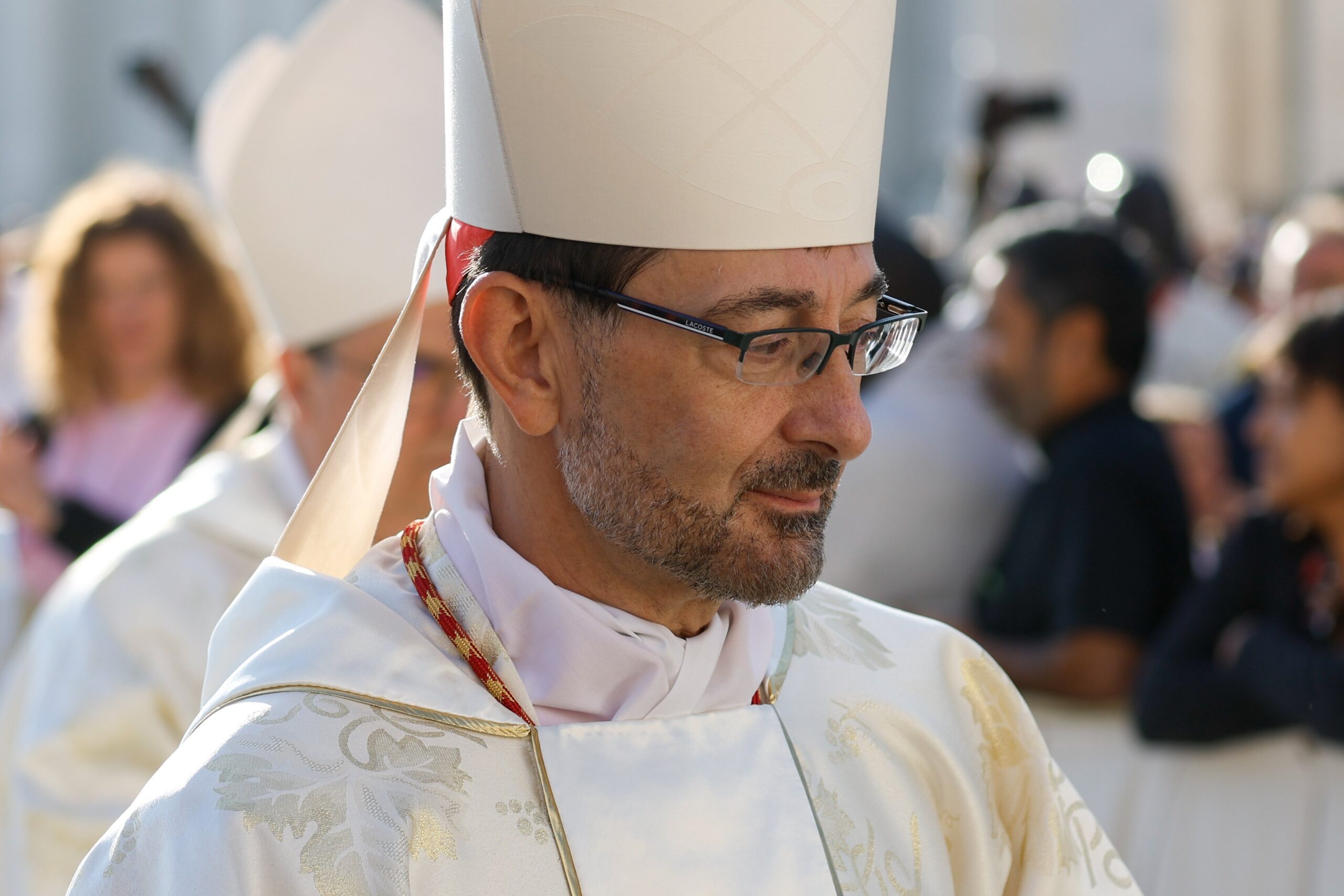



Pope Leo XIV will encounter a living and growing Church when he arrives in Madrid, a revitalization highlighted by his planned blessing of the cornerstones for 12 new parishes, said Cardinal José Cobo of Madrid.
In a May 20 interview with OSV News, Cardinal Cobo described the new parishes as a sign of continuous growth and “an interesting moment of revitalization.” Looking ahead to the fruits of the papal visit in his archdiocese, the Spanish cardinal emphasized the importance of its long-term impact.
“We don’t want it to stay there because the events are events that fade away like fireworks,” he said. But “the pope is (not only) going to leave us with experiences, but also messages,” the cardinal stressed.


“So, afterward it will lead us to ensure that in every area — in parishes, in culture, in education — we will continue working on what we have started and continue creating processes so that this doesn’t just remain in the pages of a speech,” the cardinal added.
Pope Leo XIV’s June 6-12 apostolic visit to Spain will begin in Madrid with a packed schedule of events, including meetings with King Felipe VI and his wife, Queen Letizia, government authorities and the faithful.
‘Evangelical gesture’
Among his first pastoral stops is a visit to CEDIA 24 horas, a social center run by Caritas Madrid that serves as a shelter and offers social services, psychological care and workshops for the city’s homeless.
For Cardinal Cobo, the fact that the pope’s first pastoral stop will be a homeless shelter is “an obviously evangelical gesture” where he will visit a place “where the Church is with the most vulnerable.”
“The Archdiocese of Madrid and the Church are present in the realities of the last ones. Thank God I can say — and I am very grateful for this — that there is no social reality where the Church is not present in some way,” the cardinal told OSV News.
Pope Leo’s visit to CEDIA 24 horas, he added, indicates “from where he wants to look at the Church and from where he wants the Church to be from the beginning, which is first placing the most vulnerable at the forefront.”
Among the most anticipated events during the pope’s stop in Madrid will be a Mass on the feast of Corpus Christi at Madrid’s Plaza de Cibeles, followed by a Eucharistic procession reflecting the city’s local traditions.
Cardinal Cobo told OSV News that the feast of Corpus Christi is “a very important day” in Spain and that Eucharistic adoration “is very alive and belongs not only to the ecclesial tradition in general but to popular piety.”
When asked what he hopes people will see or understand about Catholic tradition and faith in Spain, the cardinal said he hopes people will see that the Eucharistic procession celebrates the presence of Jesus “not only in the Church but in the streets.”
“That is the moment of this day. It is like centralizing a bit of what we are and our source. And to live it with our neighbors in the middle of the street, I think it almost brings us more joy. To be in the center of Madrid, being able to live the Eucharist and say, ‘Let us extend our hands to all who are unwell, to all who want to search.’ So for us it is a reason for joy. And I think it will also be a very special moment to revitalize faith and open doors to those who want to search,” he said.
Meeting with survivors proposed
However, among the events not included in the schedule released by the Vatican May 6 was a meeting with survivors of sexual abuse, an issue on the minds of many in Spain.
In October 2023, a government-led independent commission revealed in a 700-page report that over 200,000 minors had been abused by clergy since 1940. It also stated that when accounting for abuses committed by lay members of the Church, the number of victims rose to 400,000.
Recently, in January, the Catholic Church and the Spanish government signed an agreement that would seek to provide reparations to victims of clerical sexual abuse.
Cardinal Cobo told OSV News that although the pope’s schedule is full, a meeting with survivors has been proposed and will be announced only after it happens to “not create false expectations.”
Nevertheless, he noted, a meeting between the pope and survivors is “very necessary,” and Pope Leo is aware of the Archdiocese of Madrid’s efforts, such as “Proyecto Repara,” the archdiocesan office for the prevention of abuse.
The pope “knows ‘Proyecto Repara’ very well and everything we have been doing for many years, attending not only to victims of child abuse, but victims of all kinds of abuse, and how we are entering into an integral accompaniment” with them.
According to its website, “Proyecto Repara” was established in 2020 as an independent office where survivors of abuse, both within and outside of the Church, could receive support, including legal and canonical assistance, therapy and spiritual accompaniment.
The office also works with civil authorities in denouncing cases of abuse involving minors and informs victims of their rights to report alleged abuse to police.
A timely encyclical
The Vatican announced that Pope Leo’s first encyclical, “Magnifica Humanitas” (“Magnificent Humanity”), on the protection of the human person in the age of artificial intelligence, will be published May 25, less than two weeks before he lands in Madrid.
At a May 6 press conference, Archbishop Luis Argüello of Valladolid, president of the Spanish bishops’ conference, noted that the soon-to-be-released encyclical will likely “highlight the centrality of the human person” and focus on “human dignity, the common good, dialogue and encounter.”
Noting the timeliness of the encyclical’s release, Cardinal Cobo told OSV News that it will likely “be the framework for all the messages that the pope is going to give,” especially when he delivers his anticipated address to the country’s parliament.
In Spain, where politics “is very, very polarized” and “very segmented,” Pope Leo comes not “to impose anything on anyone,” but “simply to offer a higher perspective,” the cardinal said.
That perspective, he continued, is “to speak of the importance of the common good above differences, the importance of human dignity as the axis or the filter to face problems.”
“I think the pope can offer that, which is what the Church always offers: higher perspectives,” Cardinal Cobo said. “Let us not forget the grand horizons. Then we can be more or less in agreement on the small judgments, on the specifics. But let us not forget that, above the polarizations, there are broad outlines, and that the Christian tradition has something to say to society if it wants to listen to us.”