
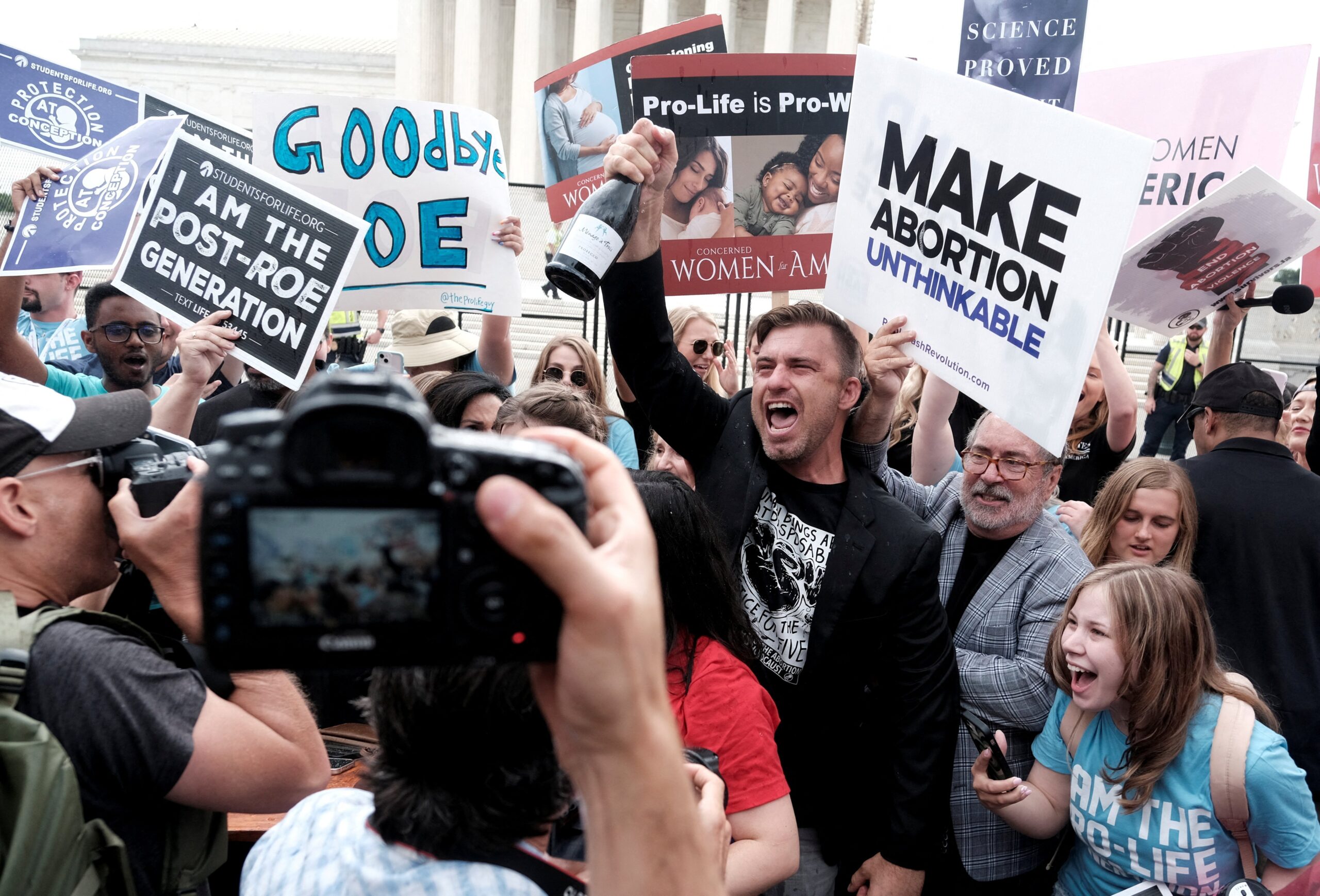

WASHINGTON — On the fourth anniversary of the Dobbs v. Jackson Women’s Health Organization decision by the U.S. Supreme Court, the U.S. Catholic bishops’ conference and pro-life leaders pointed to abortion pills as among key challenges for the cause of protecting the right to life of unborn children.
The Supreme Court issued the Dobbs ruling June 24, 2022, in a case involving a Mississippi law banning abortion after 15 weeks, where the state directly challenged the high court’s previous abortion-related precedents in Roe v. Wade and Planned Parenthood v. Casey. The high court ultimately overturned its own prior rulings, undoing nearly a half-century of its own precedent that held abortion to be a constitutional right.
In the years since that ruling, efforts to restrict or protect access to abortion have stalled in Congress. As a candidate in 2024, President Donald Trump stated his view that abortion should be a matter for the states rather than Congress, and said he would veto abortion restrictions if they reached his desk.

Individual states have moved to either restrict abortion or expand access to it in the wake of the Dobbs ruling. However, multiple reports have found that the rate of abortions in the U.S. has increased since the Supreme Court’s reversal of Roe.
According to an estimate from Guttmacher Institute, a research firm for the abortion industry, 1.12 million abortions took place in 2025, marking a 21% increase from 2020, which Guttmacher said marked “the last year of comprehensive national estimates” before Dobbs. Guttmacher found the figures were largely unchanged from 2024. It also noted that the abortion numbers overall may be an undercount due to people acquiring abortion pills in advance or obtaining them by means other than U.S. abortion clinic providers.
In a statement marking the Dobbs anniversary, Bishop Daniel E. Thomas of Toledo, Ohio, chair of the U.S. Conference of Catholic Bishops’ Committee on Pro-Life Activities, said the “victory of the Dobbs decision risks being undone by the massive influx of abortion pills.”
“While the Dobbs decision gave states the freedom to pass pro-life laws and protect preborn children, these laws are now being undermined,” he said. “The Food and Drug Administration, a government agency responsible for protecting public health, has enabled a nationwide mail-order abortion industry by allowing abortion pills to be prescribed in telemed appointments and sold both at neighborhood pharmacies and online, circumventing state laws that protect life in the womb.”
Louisiana has challenged an FDA policy issued by the Biden administration, which permitted mifepristone, a pill commonly used in abortion but also in some miscarriage care protocols, to be distributed by mail. The Trump administration has thus far left that regulation in place, prompting frustration from pro-life groups, and has sought to block state challenges to mifepristone, such as Louisiana’s.
The Supreme Court in May left that policy in place while the litigation proceeds.
Proponents of mifepristone — the first of two drugs used in a chemical or medication-based abortion — or its distribution by mail argue it is statistically safe for a woman to take at the early stages of pregnancy, and that attempts to restrict it are an attempt to ban abortion outright. Opponents of the drug’s use for abortion argue there are significant risks to those who take it, particularly outside of medical settings, in addition to ending the life of an unborn child early in its development.
Marjorie Dannenfelser, president of Susan B. Anthony Pro-Life America, told reporters on a June 23 press call that there has been “a failure to step up on the federal level and pass protections that are grounded in the 14th Amendment — whatever consensus can bear — grounded in the 14th Amendment.”
Dannenfelser is among the pro-life leaders who have argued that the 14th Amendment, which states that “All persons born or naturalized in the United States,” shall not be denied “life, liberty, or property, without due process of law” is grounds for federal abortion restrictions.
Pointing to lawsuits like Louisiana’s, Dannenfelser argued that “the abortion drug has usurped the sovereignty of those states” that have restricted abortion.
“We have insisted that the Justice Department settle with the state of Louisiana, who has sued them for justice, for undermining their state laws, for putting extra burdens of financial and health care for women who are experiencing these horrible moments,” she said.
A letter from more than 80 pro-life groups, including SBA, published June 23 to Acting Attorney General Todd Blanche said, “We respectfully urge you to settle Louisiana v. FDA, end DOJ’s defense of the mail-order abortion drug regime.”
In an amicus brief filed by groups including SBA, the March for Life Education and Defense Fund, and the National Catholic Bioethics Center, argued the in-person dispensing requirement should be reimplemented to prevent health risks to the mother and to prevent coercion by partners, abusers, or traffickers.
“Coerced consent is no consent at all, and there is an increased risk of coercion in the context of abortion drugs and procedures if the prescribing physician does not thoroughly screen for abuse or coercion,” the brief stated.
Jennie Bradley Lichter, president of the March for Life, told OSV News the group “joined this amicus brief because women deserve better than being prescribed dangerous abortion-inducing drugs without even a simple consultation with a physician — putting their health and safety at serious risk.”
“The current lack of safeguards also plays right into the hands of abusive men who can pose as women, obtain these drugs via the internet, and then coerce their baby’s mother into taking them or even forcibly drug her in order to evade responsibility for their child,” she said. “There is no semblance of true informed consent in the way abortion drugs are currently distributed. FDA must restore an in-person dispensation requirement.”
The Catholic Church teaches that all human life is sacred from conception to natural death, and as such, opposes direct abortion, which takes the life of the unborn child.
Marie T. Hilliard, senior ethicist for the National Catholic Bioethics Center, as well as a registered nurse with a graduate degree in maternal child health and a canon lawyer, said in written comments to OSV News that NCBC, which opposes all direct abortions, “recognizes the threats not only to the unborn child, but also to women and girls having access to unsafe chemical abortion practices.”
“Women and girls’ very lives are being threatened by the current lack of regulatory requirements, and the lives of these mothers also must be protected, and hopefully the lives of their unborn children when these mothers are provided with all the information they need for true informed consent,” she said.
In his statement, Bishop Thomas concluded, “On this Anniversary of the Dobbs decision, we praise God for the historic overturning of Roe v. Wade, and we beg the intercession of the Sacred Heart of Jesus in building a culture of life.”


