

A Haitian youth’s apparent suicide in Ohio, which follows the ending of deportation protections for hundreds of thousands of Haitians in the U.S., was “a death of despair,” Archbishop Thomas G. Wenski of Miami told OSV News.
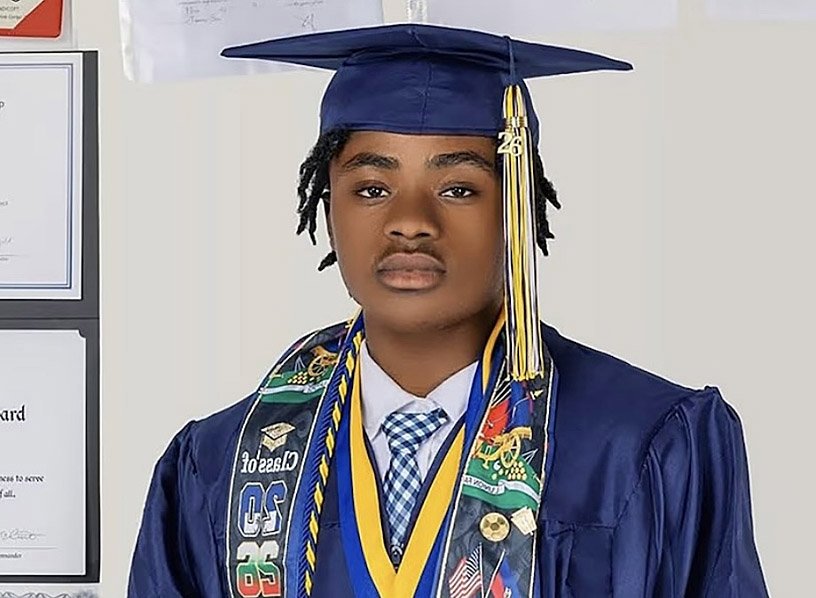
Pierre Damas Bel, a 20-year-old student on scholarship in his first semester at Dayton’s Wright State University, was pronounced dead at the scene after walking into traffic around 8:45 a.m. Aug. 31 on Interstate 70 in Springfield, Ohio.
According to the Ohio State Patrol, Bel had parked along the highway’s shoulder that morning and had exited the vehicle into the westbound lanes. He was struck by a tractor-trailer whose driver remained uninjured.

Bel — a member of the Marine Corps Junior ROTC and the National Honor Society — had left no note communicating his intentions.
However, his father said in an Aug. 31 interview that “everything changed” once his son had been fitted with an ankle monitor by Immigrations and Customs Enforcement.
In June, the Supreme Court ruled that the Trump administration could terminate Temporary Protected Status, or TPS, designation for Haiti.
The deportation protection, created by Congress as part of the Immigration Act of 1990, provides deportation protections for those from Homeland Security-designated countries experiencing ongoing crises, such as war and environmental disasters. More than 330,000 Haitians in the U.S. had TPS protection as of 2025.
In a statement to CBS affiliate WKBN in Springfield, a DHS spokesperson confirmed ICE had been notified of Bel’s death by Ohio State Highway Patrol, describing Bel as “a non-detained illegal alien from Haiti.”
The agency declined to comment on Bel’s cause of death, but confirmed it had fitted Bel — who had applied for admission to the U.S. under the former CBP One mobile app in March 2024, three years after his parents’ arrival — with an ankle monitor on July 29.
The monitor was part of Bel’s placement in an “alternatives to detention program … while he continued in his immigration proceedings,” said the spokesperson.
“No one is required to stay in the United States illegally and wear a monitor,” said the DHS spokesperson, adding that “remaining in the country illegally, while fighting removal, is a choice.”
Yet Bel was scheduled for an October asylum court hearing, according to his father, Pierre Ronal Bel.
The family attended a Sept. 1 press conference held at Central Christian Church in Springfield, home to an extensive Haitian community.
The town had gained national attention during President Donald Trump’s second-term presidential campaign, when in 2024 both Trump and then-Sen. (now Vice President) JD Vance repeated false claims that area’s Haitian immigrants stole and ate residents’ pets.
During the Sept. 1 press conference, Central Christian pastor Carl Ruby read a statement from the elder Bel, who said his son “felt like he was treated like an animal” after being shackled with the ankle monitor.
“He took two trips to Cincinnati and Westerville to plead (with) the officers to remove the bracelet since he’s a soccer player and he felt embarrassed and humiliated,” said Bel in his statement. “When he’s among his classmates at the university … he was bullied a lot with a lot of people telling him he’s a criminal.”
Prior to his death, the younger Bel had admitted feeling “shame and humiliation that I never imagined I would experience” due to the ankle monitor.
In a July 30 Instagram post, Bel wrote, “I came to this country to pursue my education. I didn’t come here to commit a crime or hurt anyone. Yet now I’m walking through the streets of the United States with a GPS monitor on my leg.”
His post included multiple images of his high school graduation, sports and JROTC activities, along with his award of excellence from a business advisory council and a social media graphic indicating his intention to study neuroscience.
Bel wrote that the ankle monitor prevented him from playing college sports, and said, “I came here to study, to build my future … not to be treated like (a) criminal.”
In Philadelphia, the faith-based New Sanctuary Movement — an immigrant advocacy nonprofit based on Catholic social teaching — planned a Sept. 3 vigil honoring Bel and calling on the U.S. Senate to pass S.B. 4814, which would require the secretary of Homeland Security to designate Haiti for TPS.
Archbishop Wenski has also urged passage of the bill, telling OSV News the U.S. should “rethink” ending Haitian deportation protections, as the Caribbean nation continues to grapple with long-running violence, including an Aug. 23 massacre that saw more than 47 killed and at least 50 kidnapped.
Bel’s death “is not an isolated tragedy,” the New Sanctuary Movement said in a Sept. 2 statement announcing the vigil. “What we are witnessing is a politics of death, a system in which human life itself becomes disposable, contingent, revocable.”
The organization described what it called “two registers of violence” against migrants, with the first “direct” and resulting in immediate harm, and the second “slower, but no less lethal,” since “operates through fear — fear of family separation, fear of return to danger, fear of a future that no longer exists.
“The second violence claimed Pierre Damas Bel,” it said.
Archbishop Wenski, whose archdiocese is home to an extensive Haitian and Haitian-American community, described Bel’s apparent suicide as “certainly tragic — as are all suicides.”
In particular, said the archbishop, “Pierre’s suicide was a ‘death of despair.'”
While “life in the United States offered him a future of hope,” said Archbishop Wenski, “looming deportation to Haiti seemingly conspired to deny him that future.”
Gina Christian is a multimedia reporter for OSV News. Follow her on X @GinaJesseReina.
NOTES: If you or a loved one are experiencing thoughts of suicide or self-harm, call or text the National Suicide and Crisis Lifeline at 988, or call 911.