

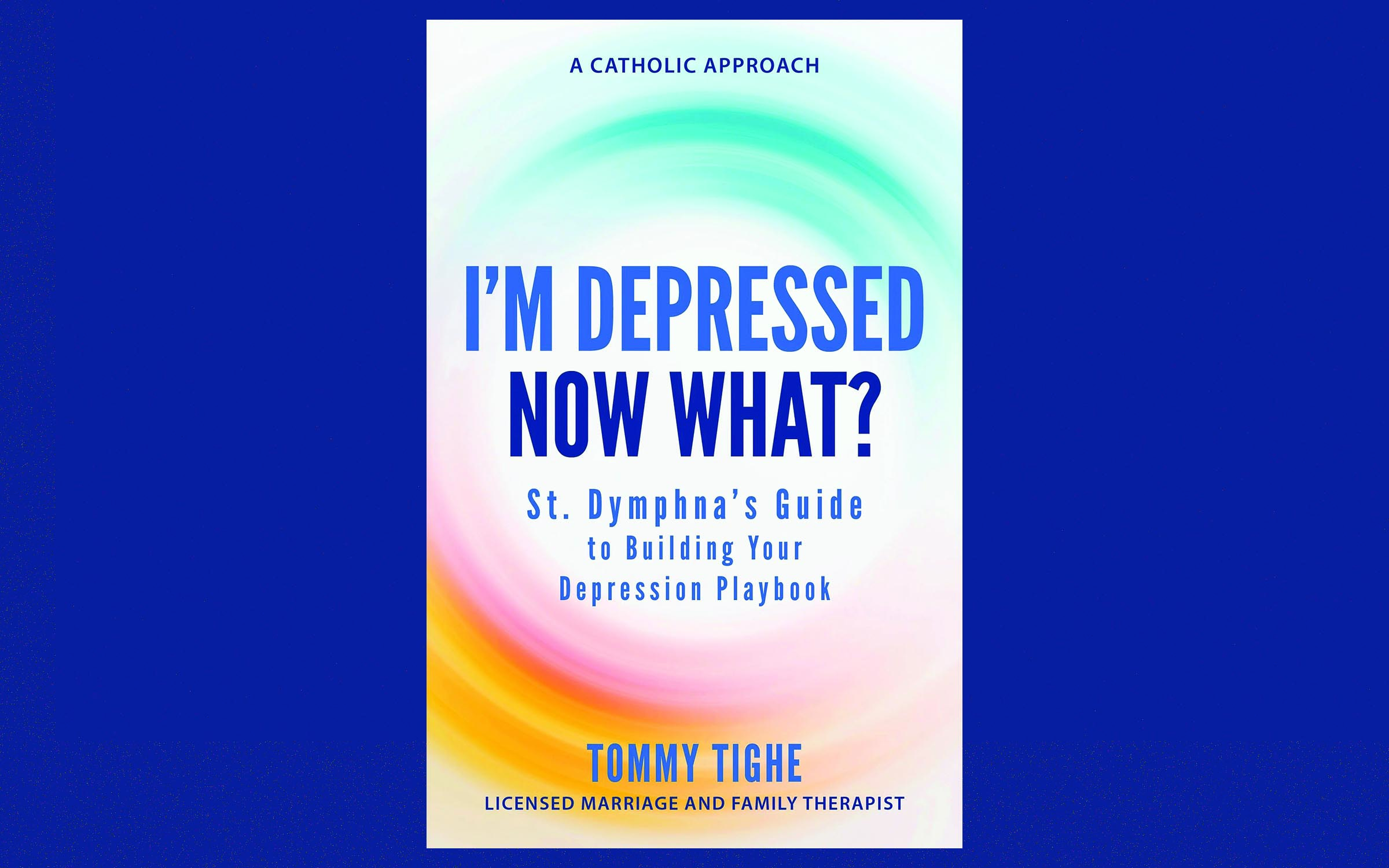

“I’m Depressed — Now What?: St. Dymphna’s Guide to Building Your Depression Playbook”
Tommy Tighe, Ave Maria Press (2026)
160 pages, $16.95
St. Dymphna was not known to have suffered from depression herself, but she was no stranger to the pain and suffering of mental illness. Her own life was taken by her father, who descended into madness while grieving the death of her mother.
In the centuries following her death, crowds made pilgrimages to her tomb, begging for St. Dymphna‘s prayers for their loved ones who suffered from mental illness after hearing of the miracles people reported after asking for her intercession. She is now well-known as the patron saint of those suffering from mental illness and psychological distress.

Tommy Tighe, a Catholic father and licensed marriage and family therapist, began speaking about understanding and coping with mental illness from a Catholic perspective under the patronage of St. Dymphna in 2019 with his podcast, “St. Dymphna’s Playbook.”
In 2021, he authored a book under the same name, exploring different diagnoses and symptoms, offering suggestions for remaining rooted in the truth of God’s love, and introducing prayers and stories of saints that may be helpful.
Tighe’s latest book, “I’m Depressed — Now What?: St. Dymphna’s Guide to Building Your Depression Playbook” is a deep dive into the experience of clinical depression and depressive episodes, looking at the science and psychology of the experiences from a Catholic perspective.
Even more than just providing information or perspective, the book is a practical manual for addressing different symptoms and obstacles, giving the reader concrete reasons for hope.
“I’m Depressed — Now What?” is meant to be used as a guide to create an action plan to cope with depression. The author highlights that being in the midst of a depressive episode is not the time to figure out what coping skills work, who to call when you can’t get out of bed, and what you can do if you are no longer capable of keeping yourself safe. Depression can cloud judgment, motivation and energy, so creating an easy-to-follow, straightforward plan ahead of time is crucial and can be a real gamechanger.
Each section of the book explores a painful spiritual question that someone with depression may be wrestling with, providing an outline that explores the experience with honesty and understanding.
Some of the questions Tighe explores are, “Lord, do I not trust you enough?” and “Lord, if you love me, why do you let me feel like this?” Then, each chapter drills down deeper into specific topics related to depression including symptoms like suicidal ideation and feelings of worthlessness, whether or not Catholics should only go to Catholic therapists, and how to build a social support system.
The chapters of the book are easy-to-read, with the author primarily writing words of encouragement to readers, making an effort to dispel any feelings of shame, speaking from professional experience to provide some context for why they may be experiencing certain symptoms or thought patterns, and encouraging them to reach out for help so they do not have to carry the burden of depression alone.
Several of the chapters then end with exercises to help the reader design their personal “playbook” for depressive episodes, offering checklists to select coping skills that are most helpful for them personally, lists to fill-in of contacts or support people, and reflections and journaling prompts to correct cognitive distortions and invite God into the experience.
The author’s compassion in the book’s pages is palpable. Tighe refers to “finding well-being through the horizontal and the vertical,” meaning respecting both the fact that humans are beings within time, in a particular place, with bodies and minds that need healing now, along with the reality that humans are made for heaven and a relationship with God.
This balance gives the reader permission to explore any thought patterns or feelings that may be rooted in lies about their worth or purpose, along with acknowledging that clinical depression causes real, existential pain and is not a sign of personal failure.
Public conversations about depression and mental illness have become more common in communities and online, creating an abundance of alleged resources and claims of quick cures.
Being able to wade through resources that are in line with the truths of Catholic teaching on the human person and the reality of God’s loving plan for hope and salvation can be difficult. “I’m Depressed — Now What?” is a trustworthy and much-needed resource for Catholics experiencing depression to grow closer to the Lord, even in the darkness, and experience hope and healing.
Cecilia Cicone is an author and communicator who works in diocesan ministry in northwest Indiana.