
The world had its eyes fixed on the 10th floor of Rome’s Gemelli Hospital in 2025, waiting, hoping and praying that Pope Francis would recover.
The pope was admitted to the hospital Feb. 14, 2025, after suffering for a week with what was later diagnosed as a respiratory tract infection.
Like all journalists at the time, Vatican News correspondent Salvatore Cernuzio was monitoring daily bulletins for updates on the pope’s condition. However, his interest in the pope’s health wasn’t just professional; it was personal.

It was the third day of his hospitalization, and the latest news was that the pope was without fever and had “devoted himself to some work activities and reading texts.”
Yet it was in the afternoon of Feb. 17 when Cernuzio’s phone buzzed; it was the pope’s nurse, Massimiliano Strappetti, with a message: “The Holy Father asks if you can come here because he needs to talk to you.”
Arriving at the hospital as soon as he could, the Italian journalist met with the pope, who was weakened and uncertain about what lay ahead.
While most people addressed the pope as “Your Holiness” or “Holy Father,” Cernuzio addressed him in the way that defined their relationship: “Padre” (“Father”).
“Here, we don’t know how it will end,” the pope told him. Occasionally interrupted by coughing, Pope Francis explained why he asked Cernuzio to come see him.
“Since you are like a son, a grandson, a brother to me, I wanted to say goodbye,” he said.
Overcome with emotion, Cernuzio left in tears after saying goodbye.
“I cried desperately,” Cernuzio told OSV News April 9. “I walked out thinking, ‘What do I do now?’ It really felt like you’re about to lose someone close.”
“At the same time, I understood that maybe I really had a special place in his heart. Even though he always showed it, he was someone who welcomed everyone, followed everyone and called many people. I always thought I was just one of many — a journalist friend, someone he had a particular affection for,” he said.
“But in that moment, amid all that chaos, the fact that he thought to say goodbye to me — it broke my heart.”
That encounter, recounted in his new book “Padre,” is among the many intimate moments he shared, offering a deeply personal portrait of the late pontiff. Cernuzio drew on years of conversations and encounters to reveal a side of Pope Francis that was known but rarely seen.
While the book is currently only available in Italian, Cernuzio said he hoped that it would be published in English in the future.
Speaking to OSV News via video call, Cernuzio said that now, upon the first anniversary of the pope’s death April 21, “I saw and felt that his memory is still very much alive” and that what remained was “this great image of the pope.”
“I thought that since I had the gift of being close to him, it was right to share it, to tell others, to show that what people saw publicly, the face that was so loved and appreciated, was not that different from the private one,” he explained.
Yet, above all, Cernuzio said the book served as a tribute and “an act of gratitude.”
“A colleague really encouraged me, saying that I had experienced so many unique and even absurd situations with him that it would be a shame not to write them down, first of all for myself and for my children. And so once it took shape, I thought it was right to go ahead.”
Cernuzio said that while he “didn’t censor many things,” he also wanted to respect “that space of trust that we had.”
“Sometimes he would joke, saying, ‘This is a pontifical secret.’ I know that no longer applies, but there’s still a form of respect I owe him,” he said.
Not long after the pope’s death, tributes on social media poured in, highlighting not only the pontiff’s compassion and down-to-earth nature, but especially his humor.
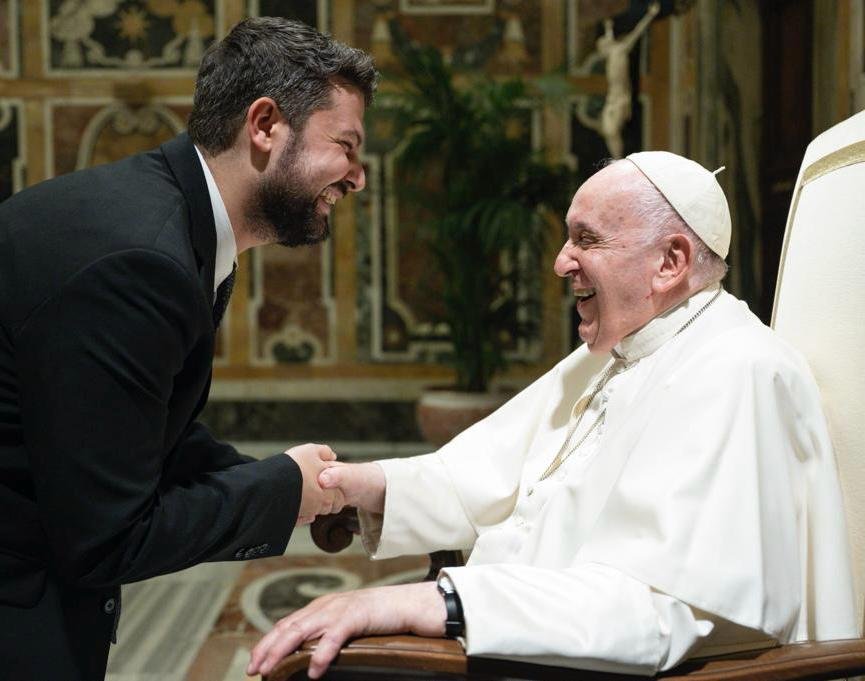
Whether it was a head of state or a group of nuns, Cernuzio said the pope always liked to break the ice with a joke.
In his book, the journalist recalled the pope telling him about a meeting with Italian Prime Minister Giorgia Meloni: “I saw her on stage dressed in white and I said to her: ‘Did you come to make your first Communion?'”
“He would joke about me, about Meloni, about others — it was just part of who he was,” Cernuzio told OSV News. “It was his way of being approachable, even likable. He always preached good humor. Of course, he could get heated or rigid — he had a very strong character — but he had this way of breaking the ice with a joke, welcoming people, putting them at ease.”
Cernuzio would often visit the pope at his residence in Domus Sanctae Marthae, often bringing the pontiff’s favorite treat: dulce de leche granizado, a caramelized milk ice cream with crunchy chocolate chips.
“There was a kind of trust,” he told OSV News. “He would say, ‘Take that from the drawer, put the ice cream in the fridge, wait — no, go into the bedroom.’ And I’d think, ‘My God, I’m in the pope’s house!'”
While Cernuzio said his meetings with the pope felt like “visiting a family friend who is a priest,” it did not diminish his leadership as pontiff nor the awareness of “his role and the important decisions he had to make.”
Nevertheless, Pope Francis “maintained this strong humanity, this priestly sense.”
“Something beautiful about him that I wrote — and others told me, too — is that he loved ordinary life. Listening to what happens in a family, to struggles, to arguments, to work issues. He was genuinely interested,” he said.
“I never felt like he was just going through the motions. Many people confirmed this: When you were with him, it was just you. Even if moments before he had called someone or had another meeting lined up, during that half-hour, you were the only one. And that made you feel valued.”
One of the interesting anecdotes Cernuzio recalled in his book is that he would sometimes talk about or even joke with the late pontiff about the future conclave.
While Cernuzio made clear that then-Cardinal Robert Prevost’s name was never discussed in conversations about possible successors, on one occasion did Pope Francis express admiration for the future pope.
“Him? He’s a saint,” the pope said of Cardinal Prevost. However, Cernuzio notes in his book that the term “saint” was often used by Pope Francis “to refer to people capable of calmly handling discussions, tensions and complex situations, and of managing to create unity.”
Pope Francis “used to categorize people in his own way: ‘He’s a saint,’ ‘he’s clever,’ ‘he’s a poet,'” Cernuzio told OSV News.
Cernuzio said that in hindsight, the late pope was not far off from his description of the man who would become his successor.
Pope Leo XIV is “facing perhaps the worst period humanity has seen in 80 years, with wars multiplying around the world,” the journalist said.
“In Pope Francis’ sense, I see him as someone calm, steady, able to handle difficult situations while remaining grounded and fostering unity. He is a ‘saint’ not in the sense of being sinless, but in the sense of someone guiding the Church through a very difficult time, also dealing with unresolved issues left behind.”
“Pope Francis used to say, ‘Initiate processes, don’t occupy spaces,'” Cernuzio added. “He opened paths, and now Pope Leo is walking them.”
It was known that the day before he died, Pope Francis thanked his nurse “for bringing me back” to St. Peter’s Square for what would be his last goodbye to the faithful.
However, Cernuzio revealed in his book that at around 5 a.m. on April 21, the pope rang a bell and asked his nurse for some water. After drinking, he said, “Thank you and sorry for the trouble.”
Those would be the pope’s final words before his death a few hours later.
Asked how those last few simple words reflected Pope Francis’ life and pontificate, Cernuzio told OSV News that it showed “exactly who he was: He valued everyone.”
“He cared deeply about small gestures of courtesy — not appearances or gifts, but whether you were respectful,” he recalled, adding that Pope Francis “noticed how you treated others.”
“For example, when I entered his apartment, he would slowly stand up, even with difficulty, to greet me properly. Or in the garage, he would wait until everyone exited and greet each person individually: the guards, the drivers, etc.”
For the late pope, he added, “those small gestures mattered.”
“So hearing those final words to a nurse shortly before his death — it perfectly reflects his character,” Cernuzio said. “From the beginning, he showed himself as close to all, and human — and that’s what people remember.”