
ABOARD THE PAPAL PLANE — Pope Leo XIV shared some of his favorite spiritual reading recommendations on the papal flight to Algeria, pointing to a particular letter by St. Augustine that he said provides wonderful tips for how to deepen prayer.
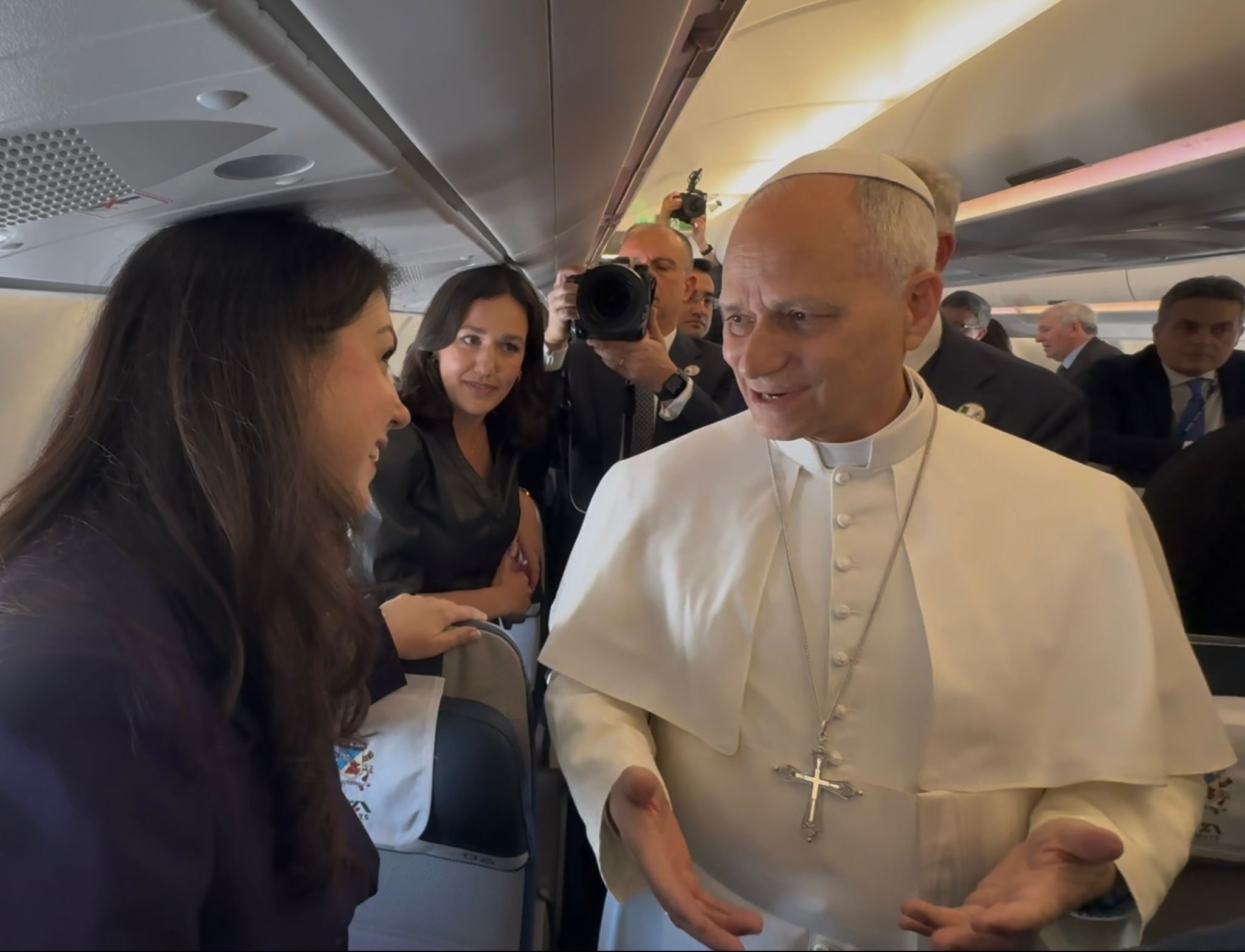
Speaking with OSV News aboard the papal plane April 13 on the first leg of his pilgrimage to Africa, the pope commended St. Augustine’s “Letter to Proba,” also known as Letter 130, written in A.D. 412.
“Augustine gives some wonderful guidelines and hints, if you will, about how our prayer can really be meaningful,” Pope Leo said.

The letter was written by St. Augustine in response to a wealthy Roman widow named Proba, who had written to her bishop, Augustine, expressing her confusion over a passage in Romans 8:26, in which St. Paul writes that “we do not know how to pray as we ought.”
In his response, St. Augustine reframes prayer not simply as speech directed toward God, but as desire. True prayer, he writes, consists less in words than in the persistent longing of the heart.
“To use much speaking in prayer is to employ a superfluity of words in asking a necessary thing,” St. Augustine writes, “but to prolong prayer is to have the heart throbbing with continued pious emotion towards Him to whom we pray. For in most cases prayer consists more in groaning than in speaking, in tears rather than in words.”
St. Augustine goes on to tell Proba that what every person ultimately seeks — a happy life — is nothing other than the possession of God himself, a reality people desire but cannot fully comprehend or articulate. It is precisely this, St. Augustine argues, that is at the heart of authentic Christian prayer. People pray, in a sense, for what they cannot yet see, increasing their desire for the One who exceeds all imagining.
“A happy life is to be sought after, and this is to be asked from the Lord God,” St. Augustine writes in the letter. “It has been briefly and truly stated in the divine Scriptures, ‘Blessed is the people whose God is the Lord.'”
Pope Leo’s recommendation came with a light-hearted acknowledgment that St. Augustine has become something of a recurring theme for him, a member of the Augustinian order who famously described himself as a “son of Augustine” right after his papal election in May 2025 and frequently quotes the influential Church father. The pope joked that on a previous occasion someone had told him, when asking a question, “Don’t talk about Augustine.” But he said he could hardly avoid it on this trip, traveling on pilgrimage through Northern Africa, the very land where St. Augustine served as bishop of Hippo.
“On this trip especially, I would say if anyone has not read ‘The Confessions of St. Augustine,’ it is a wonderful place to start,” the pope said of the saint’s autobiography, written about a dozen years before his response to Proba.
Pope Leo described the Letter to Proba as “relatively brief, but a beautiful letter” about prayer.
On April 14, Pope Leo will fly to Annaba, Algeria, where the pope will visit the Roman ruins of the ancient North African city of Hippo Regius and offer Mass at the Basilica of St. Augustine. The basilica was built near the ruins of the Basilica Pacis, where Augustine died in A.D. 430 as Vandals besieged the city. Inside the basilica today stands a statue of the saint containing a relic of one of his arm bones.
This was not the first time Pope Leo has recommended his favorite spiritual reading while flying at 30,000 feet. On the return flight from Pope Leo’s first international trip to Turkey and Lebanon in 2025, Pope Leo recommended “The Practice of the Presence of God,” a collection of spiritual reflections by the 17th-century Carmelite Brother Lawrence, and after the pope’s comments the book went flying off the shelves.