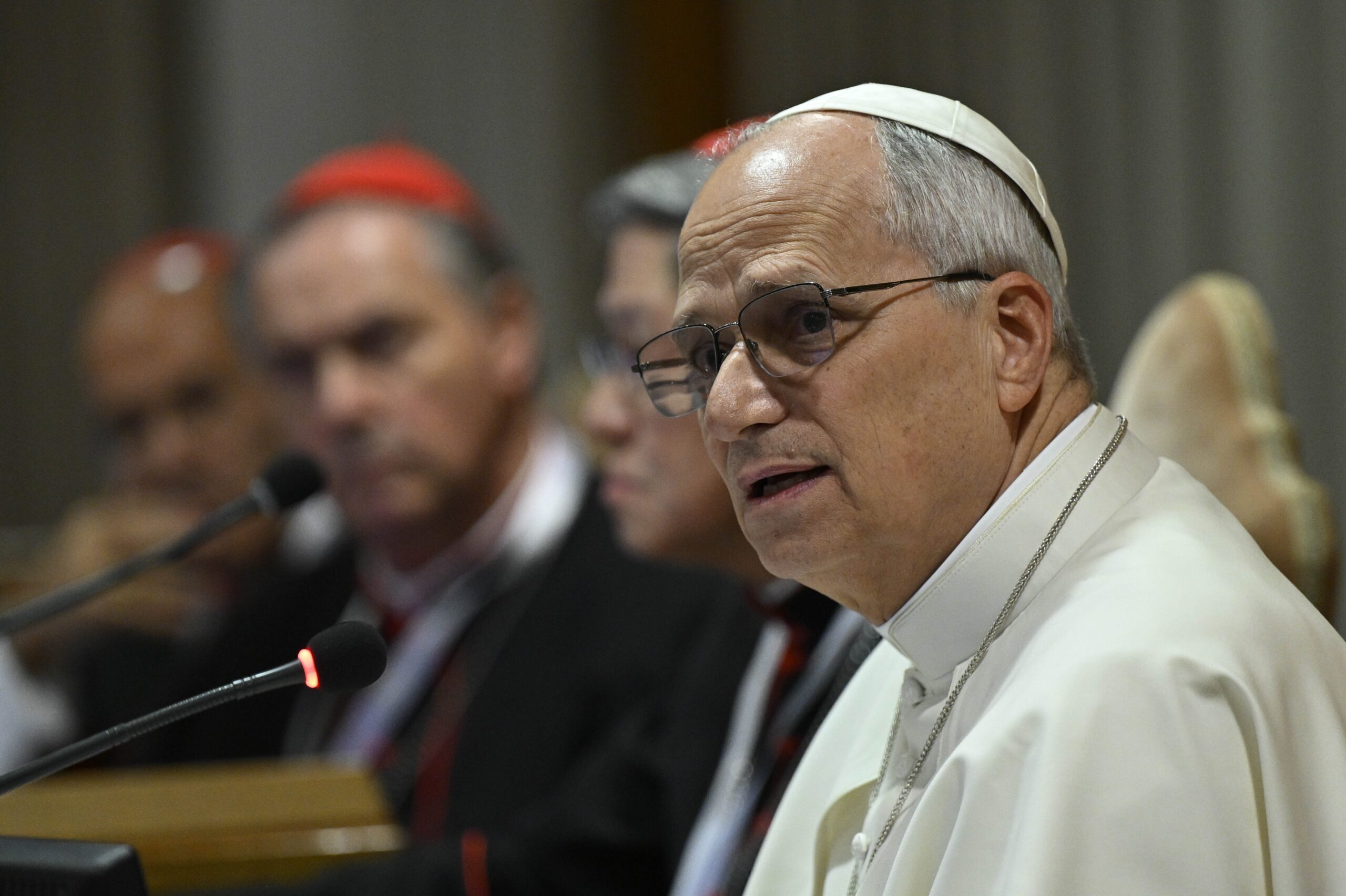

The Vatican released the official schedule of the second extraordinary consistory this year, giving a glimpse into some of the topics and major issues that will be discussed by Pope Leo XIV and the College of Cardinals.
The schedule of the June 26-27 consistory, which was published by the Vatican press office June 22, includes discussions centered on the pope’s recent encyclical, “Magnifica Humanitas,” on safeguarding the human person in the time of artificial intelligence.
As the second consistory of the year, the pope is making good on the cardinals’ requests for further collaboration, which the college expressed during the general congregations prior to his election last year.

According to the Code of Canon Law, the College of Cardinals assists the pope “through collegial action in consistories in which they are gathered by order of the Roman Pontiff who presides.”
The code also states that extraordinary consistories are convened “when particular needs of the church or the treatment of more grave affairs suggest it.”
Over the two days, the cardinals will take part in four sessions — two per day — with the first session in the morning June 26 centered on the theme “In what world are we called to proclaim the Gospel?” and featuring a biblical meditation delivered by Cardinal Grzegorz Rys of Krakow.
After a time of personal prayer and reflection, the cardinals, divided into several groups, will discuss their responses to two questions: “What sufferings, tensions, and questions currently affect most deeply the peoples and ecclesial communities entrusted to your care?” and “What signs of hope, of fidelity to the Gospel, and of possible reconciliation is it important to bring to our common listening?”
In the afternoon’s second session, Cardinal Victor Manuel Fernández, prefect of the Dicastery for the Doctrine of the Faith, will introduce the theme “The culture of power and the civilization of love.”
According to the schedule, the theme is based on the fifth chapter of “Magnifica Humanitas.” Among the issues addressed by Pope Leo in that chapter are the risks posed by technology when used irresponsibly, especially in warfare.
“Here the question is not merely the efficiency of new tools, but also the risk that technology, detached from ethics and responsibility, will render decisions about life and death more rapid and impersonal, and will present the use of force as an immediate and viable option,” the pope wrote.
Regarding the civilization of love, Pope Leo cited St. Paul VI, who “envisioned a social order in which justice and charity are intertwined and love becomes the guiding principle of economic, political and cultural life.”
“Today, we must resolutely recover this vision, for the civilization of love is no naïve utopia, but a demanding project, which consists in translating charity into structures of justice, giving institutional form to fraternity and regarding others — whether individuals or peoples — as allies necessary for building the common good,” he wrote.
Pope Leo also warned of a culture of power “in which the availability of resources and the ability to dominate tend to dictate the agenda and criteria for decision-making.” This culture relegates the common good to the background and the concrete tragedy of people at war is reduced to a secondary consideration in relation to strategic interests.”
After Cardinal Fernandez’s introduction, the cardinals will once again divide into groups and respond to two questions: “In what way do the tensions, divisions, and conflicts affecting the world touch the life of our Churches and our peoples today?” and “What languages, attitudes, and practices can help build reconciliation, coexistence, and peace?”
The groups’ responses will be presented in the Synod Hall, followed by open discussions on the theme, and the day will conclude with a closing prayer.
The consistory’s second and final day June 27 will begin with a morning Mass in St. Peter’s Basilica presided by Cardinal Giovanni Battista Re, dean of the College of Cardinals.
The third session, which reflects on the theme, “Building in the good: the worksites of our time,” includes an introduction by Cardinal Stephen Brislin of Johannesburg based on the introduction and conclusion of “Magnifica Humanitas.”
Among the notable issues the pope warns of in the encyclical’s introduction is the danger posed by the “Babel syndrome.”
Drawing from the biblical account of the construction of the Tower of Babel, Pope Leo said in the encyclical it was “a project conceived without reference to God, supported by a uniformity that eliminated diversity and that chose homogenization over communion.”
“We must, then, avoid the ‘Babel syndrome,’ namely the idolatry of profit that sacrifices the weak, a uniformity that neutralizes differences, and the pretense that a single language — even a digital one — can translate everything, including the mystery of the person, into data and performance,” he wrote.
The pope instead draws from the biblical narrative of the rebuilding of the walls of Jerusalem following the Babylonian exile, in which the people rediscover a common language that is “not one of uniformity, but one of communion.”
“The narrative shows how the city is reborn, not through the initiative of one man, but through the shared responsibility of all: men, women, priests, artisans, heads of households and young people all play a part. It is an undertaking with God at the center, which rebuilds relationships before rebuilding with stones.”
In the encyclical’s conclusion, Pope Leo rejects “the promises of transhumanism,” which often seeks “an enhanced and almost disembodied humanity,” and calls for human dignity to be placed at the forefront in the digital era.
“No computational system, however sophisticated, can create a heart that gives itself, or a conscience that discerns good from evil,” the pope wrote. “Even when machines excel in efficiency, a human face that asks to be gazed upon remains the center of our history.”
After the South African cardinal delivers his address, the groups of cardinals will hold discussions based on the questions that center on the aspects that “make it more difficult to build up the common good” and the expectations of the people “that the Church is called to listen to, and which perhaps we do not listen to enough.”
The consistory’s final session will focus on the three-year implementation process of Synod of Bishops on synodality, which was approved by Pope Francis March 11 2025, just 10 days before his death, and subsequently confirmed by Pope Leo.
The implementation process includes an assessment of progress at diocesan, national and continental levels beginning in 2027, culminating in an assembly set to take place at the Vatican in October 2028.
After a presentation by Cardinal Mario Grech, secretary general of the Synod of Bishops, and a time for cardinals to ask clarifying questions, those present will engage in a free discussion with Pope Leo on the session’s theme.
The session will conclude with an address by Pope Leo that will be broadcast, the Vatican said.
Junno Arocho Esteves is an international correspondent for OSV News. Follow him on X @jae_journalist.