
LOUISVILLE, Ky. — Louisville filmmaker Morgan Atkinson didn’t expect that his career would include producing two documentaries on a local religious congregation of women. But that’s “just the way it turned out,” he said.
Atkinson’s newest documentary — “In the Company of Change,” released in September — is his second film on the Ursuline Sisters of Louisville. His first, “A Change in Order,” released in 1987, reflected on how the Ursuline Sisters were affected by the cultural shifts of the 1980s.
While producing the first film, Atkinson said, he met the late Ursuline Sister Martha Buser, who became a friend.

“Going back to that first documentary, you know, I asked for someone from the Ursulines who could sort of guide me through what, to me, was a mystery. She was presented as that guide,” he said.
In the second documentary, Atkinson reflects on the changes in U.S. culture, especially within religious communities, through the lens of Sister Buser’s life. The Ursuline sisters plan to host a screening of “In the Company of Change” followed by a reception with Atkinson March 8 as part of Catholic Sisters Week, March 8-14, and International Women’s Day, March 8.
Atkinson didn’t have the second film in mind when he produced the first, he said. But it was his friendship with Sister Buser, which continued until her passing in 2023, that led to the second production, he said.
“When I finished the first one in the ’80s, I thought, well, that’s that,” he told The Record, the news outlet of the Archdiocese of Louisville, in August. “I wasn’t consciously thinking at the time, well, we’ll do a documentary in 30 or 40 years.”

In the decades that followed, Sister Buser became a spiritual mentor and a trusted friend, he said.
“We were friends, and she was also my spiritual director,” he said. “And so I would go to her and talk to her about anything that was on my mind.”
It uses some of his footage from the 1980s, including multiple interviews with Sister Buser. The early footage, in conjunction with his later interviews with Sister Buser, reveals an “evolution” in her spirituality, he said.
Sister Buser joined the Ursuline Sisters of Louisville in 1949, when the congregation had almost 600 members. When she died, there were fewer than 40 sisters, according to a description of the film.
“In the Company of Change” is, in part, a tribute to Sister Buser, he said. But it’s also a tribute to the congregation, as well as a reflection on his spiritual development, he noted.
He sees the Ursulines as “role models of people who have been there through the good and persevered through the bad, who have been true to the promises and vows that they made in their life,” he said.
“Seeing this congregation — the way they’ve been active and vital, despite the headwinds that they’ve had to deal with — it has been an inspiration,” he said.
The Ursuline Sisters are a worldwide congregation of religious women founded in 16th-century Italy by St. Angela Merici to live the Gospel among people as the Church’s first teaching order for women.
While the Ursulines sisters from France established the first Ursuline community in what would be the U.S. in 1727, the Louisville community traces its history to three Ursuline sisters from Germany who arrived in their city in 1858, laying the foundation for numerous schools that evolved along with their founding sisters.
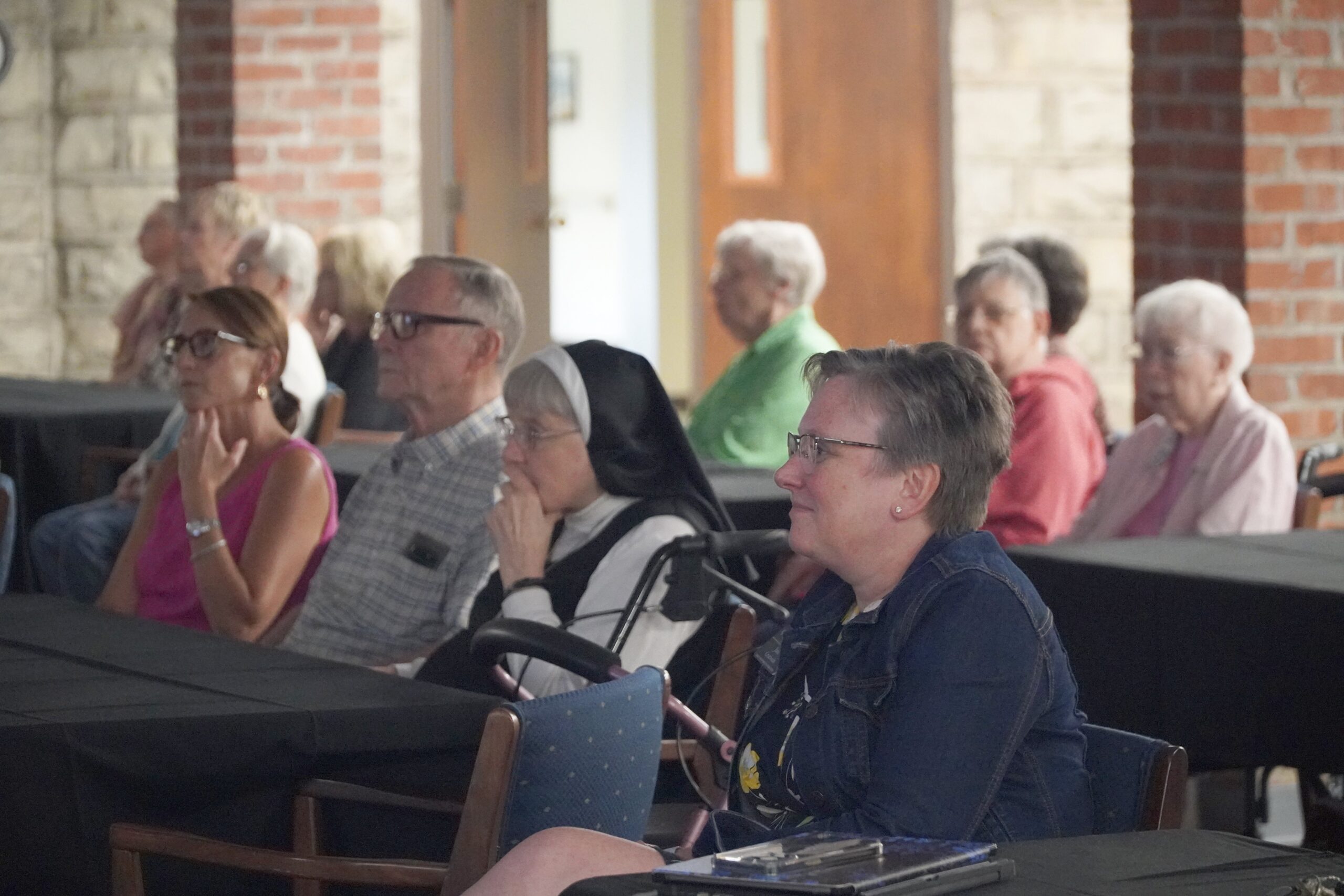
In August, a group of Ursuline sisters and friends gathered at the Ursuline Sisters’ original motherhouse for a pre-screening of the documentary. Among them were Ursuline Sister Jean Anne Zappa, president of the Ursuline Sisters of Louisville.
“I believe this documentary by Morgan Atkinson clearly reflects the wisdom of St. Angela in facing changes of our times and circumstances,” she said. “One can view the changes of religious life in our community through the firsthand experiences of Sister Martha Buser’s life.”
“In the Company of Change” is available at the PBS website through its Louisville affiliate Kentucky Educational Television (KET). It can also be viewed online at vimeo.com/1088506320.
Atkinson has also produced two documentaries on the late Trappist monk Thomas Merton.