


RIDGELY – While artificial intelligence can be a blessing with its problem-solving power, it can also pose challenges to Christians in their quest for virtue.
So warned Pasquale “Pat” Zingo, who earned his doctorate in artificial intelligence in 2024 from the University of Delaware.
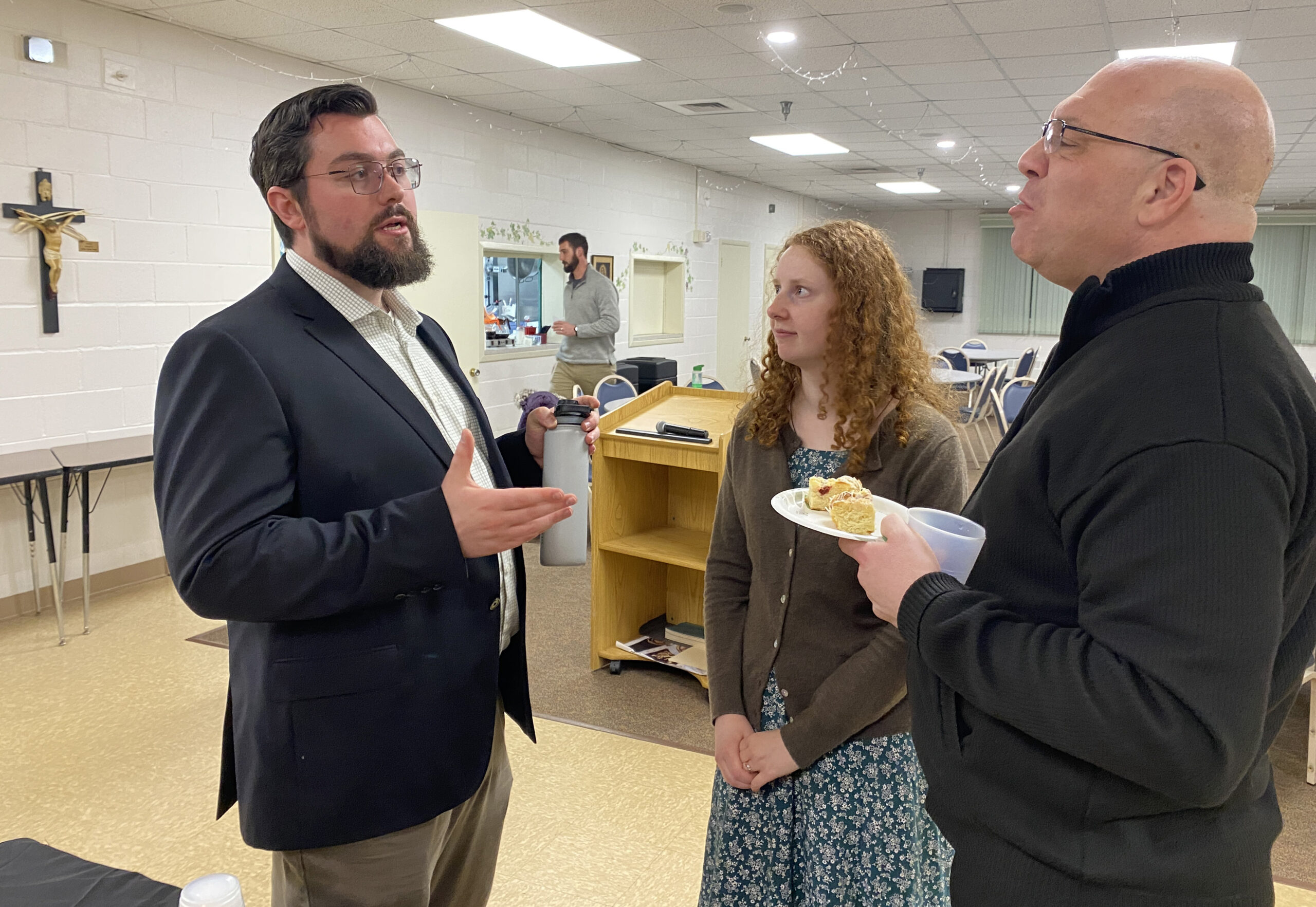
His Lenten reflection, “AI and Our Faith” followed Adoration and Mass last month at St. Benedict Catholic Church in Ridgely, Maryland.
“AI is being pushed everywhere, and even the technology that we might have mastered a few years ago is suddenly full of chatbots explaining things to us, and email assistants telling us what to say,” he said.
“Like most modern technologies (AI) seeks to win our attention, but in this season of Lent when we ought to give our thoughts and attention to our Lord, this pull must be resisted,” he said. “A tool is moral insofar as it brings us to God and to give him glory,” he said.
Rather than functioning as a “morally indifferent” tool, Zingo said AI is already being used to harvest information to market products and ideas — some antithetical to the faith. “When we use a tool we must discern, as with anything else, whether the tendency of the tool is towards the glory of God,” he said.
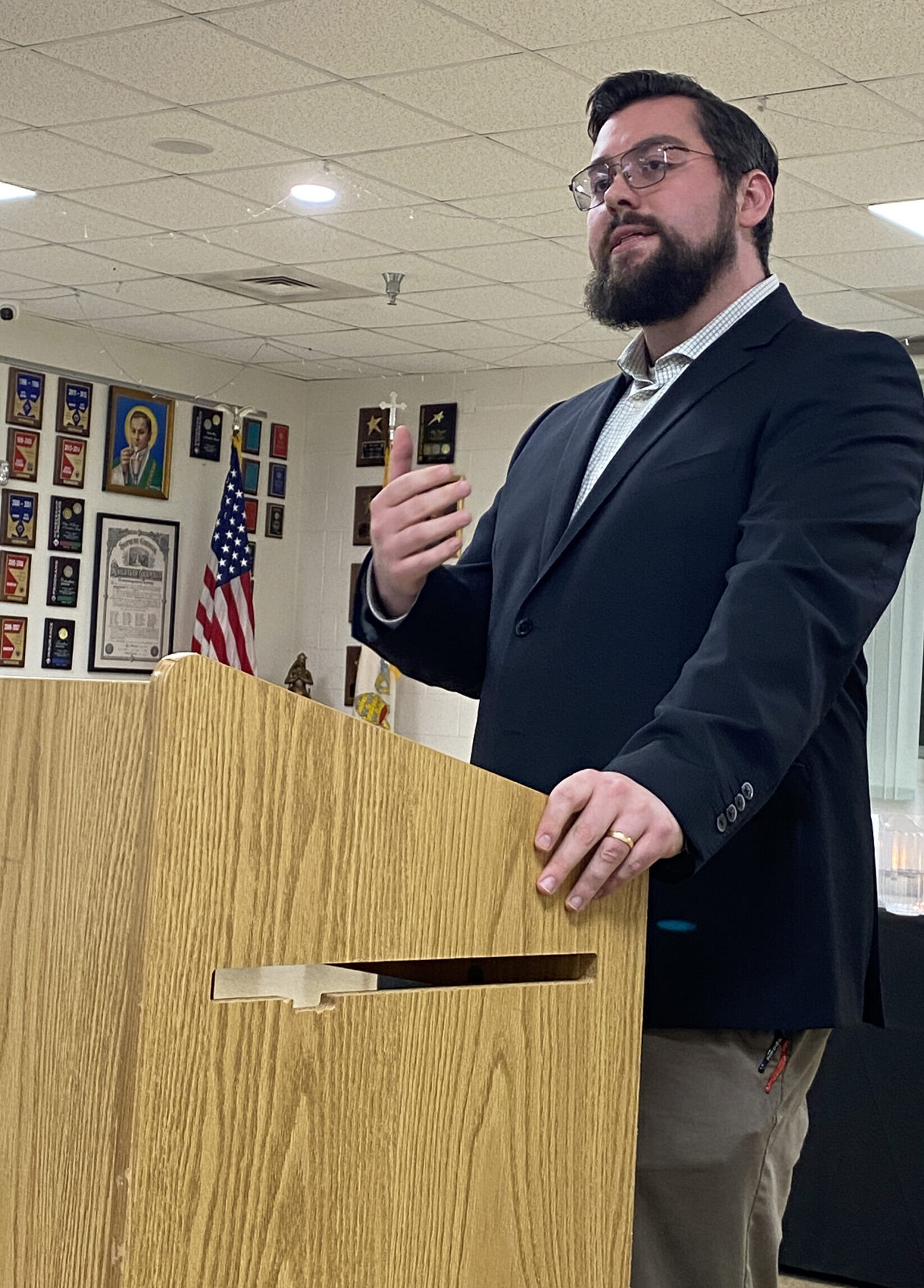
Zingo foresees the role “AI is most likely to play in our lives is just as another channel of distraction alongside the news, YouTube, social media, or whatever else we do on our phones when we know we should be doing something else.”
“What we’re called to do in the face of this new technology is to not be moved,” he said. “Every time you talk to your neighbor, call a friend, invite an acquaintance to a real flesh-and-blood group like this one, you resist the isolation that this technology pulls us to.”
Lingo, 30, earned his Ph.D. in Artificial Intelligence from UD in 2024. He is chief data scientist with FNDRSNG, a company he founded in 2021 while still a graduate research assistant at the University of Delaware.
During his doctoral studies, the self-described former atheist became convinced of God’s existence and the truth of Catholic teachings, and was confirmed in 2022. Father Christopher Markellos, parish administrator of St. Benedict-St. Elizabeth of Hungary Parish, became acquainted with Zingo during his tenure at St. Patrick’s, and he’s now Zingo’s spiritual director.
Zingo lives in Newark with his wife Kathleen, whose nickname is “Happy.”
Borrowing a working definition from Catholic Answers apologist Jimmy Akin, Zingo said, “Artificial intelligence (AI) is the ability of machines to mimic the performance of humans … in performing tasks that require the use of intelligence.”
“AI can be a more user-friendly search engine (than Google, for instance), but it’s also liable to make things up,” Zingo said. “We shouldn’t just trust anything we read on the internet, and that applies here, too.”
As an example, Zingo used an example he encountered. “Last week I saw that someone had posed a question to all the AI chatbots he could find: ‘I need to wash my car, and the car wash is 50 yards away. Should I walk or drive?’ Every single bot said that he should walk. The best way I can explain it is that when we think, we have a model of how things work. I know that no matter how short the walk is, I can’t get what I need from a car wash by walking there, but maybe that’s just because I can imagine doing it.”
“AI largely repeats what it’s been shown; it is not creative and it does not think,” Zingo said. But because it can scoop up and combine sources, it can “offend justice” by using but not compensating the “real artists and writers whose works they used.”
Even business correspondence using AI generated responses is “becoming more common, and it undermines our confidence that we are talking to actual people, even when we know them,” he said.
Having studied AI for years, Zingo said, “I’ve been into technology all my life.” However, “in the last six months, I have finally seen AI generated videos of real people which I cannot quickly detect as fake. Engaging information on the internet has always required prudence and discernment, and more than ever, we cannot take words, images or videos on the internet seriously if they do not come from trusted sources.”
“The Vatican released recommendations for how AI should be developed and used in a document last year called Antiqua et Nova, and among their recommendations were that ‘all AI-generated content must be clearly labeled, ensuring users can distinguish between human and machine contributions,’” Zingo said. “This is definitely not the case on the internet.”
The increasing prevalence of artificial intelligence and its intrusiveness prompted questions from about a dozen parishioners in the rural parish community. Grandmothers and parents, a farming and homeschooling family, a blue-collar worker, a nurse, and retired teachers were among those who attended the talk.
One attendee voiced a concern about AI developing the ability to reason, but Zingo said it wasn’t possible, given its built-in limitations.
Moving forward, Zingo said he has decided “to use almost no AI tools while programming.”
“I find that the tasks that it succeeds in automating are often those exact tasks that let me know that I’ve grown excellent in my craft,” he said. “On the other hand, I’ve caught myself in the past waiting for (AI) to spit out a solution that I know how to find on my own, and working in that way has weakened my quality and my enjoyment at work.”
He sees choosing to simply opt out as “the greatest evangelical opportunity.”
“To be a real human voice in a world drowning in cold, lifeless AI slop is to be the love of Christ to those who are spiritually dying,” Zingo said. “I remember how dark and empty the world looked before I came to faith, and it seems to me that the world outside grows darker yet.”
“Whenever you really put the time in to understand someone, or even really write them an email yourself, you stand out against a world that is too efficient to make time for them,” Zingo said. “As the world isolates around us, some will see our joy and wonder where it comes from, and God will use the opportunity created in our quiet resistance to win another soul.”