
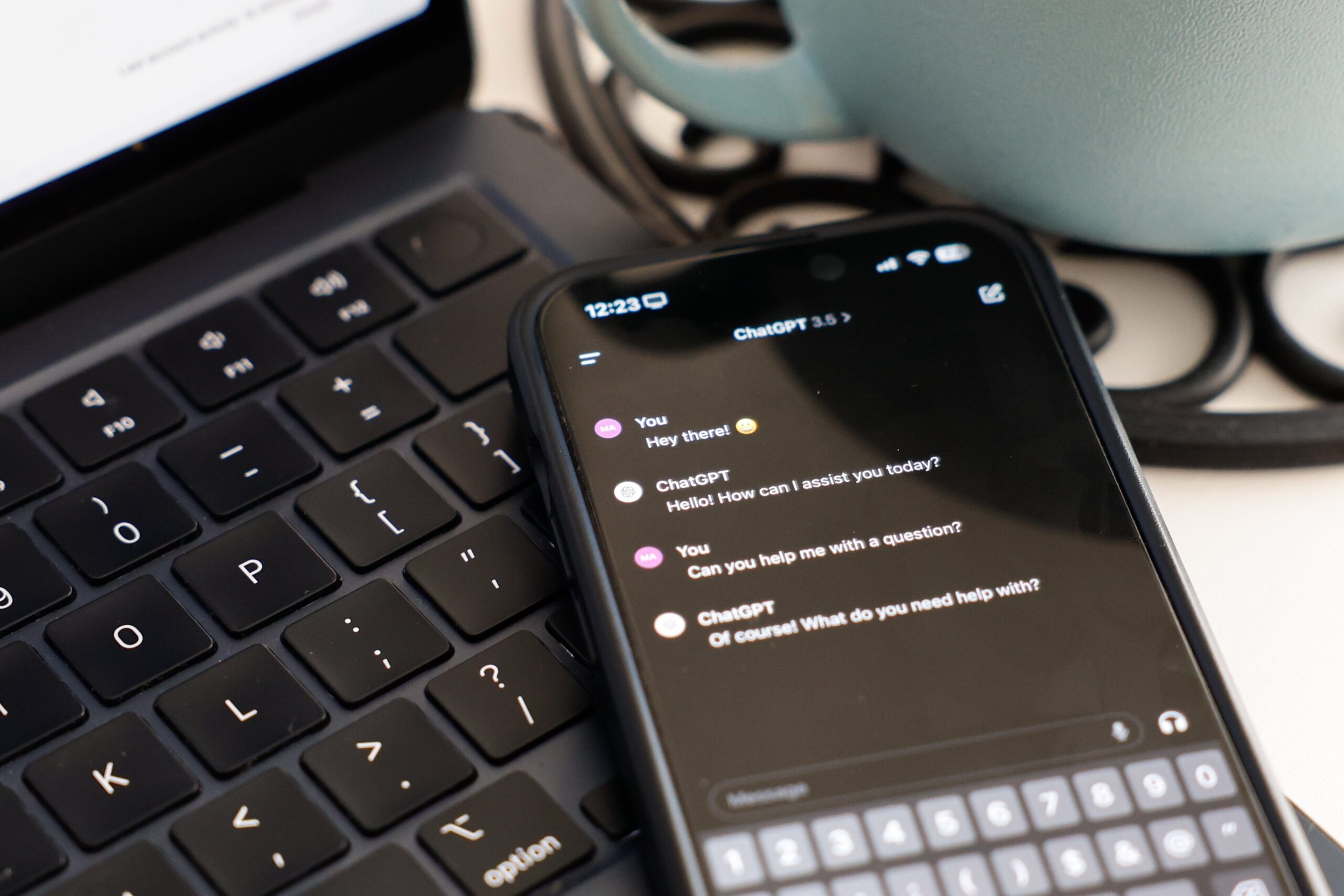



Artificial intelligence is everywhere. Suggestions for your text messages, recommended posts, your next video on YouTube – all rely on AI. It also is a tool that is becoming commonplace in education, and the Diocese of Wilmington is working on a policy that addresses its use in diocesan schools.
Tyler Kulp, who became an assistant superintendent of schools in the Diocese of Wilmington at the beginning of the 2025-26 academic year, is leading a committee that is developing a policy for diocesan schools. He said the group wants a policy ready to go by May.
“We see it’s definitely needed in the schools, where it’s becoming apparent that it’s being used a lot more than not,” Kulp said. “It’s another tool. It’s just like a computer, just like an iPad, just like a calculator, right? It’s a matter of educators learning what it is, how to use it, how to implement proper procedures all over it.”
The committee will implement a plan that takes into account the latest from the academic world, and it will reflect Catholic values and human dignity. The committee will take into account Bishop Koenig’s pastoral latter, “United in Christ,” issued in 2023, and the teachings of Pope Leo XIV.

The pope has said, “The ability to access vast amounts of data and information should not be confused with the ability to derive meaning and value from it.” He said this while addressing participants in a December 2025 conference called “Artificial Intelligence and Care for our Common Home.”
The Brookings Institution Center for Universal Education published the results of a study on Jan. 14 titled, “A new direction for students in an AI world: Prosper, prepare, protect.” The bottom line is that research suggests that the risks of artificial intelligence in schools outweigh the benefits.
AI does have some positive aspects, according to the study. It is good for language acquisition, can adjust the complexity of material depending on a learner’s aptitude, and it offers privacy in a large-group setting. Artificial intelligence can spark creativity to help overcome writer’s block.
AI can expand the reach of the classroom to students who might not be able to get to a school and to those with a wide range of learning disabilities, according to Brookings. Multiple studies show that teachers can save about six hours per week by using it to help with emails to parents, creating classroom materials and other tasks.
The cons, however, are significant, the study reports. Artificial intelligence poses “a grave threat” to students’ cognitive development — which includes how they learn new skills and perceive and solve problems, Brookings reports. The study talks of a “doom loop,” in which students increasingly offload their work to AI, thus further damaging their cognitive ability. This kind of offloading has always been around with various tools, but it is “supercharged” with AI.
Students don’t engage their material, Brookings reports, letting artificial intelligence do the creative work for them.
The wealth gap also may be affected by AI, according to the report. Many free AI tools are the least reliable, and wealthier communities can afford to use the best artificial intelligence.
Finally, AI can stunt social and emotional development, the report said. It can undermine students’ well-being, including the ability to form relationships. Many times, children are building social and emotional skills from interacting with chatbots that are designed to agree with them.
Kulp said the diocesan committee wants to outline a structure that reflects the various realities for different grade levels. There are high school teachers who are showing their students how to use AI responsibly. Schools and churches will have their own policy, he said, but the diocese will offer guidance.
The document will discuss confidentiality, when it is acceptable to use artificial intelligence and other topics.
Bill Sutherland, the director of instruction at Salesianum School in Wilmington, said artificial intelligence can be scary and intimidating, but there is a lot of upside.
“It can be intimidating, but it’s also an incredible opportunity for our students and teachers, like so many opportunities that have come before us,” he said.
AI can be a thought partner, Sutherland continued, and teachers can use it to form really powerful lessons. It still requires “kind of a human spark.”
“When you bring your own humanity to it, when you bring your creativity to it, that’s when you start to see the fireworks,” he said.
In December, Salesianum was accredited by the Middle States Association in Responsible AI in Learning. That will enable the school to tap into professional development and other resources related to artificial intelligence.
One of the steps in getting accredited was to look at Salesianum in an AI world, Sutherland said. It included doing hypothetical renovations to every aspect of the school.
“I think families can expect to see something like that become almost commonplace across institutions over the next 10 to 15 years,” Sutherland said.
Kulp came to Wilmington from the Diocese of Charlotte, N.C., and he has consulted with his former diocese and others to see what they have. Kulp also has been to a few conferences addressing the subject. The group also is monitoring research taking place at the University of Notre Dame on the use of artificial intelligence in education.
Sutherland said there is no way to avoid the integration of artificial intelligence in education.
“If an administration puts its head in the sand and pretends this doesn’t exist, they’re doing their students a disservice,” he said. “Our students are going to emerge into the workforce and into the world, and for better or worse, AI will be part of that world.
“We’d rather spend time focusing on the issue of digital citizenship.”
Salesianum’s AI policy reflects the school’s values and the virtues of St. Francis de Sales, Sutherland said. That isn’t to say that there isn’t misuse, but the school tries to turn those into a learning experience.
St. Elizabeth School in Wilmington takes the same approach, according to director of academics Diaonne Taylor. Teachers can run assignments through an AI detector, and if they suspect something is amiss, they treat it as a teaching opportunity.
“I try to tell them there are appropriate ways to utilize AI,” said Taylor, also the college and career counselor.
There are signs teachers look for that signal misuse of artificial intelligence, such as the use of certain punctuation, she said. The school starts with a conversation with the student; teachers and administrators don’t always know the student’s story.
Stacey Reyburn, St. Elizabeth’s assistant principal, said they try to impress upon their students the importance of academic integrity.
Whatever the policy looks like, there’s no going back, Kulp said.
“It’s the next step,” he said.